Get Full Government Meeting Transcripts, Videos, & Alerts Forever!
Get email alerts on the Information Technology topic
No spam. Unsubscribe anytime.
Hocking County IT director outlines AI policy, NextGen 911 timeline and Starlink tests for rural sewer sites
Summary
IT Director Mark Scott told commissioners the county is drafting an AI policy with a three‑tier risk framework, plans wall‑mounted emergency manuals, expects NextGen 911 to go live after state testing in early March, and is testing Starlink as a lower‑cost backup for remote sewer pump connectivity.
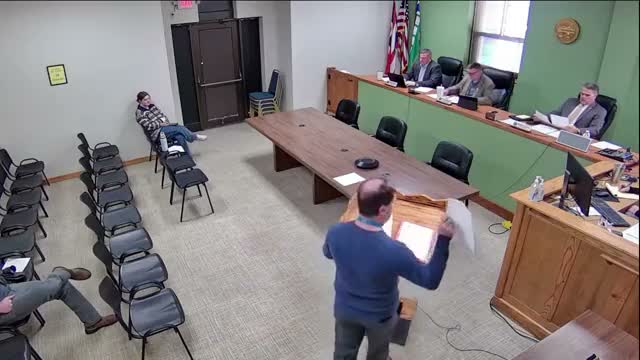
Mark Scott, Hocking County’s IT director, told the Board of Commissioners on Feb. 5 that the county is finalizing several technology initiatives aimed at improving public safety, emergency preparedness and cybersecurity.
“We're currently working on a policy for the whole entire county,” Scott said of a draft artificial intelligence policy now with the prosecutor’s office. He described an annual inventory of county AI systems and a three‑tier risk ranking; tier 3 systems that would manipulate data would trigger public notice explaining how resident data are being handled.
Scott also showed a template emergency plan manual intended to be mounted and available in every office. “It will include plans for disasters…active shooter information, cybersecurity threats,” he said, so staff unfamiliar with a department’s procedures can quickly find instructions.
On public‑safety communications, Scott said the county is aiming for a March rollout of NextGen 911. The system, he said, will let dispatchers receive text messages, pictures and video and will provide improved location tracking. “They’re going to, at the beginning of the week, have a full day testing where they go through scenarios,” Scott said; after state certification, officials plan to flip the system to live operation.
Scott reported connectivity problems at several remote sewer pump stations where cellular service was unreliable and AT&T phone lines cost about $750 per month at one location. The county has explored replacing those lines and is “now investigating Starlink as an alternative,” he said, citing a $65‑per‑month plan that includes 50 gigabytes of prioritized data as a lower‑cost option and noting theft‑mitigation steps and locked cabinets are being considered.
The county completed a migration of county email to Microsoft cloud services in November, Scott said, with EMS accounts in the process of being merged later in the year. He reported roughly 86% employee completion of a mandated cybersecurity training cycle and said the county processes about 46,000–50,000 emails per month with approximately 10% blocked as malicious by layered defenses including an AI model.
Scott also summarized IT operations metrics: a new ticketing system averaging about 500 tickets a month (including security alerts), and website traffic averaging roughly 43,000 unique visitors.
Scott provided an executive summary and an ROI calculator that, he said, shows roughly $96 returned for every dollar spent per user on cybersecurity subscriptions based on modeled threat probabilities and potential loss estimates.
Next steps: county staff will continue state testing for NextGen 911, pursue Starlink trials at remote pump stations while designing theft‑mitigation measures, and circulate the AI policy to elected officials and department heads once the prosecutor’s office completes its review.