
Mill Creek board approves design work for Gus Anderson Field and Chestnut Hill renovation amid fundraising and scope questions
Get AI-powered insights, summaries, and transcripts
Subscribe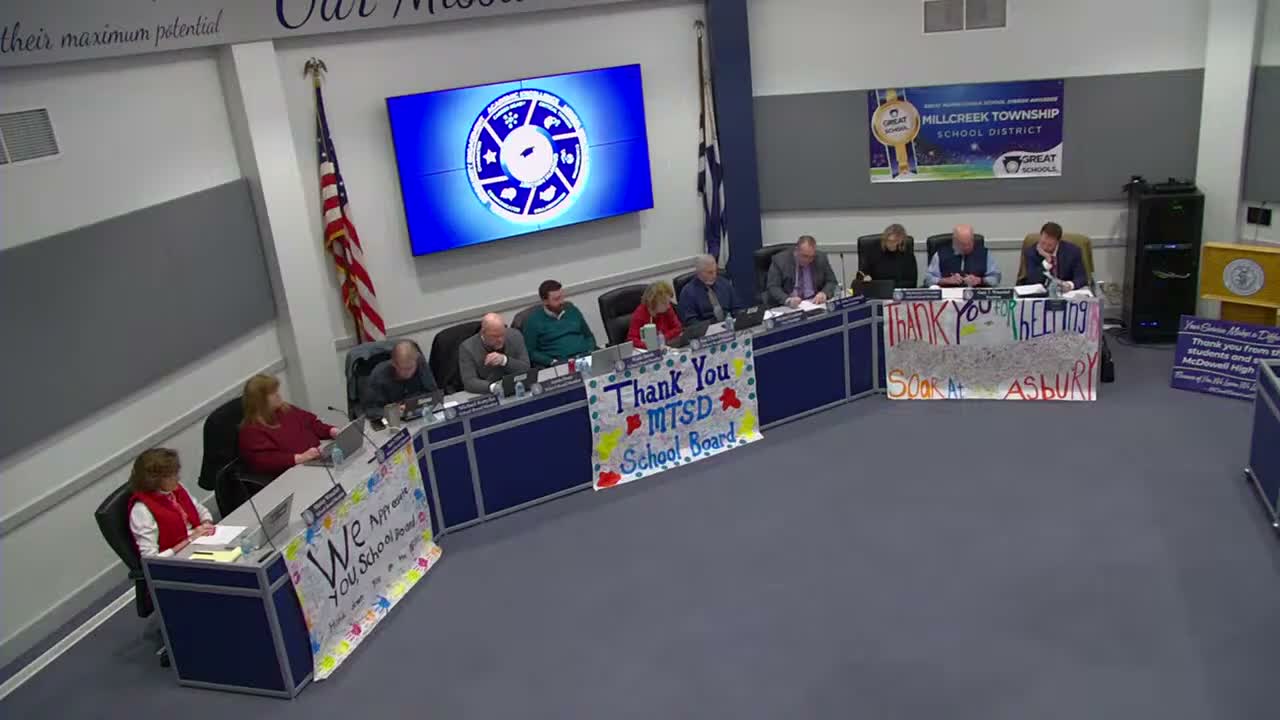
Summary
The Mill Creek Township School District approved two design contracts on Feb. 10: CHA was cleared for design of the Gus Anderson Field ($910,550) and HHSDR for Chestnut Hill Elementary additions/alterations (design fee recorded at $1,650,000), while board members pressed for clearer fundraising agreements and phased options if private fundraising falls short.
The Mill Creek Township School District board on Feb. 10 approved two separate design contracts for large capital projects, moving both efforts forward while stopping short of full construction commitments.
The board voted to accept a CHA proposal to perform design work for the Gus Anderson Field project in the amount of $910,550 and separately approved HHSDR’s proposal for design work tied to Chestnut Hill Elementary School additions and alterations (design fee recorded at $1,650,000 in the board motion). Both approvals were limited to design services; final construction contracts will require later board approval and depend on fundraising, bids and further review.
Why it matters: The projects address failing athletic infrastructure and elementary school space constraints. Administrators told the board the current bleachers and turf require attention and that Chestnut Hill’s classrooms and specialty spaces—music, in particular—are overcrowded. Approving design work lets the district develop detailed drawings, cost estimates and public renderings that officials say are required to raise funds and seek construction bids.
Fundraising, risk and MOU: Board members repeatedly asked who would bear financial risk if community fundraising for the athletic complex fell short. Administration said the Football Booster Program will partner as a 501(c)(3) and a fundraising committee—led publicly at the meeting by John Cushone—will pursue major gifts and naming-rights opportunities. Superintendent John Kavanaugh and the administration committed to providing a memorandum of understanding (MOU) for board review before large-scale fundraising or project procurement moves forward. "We will have the memorandum of understanding approved by you, and hold off any fundraising until everybody is comfortable," Kavanaugh said.
Booster-club liability concerns were a central theme in the discussion. One board member pressed for an MOU and clear funding vehicle before approving the design work; the committee-level attempt to require an approved MOU before advancing the CHA design failed, but the full board ultimately approved the CHA design. Coach and community fundraising veterans described prior campaigns that raised about $1 million for a turf field and said the current committee aims for larger gifts to meet a bigger project budget.
Scope and phased options: Design consultants told the board the projects can be phased and that add-alternate items (storage, band amphitheater, nonessential site elements) can be separated from code-driven work. "There are definitely parts of the project that we can look at and incorporate as an add alternate or potentially as a phase 2," said Chris Richardson of CHA, describing how the team would structure a base bid and alternates to match fundraising reality. Consultants also warned that certain code-triggered items—such as restroom upgrades tied to touching the bleachers—cannot be avoided if structural work proceeds.
Board votes: The CHA design motion passed on a roll call (one 'No' from a board member at the Committee of the Whole). The HHSDR Chestnut Hill design motion passed similarly with one dissenting vote. Both votes authorized design services only.
What comes next: District officials said they will return with the written MOU, fundraising plans and detailed design documents. Construction will only move forward after fundraising benchmarks are met and the board approves bids and contracts.