
HRSA details geriatrics workforce grants and dementia training requirements
Get AI-powered insights, summaries, and transcripts
Sign Up Free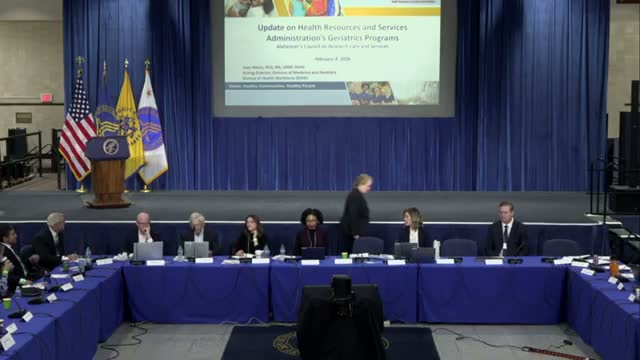
Summary
Dr. Joan Weiss (HRSA) described workforce programs including the Geriatrics Workforce Enhancement Program (GWEP), training metrics showing thousands of courses and hundreds of thousands of trainees reached, and grant requirements that obligate grantees to set aside $230,000 per $1 million award for dementia and related mental‑health training.
Dr. Joan Weiss, acting director in HRSA's Division of Medicine and Dentistry, briefed the council on the agency’s geriatrics and workforce programs designed to expand dementia‑capable primary care and interprofessional training.
Weiss outlined GWEP objectives: recruit and train health workers from underserved communities, transform clinical training environments to be age‑ and dementia‑friendly, and build reciprocal partnerships among academia, primary care and community organizations. She said the 2024 cohort awarded 42 GWEP grants for the 2024–2028 cycle, with each award up to $1,000,000 across five years.
Noting statutory requirements, Weiss said grantees must spend interprofessional training funds and establish programs in tribal, rural and underserved sites. She specified a required grant set‑aside: $230,000 of each $1,000,000 award must be used for Alzheimer’s disease and related dementia (ADRD) and broader mental‑health training, including delirium, depression and substance‑use disorders. Weiss added that grantees are expected to train primary‑care providers on early detection, referral and enrollment in clinical trials.
Weiss also summarized GWEP output metrics for academic year 2021–2024: development or enhancement of more than 2,000 clinical and didactic courses, hundreds of thousands of trainees reached (including healthcare professionals, patients, families and caregivers), and growth in faculty development programs. She noted HRSA’s Geriatrics Academic Career Awards program continued to support junior faculty, with 26 awards in 2025 and statutory cost‑of‑living increases planned for 2026.
Weiss emphasized workforce development as essential to translating research into clinical practice and urged integration of dementia training into primary care education.