Get Full Government Meeting Transcripts, Videos, & Alerts Forever!
Get email alerts on the Groundwater Study Control Areas topic
No spam. Unsubscribe anytime.
Committee advances bill to fund state-engineer groundwater study in control areas with SEO-suggested amendments
Summary
Senate File 50, authorizing a state-engineer groundwater study of control areas and assessing corrective controls, was advanced from committee after SEO-proposed amendments narrowed scope, added 'subject to available funding', and set a tentative two-year study timeline with a roughly $500,000 cost estimate.
Senate File 50, a bill directing the State Engineer to conduct groundwater/aquifer studies in areas subject to corrective controls, passed the Senate Agriculture Committee as amended and will go to the floor for further consideration.
Sponsor Senator Love told the committee the bill responds to long-standing requests to re-examine groundwater control areas and the corrective controls placed there. "We've now exceeded both of those recommendations," Love said, urging updated analysis to inform county planning and management.
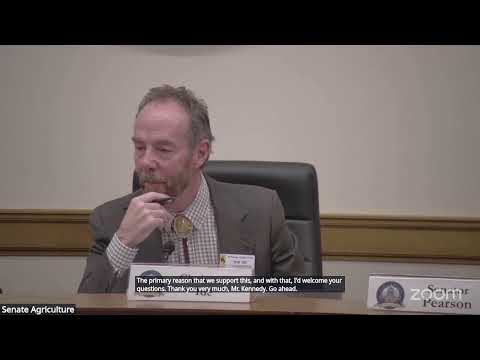
Brandon Gebhardt, the State Engineer, presented a set of SEO amendments that narrow the bill's scope to areas where the State Engineer has issued corrective-control orders (citing W.S. 41-3-915), clarify that the study should assess the effect of ordered corrective controls (rather than unilaterally determining future controls), add "subject to available funding" to the statutory duty, and replace some terminology (for example, preferring "aquifer" and "monitoring" over "test wells"). Gebhardt outlined a plausible schedule and budget: a two‑year study starting in winter with a projected cost around $500,000 and a suggested extra year for appropriation reversion and closeout.
Laramie County and other county commissioners testified in support. Troy Thompson, representing the Wyoming County Commissioners Association and Laramie County, said local governments need better data to guide decisions about minimum lot sizes and development in control areas. "We have been going with that [AMEC memo] since that time. The more data we can have, the more studies we can do," Thompson said, adding that local lot-size authority remains with counties and the SEO's role should be information provision rather than mandating lot sizes.
Committee members questioned whether proposed amendment language emphasized backward assessment at the expense of forward-looking planning; Gebhardt said the study is intended to do both: assess prior corrective controls' effects and produce modeling and information to support future decisions. Senators agreed to work with SEO and sponsors on precise floor language where needed.
The committee accepted most SEO amendments (with one provision to be refined later) and approved SF50 as amended on a roll call (4 ayes, 1 no). The SEO emphasized timing, procurement needs, and the likelihood that additional appropriations may be required for future statutorily required reanalysis periods.
Next steps: SF50 moves to the Senate floor. The SEO indicated an intent to return with scope details and a procurement plan and noted an estimate of roughly $500,000 for a two‑year study and a likely two‑year delivery timetable if funded.