Senate committee advances voluntary Colorado River conservation pilot with notice, Fontenelle storage and limits on participation
Loading...
Summary
The Senate Agriculture, State & Public Lands & Water Resources Committee advanced Senate File 84, a voluntary water conservation pilot aimed at giving Wyoming tools to avoid mandatory curtailment tied to Colorado River obligations. The bill adds notice requirements, limited Fontenelle storage, participation caps and an appeals path; it passed the committee after amendments and public testimony from industry, municipalities and agricultural interests.
Senate File 84, a bill to establish a voluntary water conservation program focused on Wyoming's portion of the Colorado River Basin, was advanced out of the Senate Agriculture, State & Public Lands & Water Resources Committee on a 5-0 voice/roll-call after amendments on Tuesday.
Brandon Gebhardt, the State Engineer, told the committee the bill was developed to give Wyoming flexible tools to reduce the risk of involuntary curtailment tied to Colorado River compact obligations. "One of the primary goals of us bringing this was, 1, it helps avoid mandatory and uncompensated water use reductions," Gebhardt said, framing the program as both a state-level mitigation tool and a possible component of a broader Upper Basin agreement.
The bill, as amended, sets out definitions and an application-review process tailored to the Colorado River Basin. It requires an applicant to demonstrate a recent history of consumptive use, allows non–water-right-owners to apply with written consent from owners, and permits multiple water rights to be part of a single project. Projects cannot injure other water rights; the draft clarifies that "injury to other water rights" is a legal standard distinct from other types of impacts (for example, impacts to return flows or shared ditches) that the State Engineer may mitigate through conditions on approvals.
Chris Brown of the Attorney General's Office stressed the legislation is the product of long-term stakeholder work: "We've actually been working on these issues for over a decade," he said, describing advisory-committee and select-water-committee meetings that informed the draft.
Key program features adopted in committee include:
- Notice and outreach: an amendment requires the State Engineer to publish program notice in Basin newspapers for three consecutive weeks, post notices in two Wyoming irrigation trade publications within 90 days, hold at least three public meetings in the Basin within 120 days, and provide a sign-up system for email or regular-mail notice organized by water districts. SEO officials said the expanded notice aims to ensure adjacent landowners who might be affected get timely information.
- Storage and release limits: the bill authorizes the State to store conserved water in Fontenelle Reservoir under contract with Reclamation and limits releases to three purposes: exchanges/direct delivery to downstream Wyoming users; mitigation of curtailment impacts (via the Upper Colorado River Commission or court order); and participation in an Upper Basin conservation program.
- Participation limits and protections: projects are generally temporary; the draft limits participation to five consecutive years for a given water right and requires a two‑year return to original use before eligibility again, and contains a provision protecting participating water rights from abandonment.
- Limited shepherding authority: the bill declines to grant general authority to shepherd conserved water, but contains a narrow exception allowing administrative measures when a stream is already under priority regulation; SEO and AG staff emphasized the provision is designed to avoid unintended impacts while permitting limited operations in already‑regulated reaches.
- Appeals and due process: decisions by the State Engineer may be appealed to the Board of Control and then to district court under Wyoming's Administrative Procedure Act; SEO officials said the administrative appeal path was intended to be more efficient than full judicial process.
The committee heard dozens of short testimonials. Industry witnesses from the trona and soda-ash sector said the program adds tools to sustain operations through drought: "If we don't have water, we don't have a soda ash industry," Jody Levin told lawmakers, warning of economic impacts in Sweetwater County without tools to conserve. Craig Rood of WeSoda said the industry has reduced water use historically and viewed the bill as another option.
Municipal and irrigation interests generally supported the bill as a flexible option. Kelly Carpenter of the Wyoming Farm Bureau Federation said the pilot program's voluntary nature is important and urged it remain non‑mandatory.
Not all testimony was supportive. Jack Berger and other irrigators warned the statutory standard of "no injury" can be ambiguous in practice and described prior disagreements and slow administrative responses when they reported alleged impacts; Berger recounted a situation where he said he had 150 acres dry after raising concerns, and he urged caution about potential local harms.
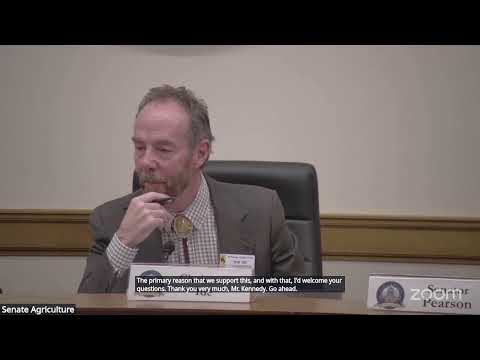
Senator Pearson led questioning focused on groundwater/aquifer impacts, downstream diversion effects, and the mechanics of notification and appeals. She asked whether an enrolled landowner would be required at all times to forgo water use; Chris Brown and Gebhardt answered that participation is not necessarily all‑or‑nothing and that projects can be partial, seasonal, or infrastructure improvements that reduce consumptive use while allowing continued limited use. Brown said the SEO prefers system‑improvement projects and that enrollment is designed to be flexible rather than an "on/off" switch.
On a procedural front, committee members adopted the SEO's notice and definition amendments, and Senator Pearson won a friendly amendment to require that the State Engineer file the annual program report to both the Select Water Committee and the Senate Agriculture Committee. The committee then voted to advance the bill.
Next steps: SF84 was reported out of committee as amended and will proceed to the full Senate for further floor consideration and any additional amendments.