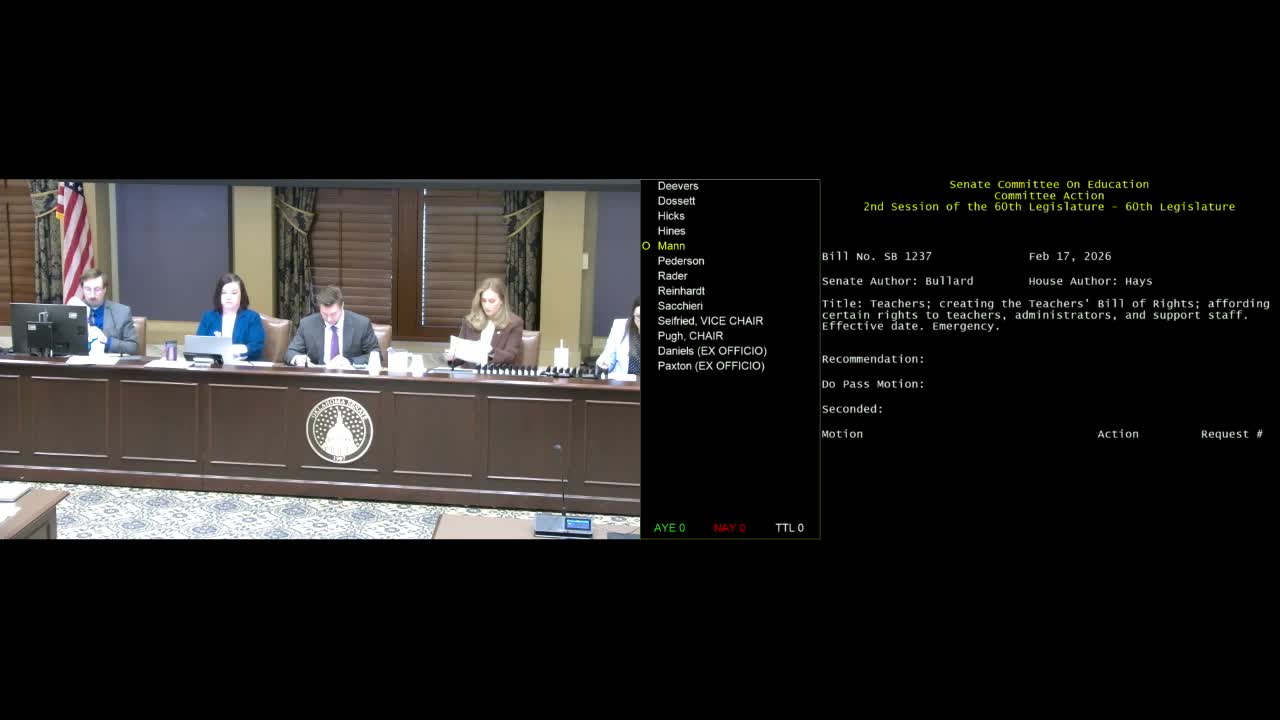
Senate Education Committee advances 'Teacher Bill of Rights' after extended debate; measure passes 7–4

Senate Education Committee · February 17, 2026

Get AI-powered insights, summaries, and transcripts

Subscribe
AI-Generated Content: All content on this page was generated by AI to highlight key points from the meeting. For complete details and context, we recommend watching the full video. so we can fix them.

Summary

The Senate Education Committee voted 7–4 to advance Senate Bill 12‑37, a proposed 'Teacher Bill of Rights' that enumerates teachers' rights to free expression, planning time and due process and addresses discipline, religious expression and workplace protections. Sponsors said the bill aims to improve teacher retention; critics warned some terms are subjective and could be misapplied.

Senate Education Committee members voted 7–4 to advance Senate Bill 12‑37, a package billed by the sponsor as a "Teacher Bill of Rights" that lists classroom protections for teachers, clarifies teachers' rights to religious expression and prayer subject to established case law, and directs local school boards to adopt due‑process plans.

The bill’s sponsor, Senator Bullard, said the statute is intended to stop the outflow of teachers by protecting instructors from what he described as mounting disciplinary and professional pressures. "If we don't start protecting teachers ... we're never gonna see teacher recruitment go up," Bullard said during closing remarks, arguing the measure consolidates protections he said are already present in case law and statute but are not consistently enforced.

Supporters stressed the procedural elements the bill would require: school boards would have to create due‑process plans for teachers and staff, districts would be encouraged to ensure a minimum of one hour of planning time per day, and administrators would be directed to use evidence‑based, peer‑reviewed materials when evaluating instruction. John Fisher, testifying on unrelated land‑office legislation earlier in the hearing, and committee members’ questioning on this bill underscored the committee's focus on implementation and oversight.

Opponents focused on uncertain or open‑ended language. Senator Rader questioned whether the bill’s use of the term "promote" could be read to bar traditional seasonal school activities, asking, "Would we not be able to have Christmas plays anymore?" Bullard replied the bill was not intended to ban such activities and suggested language could be clarified.

The bill also explicitly addresses religious expression in the classroom; Bullard and other senators discussed recent U.S. Supreme Court precedent. Bullard cited Kennedy v. Bremerton (2022) and Abington School District v. Schempp to argue that personal religious expression by public employees that is noncoercive is protected. "You don't lose your constitutional freedom because you walk into a schoolhouse," Bullard said.

On discipline, the sponsor said the statute would not create new civil remedies for teachers who are assaulted in the classroom but would require administrators and school boards to establish clear policies and enforcement mechanisms, and to ensure teachers have avenues to report assaults and receive administrative action. During Q&A, Bullard referenced educator surveys about classroom assault rates—saying one study showed 14 percent of teachers reported being physically assaulted—then acknowledged that the National Education Association conducted one of the surveys cited.

Committee debate repeatedly returned to definitional questions: what is meant by "faith‑based or religious symbols," how "prayer" is to be treated in public settings versus compelled situations, and whether terms such as "promote" or "demean" are suitably precise for statute. Sponsor Bullard said he was open to tightening language and to follow‑up meetings with colleagues.

The committee recorded a roll call: 7 ayes and 4 nays. Vote counts and the roll call advanced the bill to the next stage of consideration.

The committee hearing record shows members asked for clarification and for follow‑up conversations; the sponsor said his office was open to amendments and to refine the statutory language before floor debate.

What happens next: SB 12‑37 leaves the Education Committee with a committee recommendation to advance; sponsors and dissenting members signaled that definitions and implementation details will be subject to amendment before any floor vote.