
Volusia Council rejects measures to bar 'potable reuse' and deep‑well injection; debate exposes split over local control
Get AI-powered insights, summaries, and transcripts
Sign Up Free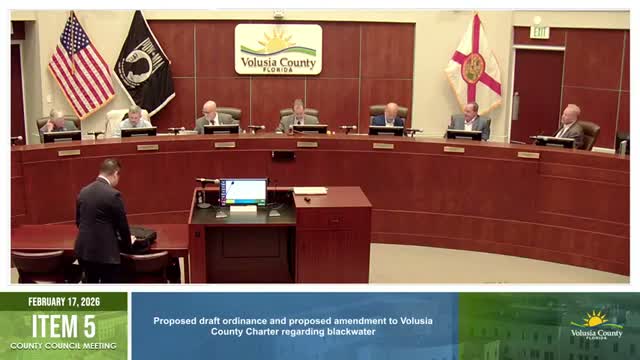
Summary
After several hours of public comment and technical briefings, the Volusia County Council voted down both an ordinance and a proposed charter amendment that would have restricted use of treated reclaimed ("black") water for injection into the aquifer or potable reuse in the county utility service area.
The Volusia County Council on Feb. 17 rejected two measures aimed at preventing treated reclaimed wastewater from being injected into the county’s aquifer or added to its potable water supply.
Council members Tuesday voted 3–4 against an ordinance that would have barred the county utility from approving deep injection or potable reuse projects and later failed to secure the five‑vote threshold needed to place a charter amendment on the ballot. The votes followed a lengthy staff briefing, hours of public testimony and in‑chamber debate about technical risks, local authority and the likelihood of state preemption.
Why it matters: The item drew a packed public turnout and divided the panel because it touched on public health, long‑term water planning and local government authority. Supporters of the proposals urged a preventive approach to protect drinking water and to give residents a direct vote; opponents — including some council members and utility staff — said the county has no immediate plans to pursue potable reuse for its utility, that the county’s authority is limited by state law, and that other alternatives (reclaimed water, infiltration basins, storage) remain the county’s focus.
Staff briefing and technical context Public Works and utilities staff described how potable reuse projects are regulated, and they said a neighboring utility (Deltona) has received permits to test an injection well configuration but has proceeded only with a non‑ASR test permit so far. Staff emphasized the difference between a short‑term testing phase (when only potable water may be injected under permit) and a broader operational scenario that could permit alternate source injections under separate approvals. The county attorney warned council members that state bills (discussed in testimony as SB 718) and statutory provisions limit the scope of local rules and that broad countywide language risks conflict with state law.
Public comments and competing frames Members of the public packed the chamber and gave contrasting perspectives. Opponents of injection and potable reuse framed the issue as a once‑in‑a‑generation public‑health decision. "I do not support toilet to tap," said Gary Singleton, a resident who urged council action. Environmental advocates and grassroots groups urged a precautionary stance and asked for a public vote, arguing the aquifer and springs are vulnerable to contamination.
Others urged context and restraint. Several speakers noted the county serves a portion of the population directly through Volusia County Utilities and that city utilities retain authority over their systems. "This is a county solution looking for a county problem," Councilman David Santiago said, arguing the county does not currently plan to implement injection wells for its system and cautioning against creating a false sense of county‑wide protection through a vote that only affects the county utility service area.
Council debate and votes The council debated two separate procedural paths: adopt an ordinance (four votes required for passage) that would be easier for a future council to undo, or place a charter amendment on the ballot (five votes needed to put it before voters) that would be harder to change. Supporters favored the charter route as the more durable check; opponents were concerned a county‑wide referendum would be misleading because Volusia County Utilities serves a smaller share of the county’s customers.
On the ordinance vote the roll call read: Johansson No, Kent Yes, Reinhart No, Robbins No, Santiago No, Dempsey Yes, Brower Yes — the ordinance failed 3–4. On the motion to place the proposed charter amendment on the ballot, the measure required five affirmative votes; it received only three and did not pass.
What the council can and cannot do County attorneys and staff repeatedly told the council that utilities regulation is circumscribed by state statute and administrative rules, and that local prohibitions can invite legal challenge or retroactive preemption. Staff also highlighted the county’s ongoing alternatives such as reclaimed water use, rapid infiltration basins and storage, and described ongoing FDEP‑backed plant upgrades in the region. The council heard that Deltona has permits related to testing, but that Deltona’s most advanced ASR permit is not funded or operational.
Next steps With both measures failing, the issue may re‑emerge in future agendas or via citizen initiatives in the cities and county service areas where water utilities are operated. Council members and speakers urged continued public engagement on water conservation, stormwater planning and protection of recharge areas as part of any long‑term strategy.
Votes and outcome - Ordinance to prohibit treated reclaimed/black water injection and potable reuse: failed, 3–4 (Johansson No; Kent Yes; Reinhart No; Robbins No; Santiago No; Dempsey Yes; Brower Yes). - Motion to place a charter amendment on the ballot (would have required five votes to proceed): failed (only three affirmative votes).