Senate Education Committee amends and advances K–12 recalibration bill after hours of testimony on class size, insurance and local control
Loading...
Summary
After extensive public testimony from superintendents, unions, insurers and local officials, the committee amended and advanced Senate File 81 to increase teacher pay targets, alter ADM calculations, accelerate counselor/nurse funding, and delay or modify a mandate for districts to join the state health plan; committee approved the revised package on a 5–0 vote.
The Wyoming Senate Education Committee on Feb. 16 advanced Senate File 81, a comprehensive recalibration of the state's K–12 school funding model, after nearly two hours of public testimony and multiple committee amendments.
Cochairs presented the bill as the product of the select committee on school finance recalibration, citing the statutory requirement under Wyoming statute 21-13-309 to recalibrate the education resource block grant. The cochair said the bill would increase estimated funding for districts across multiple years, adjust salary and staffing calculations, and adopt measures to protect instructional resources.
Public testimony spanned superintendents, teachers, school board members, benefit trusts and insurers. Speakers warned that proposed increases in class sizes would result in fewer funded teachers; Dr. Jeff Jones, superintendent of Sheridan School District No. 1, said the bill would "solve a math problem by creating a human one," and estimated about 20 funded positions could be lost in his district. Directors of benefit trusts and private carriers — including Patricia Bach of EGI and Dirk Dykstel of Blue Cross Blue Shield of Wyoming — cautioned that mandating district participation in the state insurance plan without actuarial study and adequate reserve funding could destabilize local trusts and raise premiums; Bach estimated the transition could require roughly $75,000,000 in reserves to cover initial claims and staffing.
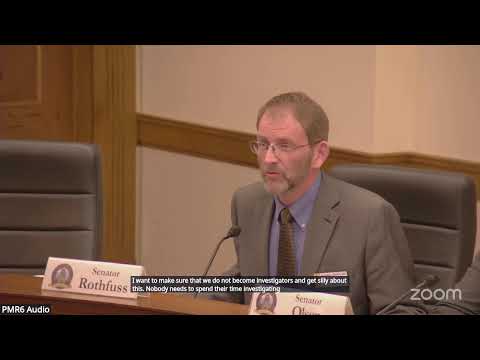
In response to testimony, Senator Rothfuss offered a broad amendment that the committee adopted. Key elements included raising the funded salary target toward 85% of the comparable wage (up from the bill's 79.1% recommendation), changing ADM to the higher of a two-year rolling average or prior year, reverting the ECA (experience/compensation adjustment) to annual calculation, creating a minimum-teacher floor for small districts, restoring middle-school elective/specialist staffing to roughly one-third, and moving funding for elementary counselors and nurses into the first year (rather than deferring), while eliminating a separate $5 million mental-health grant in favor of direct staffing funding.
On employee group insurance (EGI), the amendment kept current law for the 2026–27 school year, limited reimbursable counts to actual users to avoid paying for potential positions not filled, and proposed seeding transition costs from the school foundation program reserve account rather than a rainy-day loan. LSO staff estimated the amendment would add tens of millions of dollars to the bill's costs (estimates discussed ranged in the tens of millions per year, with multi-year totals discussed in committee). Senator Rothfuss and budget staff described the funding trade-offs as primarily shifting within the education funding silo.
Committee members also approved several additional amendments: a $10 million annual categorical grant to reimburse district dual-enrollment expenses and require unlimited student access statewide; and a noncodified three-year salary rollout with an instructional reserve account to smooth implementation and avoid artificial market inflation if districts cannot immediately hire the number of teachers the model would fund.
After debating and passing the amendment package, the committee took a roll-call vote on SF 81 as amended. The clerk recorded: Brennan—Aye; Olson—Aye; Rothfuss—Aye; Scott—Aye; Chairwoman Schueller—Aye. The committee advanced the measure 5–0.
Next steps: The bill will be reported out of committee to the Senate with the amendment package attached. Sponsors said staff and the select committee will continue interim monitoring of counselors, nurses and mental-health implementation and that an actuarial study of insurance impacts will be pursued during the delay period.