Proposed RPS overhaul would move ACPs into escrow to fund solar procurements, staff say
Loading...
Summary
At the Feb. 17 energy subcommittee briefing, staff described HB 345, which would redirect alternative compliance payments into an escrow outside the state budget to pay for existing solar commitments and to fund two new solar procurement streams (distributed <=5 MW and annual competitive utility‑scale procurements up to 2,000 MW); members pressed staff on ratepayer impacts and funding stability.
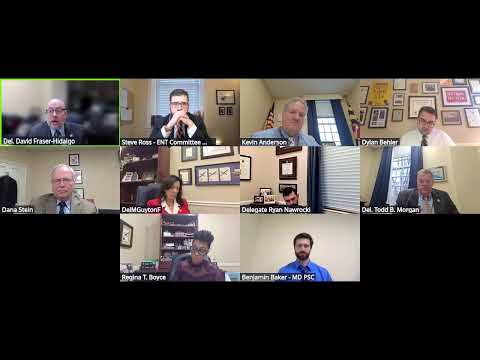
Legislative staff and PSC analysts briefed the Environment and Transportation Committee’s energy subcommittee on Feb. 17 about House Bill 345, a substantial proposal to change how Maryland funds and procures solar resources and how the Renewable Portfolio Standard (RPS) operates.
Steve, a committee staff presenter, said HB 345 would ‘‘package’’ alternative compliance payment (ACP) revenue, franchise tax revenue from large data centers and any additional required funds into an escrow account outside the state budget. That escrow, Steve said, would fund three ongoing streams: (1) payments to uphold existing solar program commitments, (2) a distributed‑system incentive program for smaller systems (defined in the bill as 5 megawatts or less, including rooftop and community solar), and (3) a utility‑scale procurement program administered through annual competitive solicitations that could procure up to 2,000 megawatts per tranche by 2035. ‘‘The escrow account then effectively funds three different procurements on an ongoing basis,’’ Steve said. ‘‘ACPs would no longer be in the state budget; they would go to the escrow.’’
Staff explained technical RPS background for the committee: the statutory RPS contains tiered obligations and carve‑outs (for example, a solar carve‑out inside tier 1). Currently utilities meet RPS requirements by buying renewable energy credits (RECs) or paying ACPs if RECs are unavailable; ACPs historically flowed into CIF (Clean Energy Infrastructure Fund) and the state budget for a variety of uses. Steve presented historical ACP receipts as context: ACP receipts were around $100,000 in 2020, about $77 million in 2021, and roughly $362 million in 2024. He said those ACP receipts have grown recently and that HB 345 would redirect those flows into the new escrow for solar purchases rather than routing ACPs through the budget process.
Program design described at the briefing: distributed incentives would be administratively set by PSC with sub‑tiers (residential, community solar, etc.) and a statutory guardrail limiting distributed incentives to a percentage of an average monthly bill (a 5% cap for distributed incentives was discussed); utility‑scale projects would be procured by RFP with PSC accepting bids to meet capacity needs. Staff said the PSC would establish proceedings to set the administratively determined incentive (ADI) methodology and run solicitations for utility‑scale projects.
Members raised several concerns. Delegate Boyce and others noted HB 345 appears to direct ACP funds collected from a range of Tier 1 sources toward solar only; staff acknowledged that is a policy choice and observed the historic statutory purpose of ACPs was to encourage new renewable generation. Members pressed on funding stability if ACP receipts decline (for example, because in‑region REC markets change): staff and Ben Baker said the bill contemplates additional revenue sources — franchise tax on large data centers and, if necessary, a non‑bypassable utility surcharge — and that the PSC must structure commitments to avoid unresolvable long‑term payment obligations if ACP revenues diminish. Ben said commitments would need to be limited to what is known in escrow or else be backed by a surcharge or other revenue. ‘‘If I make a commitment only with what is in escrow… the commitments we make or the incentives that we structure would have to be in a manner that would not require getting money from somewhere else,’’ he said.
Staff also explained geography and REC eligibility: most Tier 1 resources must be within PJM or delivered into PJM, and solar REC eligibility for the solar carve‑out typically requires in‑state interconnection or connection to the local distribution grid that serves Maryland customers. Members asked whether battery storage would be eligible under the RPS; staff and PSC analysts said storage is not currently an RPS‑eligible REC under existing law and was not included in HB 345 as presented, though storage has separate state targets and PSC incentive programs.
Staff walked through current ACP allocations in the FY2025 budget as examples of existing uses: Steve identified sample allocations that included about $198 million to MEA, $100 million for a ratepayer credit, $20 million to DGS, $10 million to MDOT and other studies and programs, and noted transfers to the general fund referenced in the budget discussion. Members requested a more detailed fiscal note and additional analysis to quantify potential ratepayer impacts and the effect of possible sponsor amendments.
The subcommittee did not vote on HB 345. Staff said sponsor amendments and a fiscal analysis would be circulated to the committee and that further briefings can be scheduled to examine remaining items (including a ‘‘balcony solar’’ provision and guardrails on rate impacts).