
Sentencing commission hears competing views on methamphetamine thresholds and purity testing
Get AI-powered insights, summaries, and transcripts
Subscribe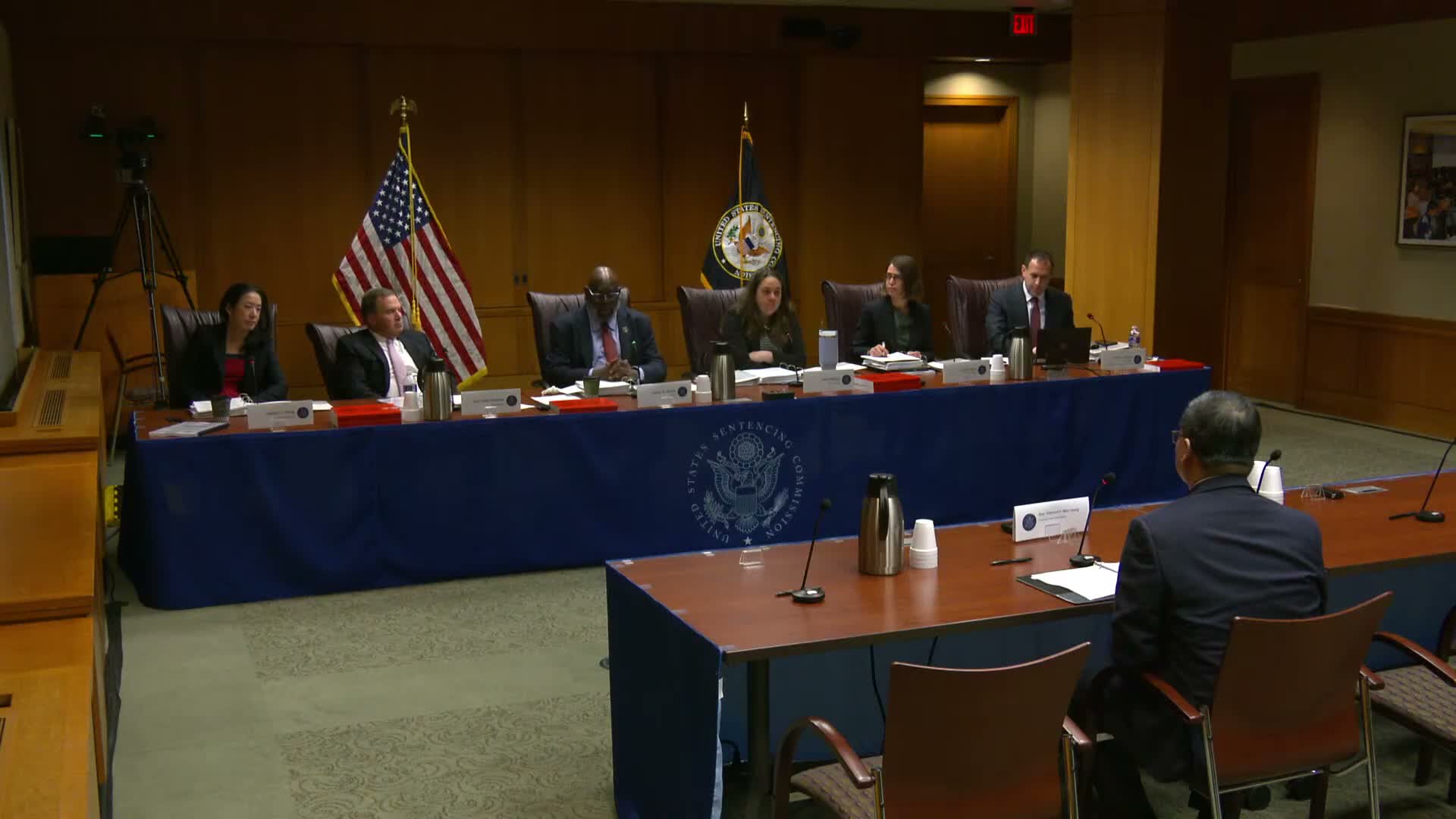
Summary
Witnesses at the U.S. Sentencing Commission hearing urged the commission either to eliminate purity‑based meth distinctions (defenders, practitioners) or to preserve levels that track mandatory minimums (Department of Justice). Debate focused on disparate lab testing, possible cost savings, and whether a study of relative harms is needed before changing quantity thresholds.
Chair Carlton W. Reeves opened the hearing and introduced the first panel seeking comment on proposed sentencing guideline amendments.
Judge Edwin Chang, chair of the Judicial Conference Criminal Law Committee, told commissioners the committee generally supports treating methamphetamine the same “across the board” but opposes the complex, factor‑by‑factor approach labeled Option 2. He urged a study comparing relative harms of methamphetamine, fentanyl and other drugs before picking new quantity thresholds and said purity testing no longer maps reliably to culpability because most meth now tests very pure.
Department of Justice prosecutor Vincent Lombardi argued against changes that would “divorce the guidelines from those mandatory minimums,” saying Congress has repeatedly increased statutory penalties for meth trafficking and that equalizing at lower base levels could produce cliffs and unwarranted disparities. Lombardi said courts and prosecutors still often seek purity testing to determine whether mandatory minimums apply and that any cost savings from eliminating purity testing may be limited.
Federal defenders and several advisory groups urged the commission to adopt Option 1 — a single set of meth thresholds that eliminate the 10:1 purity distinction — and to set those thresholds at the current mixture or powder‑cocaine levels. Natasha Perdue Silas, executive director of the Federal Defender Program for the Northern District of Georgia, described a client, “Carlos,” whose guideline range rose because his district sent evidence to the DEA lab and a high purity result produced a much higher offense level; she and other defenders called that a non‑principled, arbitrary result.
Commissioners pressed witnesses on operational details: where purity testing is still used, whether field tests could substitute for lab work (witnesses said lab testing is still required to confirm identity and purity), and how changes would interact with mandatory minimums and recent role‑adjustment reforms. Multiple witnesses said geographic differences in lab capacity and testing protocols have produced unwarranted sentence variance.
The hearing did not resolve policy choices but produced a clear map of the points the commission will weigh: data on relative harms, the operational costs and availability of purity testing, the statutory mandate of mandatory minimums, and whether a simpler, uniform threshold would reduce disparities without undercutting congressional directives. The commission will accept additional written comments and data before rulemaking decisions.
The commission adjourned after panels on related drug and guideline subjects.