Get Full Government Meeting Transcripts, Videos, & Alerts Forever!
Get email alerts on the Transportation Infrastructure topic
No spam. Unsubscribe anytime.
California’s transportation chief urges ITS-led push on safety, ZEVs and port modernization
Summary
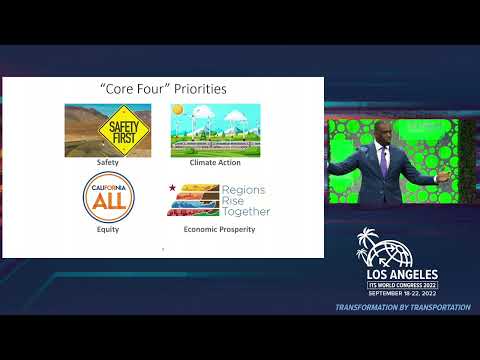
California Transportation Secretary Toks Omishakin told the ITS World Congress that the state’s 'core 4' priorities — safety, climate action, equity and economic prosperity — will guide intelligent-transportation deployments, with targets for ZEVs, a nearly $2 billion Otay Mesa East port investment and expanded testing of connected and automated vehicles.
Toks Omishakin, secretary of the California State Transportation Agency, used a keynote address at the ITS World Congress in Los Angeles to lay out how California plans to use intelligent transportation systems to pursue four priorities: safety, climate action, equity and economic prosperity.
Omishakin said California accounts for about 10% of U.S. roadway fatalities and cited roughly 4,258 deaths last year on the state’s transportation system, calling for a safe-system approach and more deployment of proven countermeasures. "If you don't believe the science, believe your eyes," he told the audience when describing rising climate impacts such as floods and extreme heat.
The secretary outlined aggressive zero-emission vehicle (ZEV) goals and infrastructure targets, saying California aims for 1.5 million ZEVs sold by 2025 and 100% electric passenger and heavy-duty vehicles by 2045. He noted the state is already a market leader — "today, we’re 40% of the entire ZEV market for America" — and warned that charging and other infrastructure will be a major challenge.
On freight and ports, Omishakin described efforts to reimagine heavily used corridors such as the 710 Corridor rather than simply adding lanes. He previewed Otay Mesa East, a San Diego border facility he said represents "nearly a $2,000,000,000 investment," and said the project aims to shorten truck wait times at the border from hours to, in some cases, about 20 minutes while deploying extensive ITS technology.
Omishakin also highlighted California’s role in testing connected and automated vehicles: he said about 60 companies are testing on California roads (an estimated 4,000,000 miles of testing in 2021) and that several firms are testing fully driverless vehicles interstate.
On equity and transit integration, Omishakin described a statewide account-based fare effort (Cal ITP) using a vendor called Rebbo and said the system is being piloted by multiple agencies to make transit payments more seamless across the state's more than 400 transit providers.
Asked during a short Q&A about homelessness and equity, Omishakin attributed high homelessness rates to housing shortages — "we're roughly 3,000,000 units behind" — and cited a state investment of about $22,000,000,000 to address homelessness while calling for local partnerships to implement solutions.
Omishakin closed by offering a short question period and turned the stage over to a global panel that would further explore how ITS can advance climate and equity goals.
The address framed California as both a testing ground for advanced mobility technologies and a policymaker pushing to align deployments with climate and safety goals. The announcements illustrated both ambition (broad electrification, major port investment) and practical constraints (charging infrastructure, freight modal challenges) that will shape implementation in coming years.