Get Full Government Meeting Transcripts, Videos, & Alerts Forever!
Get email alerts on the Public Safety topic
No spam. Unsubscribe anytime.
Greene County sergeant details patrol duties, training and officer supports
Summary
Sergeant Dilday of the Greene County Sheriff’s Office described patrol staffing, training standards, campus security and mental‑health supports, saying deputies respond to roughly 46,000 calls a year across 678 square miles and the office is hiring.
Sergeant Dilday of the Greene County Sheriff’s Office gave a public briefing on patrol operations on Feb. 19, outlining division size, training requirements, day‑to‑day duties and the supports available to deputies.
Dilday said the patrol division includes about 76 deputies organized into traditional patrol, campus patrol and a K‑9 unit. "There are no two days the same," he said, and added the division fields seven patrol squads and six multipurpose canines that perform tracking, drug detection and apprehension duties.
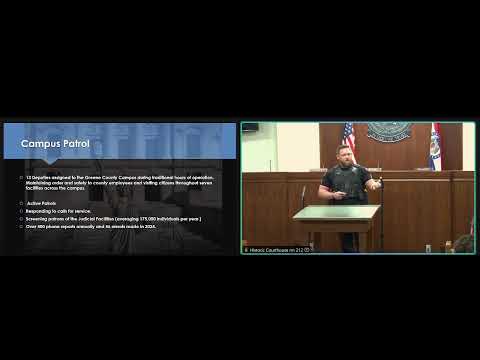
The sergeant said deputies work 10‑hour shifts and provide continuous coverage, responding to about 46,000 calls for service annually across 678 square miles serving nearly 308,000 residents. He described campus patrol duties at Greene County‑owned buildings downtown, noting 13 deputies are routinely assigned during business hours to staff security screening points and assist visitors.
On training, Dilday said Missouri requires a minimum police academy of 600 hours for certification but that the county sheriff’s academy runs "up to 1,000 hours" and involves months of classroom and practical work. "You go through a police academy. It's a minimum of 600 hours for certification. The Greene County Sheriff's Office, we have our own academy. It's actually up to 1000 hours rather than the minimum of 600," he said. After the academy, officers complete roughly four months of field training under a Field Training Officer before solo patrol.
Dilday reviewed core training topics — emergency‑vehicle operations, traffic enforcement, domestic‑violence response, drug‑impairment recognition and weapons qualification — and said some subjects, especially mental‑health response, require more experience than classroom training can provide. "We encounter a lot of that…it's going to come down to who people call — they call 911," he said, adding that deputies frequently arrive first and coordinate with fire and EMS.
On officer wellness, Dilday described a peer‑support network and access to licensed therapists. In response to a question about trauma resources, he said the agency has on‑call peer supporters and 24‑hour professional counseling, and that squad‑level debriefs with counselors occur after particularly traumatic events.
Dilday gave operational details and clarifications: facility screening handles about 175,000 people per year (roughly 15–16,000 per month); deputies take more than 500 phone reports annually for lower‑priority matters; and the campus recorded 56 arrests in 2025, a rise he attributed partly to increased active patrols after organizational changes.
He also covered practical matters such as equipment load — saying typical carried gear weighs about 30–35 pounds though his personal kit weighed 42 pounds — and scheduling, explaining Greene County uses an annual bid by seniority to assign squads and days off, which he said helps stabilize sleep cycles.
Dilday closed by noting community outreach remains important and that the sheriff’s office is hiring. He answered audience questions about the academy, retention of trainees, equipment and shift bidding before thanking attendees and ending the session.