Ashland County panel presses Xcel on solar siting, transmission upgrades and local opportunities
Loading...
Summary
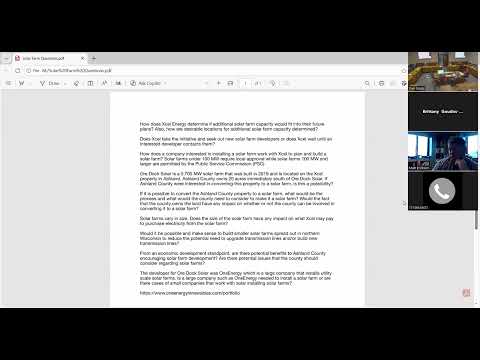
At a Feb. 17 meeting the Ashland County Zoning and Land Committee questioned Xcel Energy about how it selects solar sites, interconnection limits and whether battery storage or county land could be used so more economic benefit stays local. Xcel offered follow-up materials and a December 2025 RFP link.
Ashland County’s Zoning and Land Committee questioned Xcel Energy representatives on Feb. 17 about how utility-scale and community solar projects are sited, how transmission upgrades affect local opportunities and what the county could do to retain economic benefits.
"I am the community relations manager for this area," Lynn Hall told the committee, identifying herself as Xcel Energy’s local liaison. Hall said she would relay detailed, technical questions to the company’s project teams and provide written answers to committee member Pat Kenny.
Phil Baltazar, Xcel’s project manager for Solar Gardens, described how Xcel plans generation: the company’s resource adequacy and RFP process looks roughly 10 years ahead and issues solicitations to developers, who then propose locations and handle much of the siting. "Our RFPs… look 10 years down the line," Baltazar said, explaining that developers must consider available land, interconnection points and whether transmission lines and substations can accept new generation.
Baltazar told the committee that storage batteries are a common way to extend output hours without increasing an interconnection’s AC rating. "Batteries… extend the production hours," he said, adding that recent cost declines in battery technology make storage an attractive option to increase usable generation hours while staying within interconnection limits.
Committee members pressed several local points: Pat Kenny asked whether planned transmission reroutes or upgrades around Ashland are being designed with future solar capacity in mind; the panel also noted the county owns about 20 acres just south of an existing solar garden and asked whether that land could be used. Baltazar said interconnection thresholds vary — small gardens (under about 1 megawatt) typically do not trigger transmission studies, while projects up from roughly 1–5 megawatts often do — and that studies are done on a case-by-case basis.
Lynn Hall said Xcel issued a request for proposals in December 2025 seeking generation (wind, solar and hydro) "with or without batteries" and offered to provide the RFP link and written responses to the committee. Hall also provided contact details and said she would relay follow-up questions to the appropriate technical teams.
The committee did not take formal action on solar but requested written answers and follow-up conversations between county staff (Pat Kenny and others) and Xcel to explore whether county land or local developers could participate in future projects.
Next steps: Xcel will provide written answers to the committee’s questions and the company’s December 2025 RFP link; county staff said they will follow up with Xcel to explore potential consultants, developers and options for the county’s 20 acres adjacent to the current solar garden.