
Tracy council directs staff to develop water‑rate plan under Scenario 1 after study shows fund shortfall
Get AI-powered insights, summaries, and transcripts
Subscribe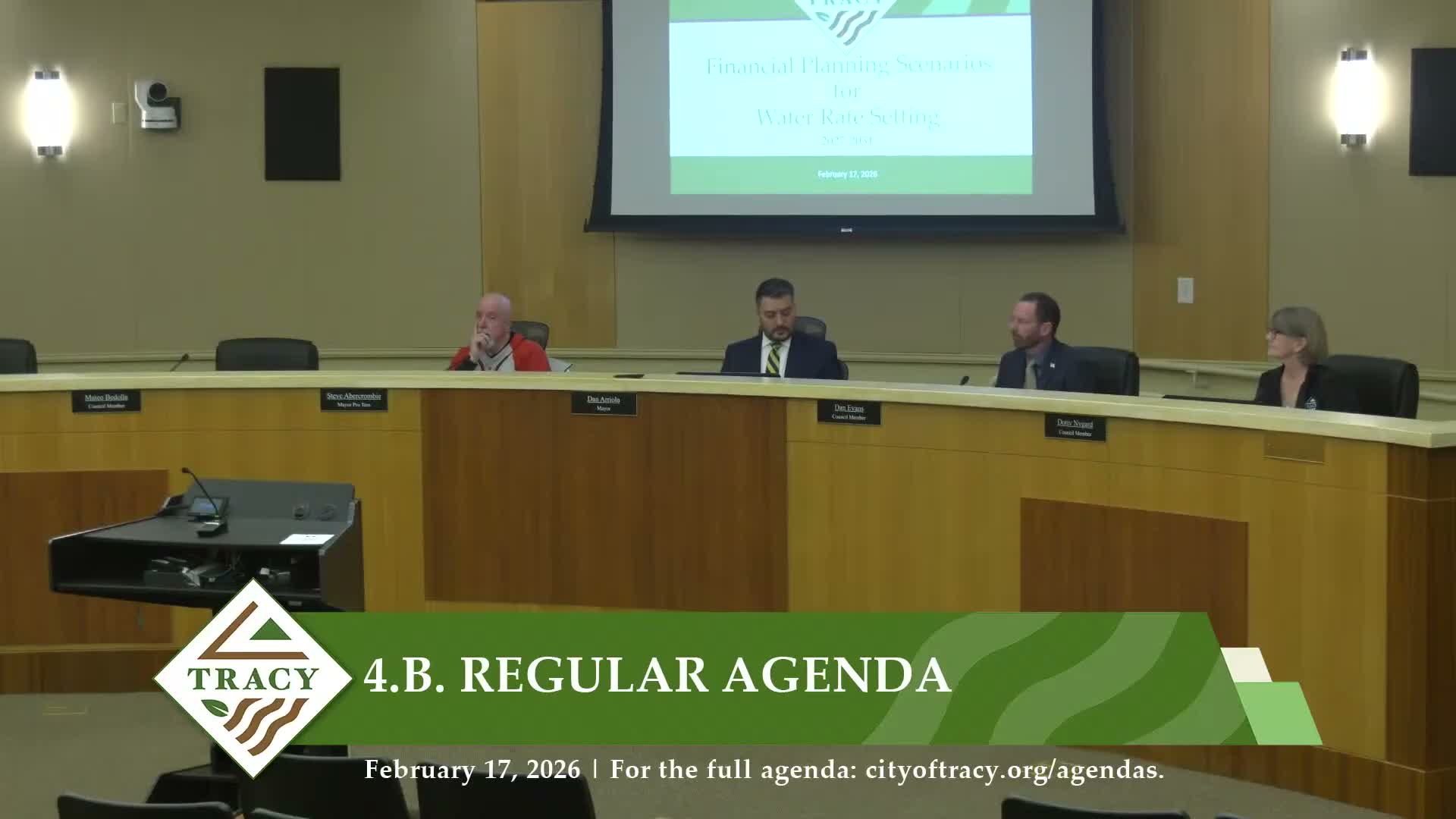
Summary
Following a presentation showing FY25 water revenues of $25.2M vs. expenses of $27.5M and more than $60M in deferred CIP, council unanimously directed staff to prepare a Prop 218 compliant rate plan based on Scenario 1 (largest near‑term increase, strongest long‑term stability) and set a public hearing to begin the formal notice process.
City finance and utilities staff told the council that the Water Enterprise Fund is under significant pressure and presented three financial scenarios to restore long‑term stability.
Director of Finance Sarah Castro said the water fund’s FY ending 07/30/2025 operating revenues were $25.2 million while operating expenses were $27.5 million, and staff identified more than $60 million in necessary capital improvement projects deferred over many years. The study, prepared with a consultant, modeled three scenarios for the five‑year interval July 2026–June 2031. Each scenario eliminates the tiered rate structure (court decisions require cost‑of‑service ties) and applies a uniform volumetric rate across customer classes while updating fixed meter charges to American Waterworks cost‑of‑service standards.
Scenario 1 provides the most immediate revenue and would fund approximately $68.3 million of CIP maintenance, add about 29 full‑time equivalents for utility operations and fund a proactive maintenance program; Scenario 2 is intermediate and Scenario 3 is the most modest with the highest long‑term risk. Staff recommended a $2 million general‑fund loan in year 1 to smooth near‑term rate impacts and proposed reserve targets (120 days operating cash, 2% capital reserve, 5% rate stabilization fund). The presentation also described a low‑income rate assistance program (LIRA) and mapped Prop 218 public‑notice and protest timelines.
Councilmembers debated near‑term bill impacts versus long‑term solvency and asked questions about staffing, energy savings potential and how to memorialize a regular cadence for future studies. After discussion council unanimously directed staff to proceed with Scenario 1, prepare Prop 218 notices, return with a proposed rate plan and set a public hearing to begin the formal adoption process.