
House approves change to Vermont’s "single plant" definition to ease community solar expansion
Get AI-powered insights, summaries, and transcripts
Subscribe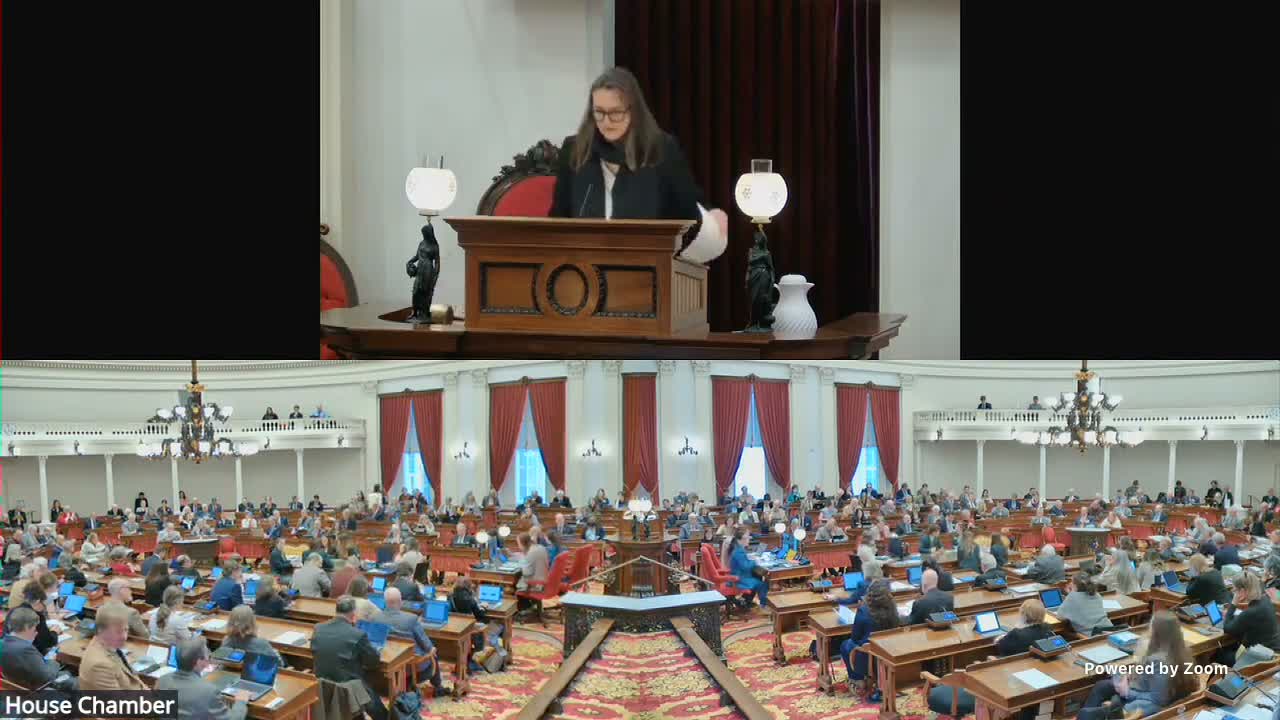
Summary
The Vermont House amended and approved H 7 10 to adopt a new definition of "single plant" for electricity generating facilities, allowing adjacent renewable facilities with separate points of interconnection to be treated separately; the change takes effect July 1, 2026.
The Vermont House on Wednesday amended and approved H 7 10, a bill that replaces the Public Utilities Commission’s "single plant" definition to allow adjacent renewable electricity facilities to be counted separately if they have distinct points of interconnection.
Representative Kleppner (Burlington), speaking for the House Committee on Energy and Digital Infrastructure, said the existing PUC rule prevented communities from expanding solar at sites they had already chosen by treating adjacent arrays that shared infrastructure as one facility. The committee reported the bill out on a 6-3-0 vote and recommended the committee amendment pending before the body.
The new definition preserves program caps — for example, net‑metering facilities remain limited to 500 kilowatts and standard‑offer facilities to 2,200 kilowatts on a single parcel or adjoining parcels — while allowing two adjacent facilities to be treated as separate projects if they have separate points of interconnection. Kleppner said the change prevents "unnecessary roads" and redundant utility poles that would otherwise be required to keep facilities separate.
Members asked whether the change affects larger renewable technologies. Kleppner said the measure applies to wind, hydro and biomass as well as solar and that the practical effect is the same across technologies: shared infrastructure is allowed provided separate points of interconnection are used and program size limits are respected. He added that "this bill will have no effect on the licensing or regulation of large hydro."
Debate also surfaced land‑use concerns. A member from Poultney said that permitting large renewable installations across many acres could displace land that might otherwise be used for housing and urged attention to housing development. The member from Manchester said, "I vote yes to support solar smart growth and to make renewable power more affordable for ratepayers." Another member urged that nuclear be considered among electricity generating technologies.
A roll‑call was requested for third reading. The clerk recorded 108 votes in favor and 30 opposed; the ayes prevailed and third reading was ordered. The bill as amended is effective on July 1, 2026.
The House advanced H 7 10 to the next step following the vote; no further action was announced at the conclusion of the session.