Get Full Government Meeting Transcripts, Videos, & Alerts Forever!
Get email alerts on the Medical Debt Interest topic
No spam. Unsubscribe anytime.
Committee hears bill to cap interest on medical debt at 1% for new debts
Summary
ESSB 5993 would cap prejudgment interest on unwritten medical debt accrued after Dec. 31, 2026, at 1% per year; sponsors say it protects patients and is a compromise, providers and collectors warn of unintended access and sustainability impacts.
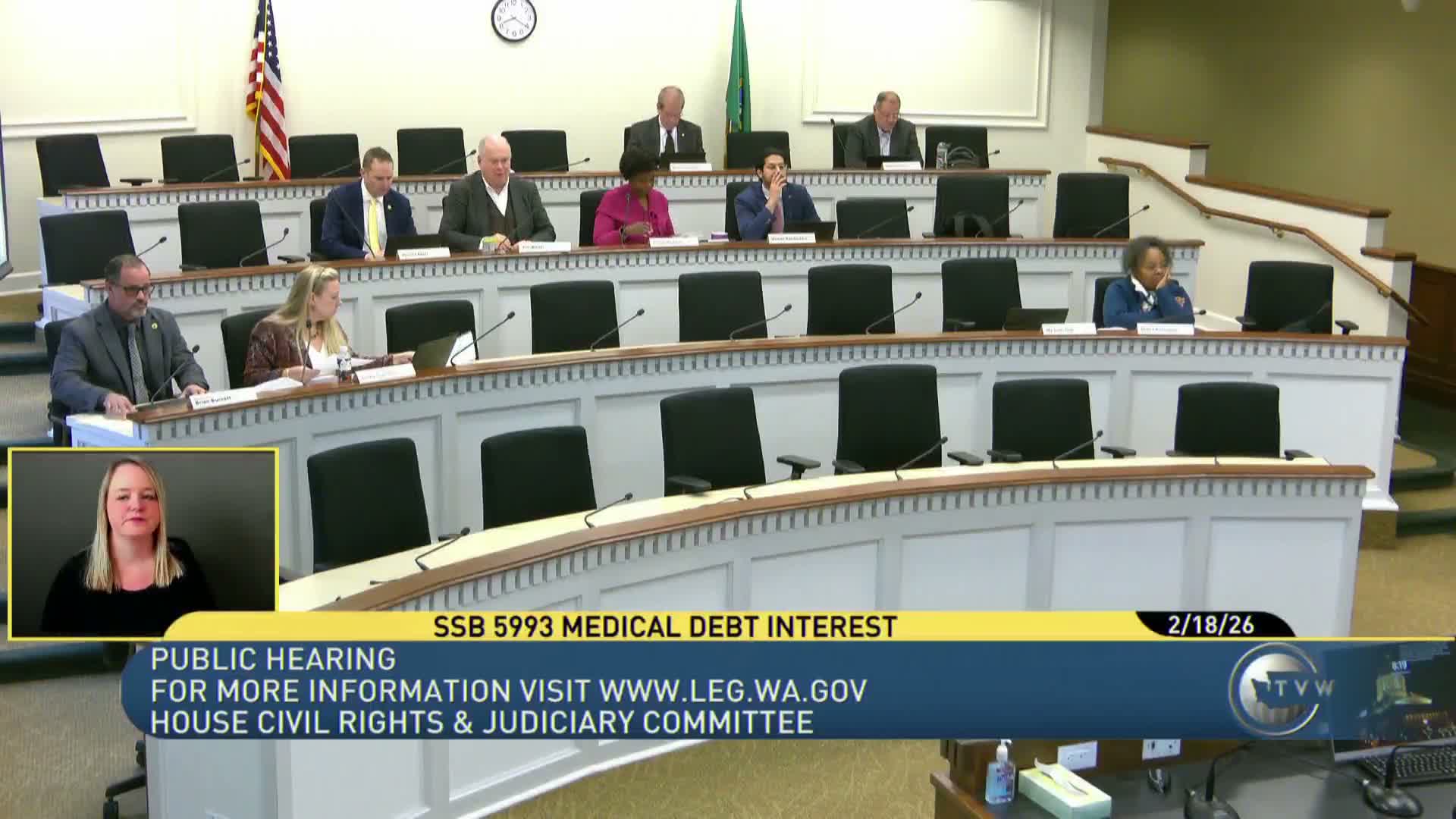
On Feb. 18 the Civil Rights and Judiciary Committee heard testimony on ESSB 5993, which would limit prejudgment interest on medical debt without a written agreement to 1% per year for debts that accrue after Dec. 31, 2026.
Senator Emily Alvarado (34th), the bill—s sponsor, described the bill as a compromise: the initial draft banned interest entirely, but the current version sets a 1% limit to cover administrative costs and preserves the judgment timeline. "This is a compromise...we raised it to 1% to cover the costs of administration," Alvarado said.
Matt Sterling, staff, explained key provisions: unwritten-agreement medical debt accrued after 12/31/2026 would be capped at 1% prejudgment interest; written agreements remain unchanged; interest may not be charged for portion of debt accruing while required hospital charity-care screening and initial determination have not been completed.
Patients and advocacy groups, including AARP and the Patient Coalition, supported the bill and offered personal accounts of debt—s harms and treatment delays. "Medical debt is just different and it should be treated as such," an AARP representative said.
Opponents including the Northwest Collectors Association, hospital representatives, and the Washington State Medical Association warned the bill could disproportionately hurt small providers, shift care to cash-only models, and create uncertainty because the bill applies equally across provider types. Hospital witnesses asked for clarity on how the bill references existing Charity Care statutes and how that compliance would be demonstrated.
Committee members questioned the empirical basis for the sponsor—s claim that lowering interest does not reduce repayment; Alvarado acknowledged there is limited evidence on repayment impacts and said the policy trend favors reducing medical debt burdens.
The committee recessed public testimony after panels for and against the bill and indicated it would accept further written input and technical amendments.