Get Full Government Meeting Transcripts, Videos, & Alerts Forever!
Get email alerts on the ALPR Regulation topic
No spam. Unsubscribe anytime.
Committee weighs limits on license-plate readers; privacy advocates press tighter retention and felony standard
Summary
ESSB 6002 would tightly regulate automated license-plate reader (ALPR) systems, restricting which agencies may operate them, limiting disclosure and third-party vendor sales of data, and setting a default retention period (Senate: 21 days; House: 72 hours). Privacy groups urged shorter retention and felony-only access; law enforcement warned the bill as drafted could render the tool unusable.
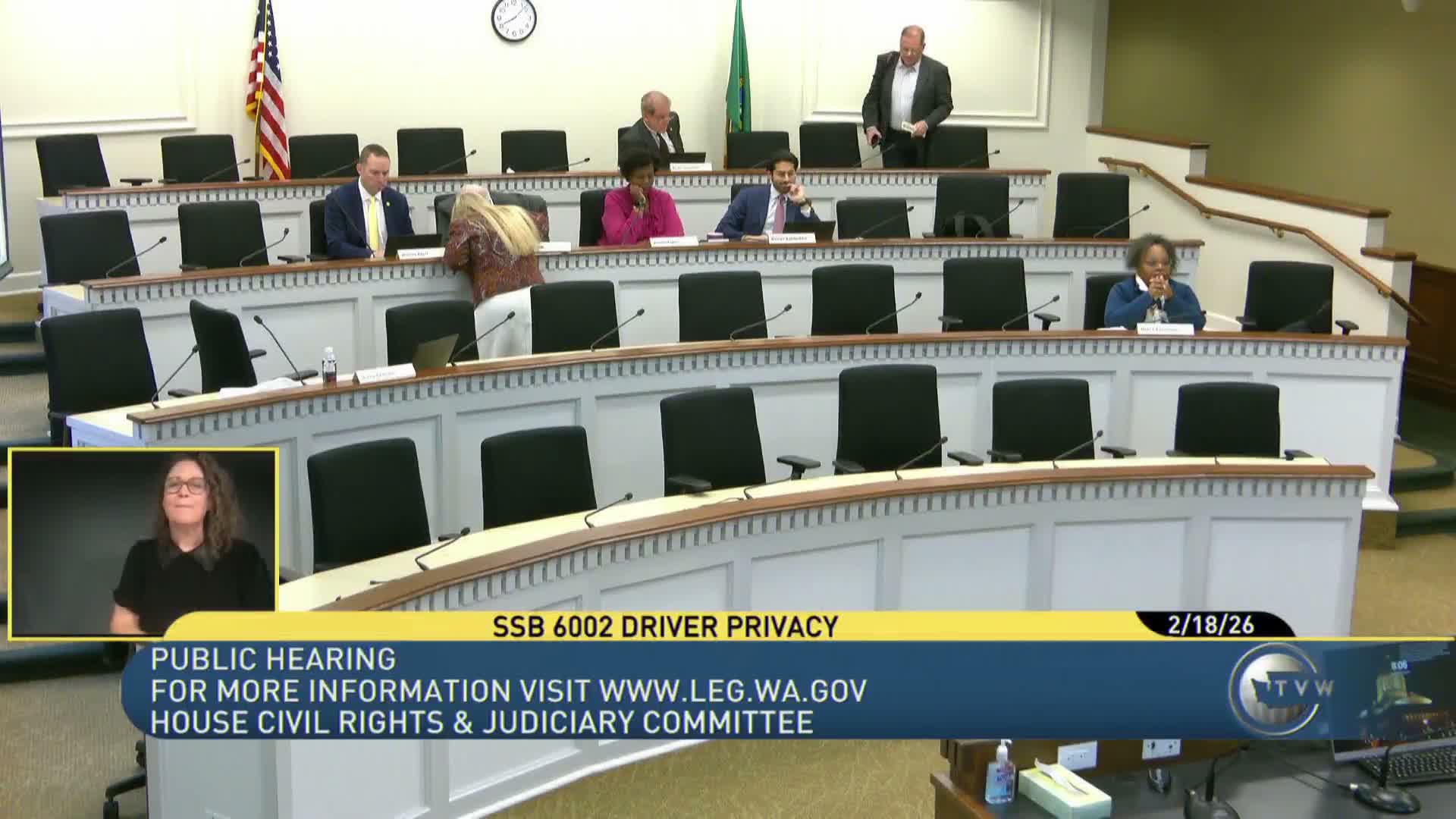
The Civil Rights and Judiciary Committee on Feb. 18 considered ESSB 6002, a bill to regulate automated license-plate reader systems and limit how state and local agencies collect, share, retain and access plate data.
Yolanda Baker, committee staff, summarized the Senate—s version as substantively similar to the House companion (HB 2332) but with key differences: toll enforcement was removed from authorized users; Department of Enterprise Services and institutions of higher education were explicitly listed as parking-enforcement agencies; and the Senate default retention period for ALPR data is 21 days versus 72 hours in the House bill.
Senator Yasmin Trudeau (27th), the prime sponsor, said constituent complaints and a University of Washington report showing unauthorized collaborations prompted the legislation. "We're in Washington. We have no regulation on these systems. None," she said, adding the bill seeks transparency and oversight rather than an outright ban.
Testimony split along expected lines. Privacy and civil-liberties groups urged shorter retention and strict third-party limits. "We recommend maintaining the focus on felonies because expanding use of misdemeanors would greatly expand routine access to millions of driver's records," the ACLU—s witness said. Legal Voice, the Electronic Frontier Foundation, and Lavender Rights Project asked for retention as short as seven days or less and for warrant-level protections for cross-jurisdictional searches.
Law-enforcement witnesses and some local officials said the bill as drafted contains technical and policy flaws that would hamstring legitimate investigations. Spokane County—s ALPR manager listed operational concerns including unclear "watch list" definitions, exclusions that would block use for many serious crimes such as domestic violence and stalking, and no allowance for testing or maintenance. Several sheriffs and police groups urged preserving access for a broader set of crimes, including gross misdemeanors.
City and county officials and some police representatives asked for carve-outs for parking enforcement, for clarity on retention counting, and for data-exchange rules that do not inadvertently criminalize routine maintenance.
The committee closed public testimony after extensive panels, and members asked staff and sponsors to submit technical amendments and usage data to inform further work.