
Cabrillo USD midyear LCAP review flags gaps for English learners, outlines interventions
Get AI-powered insights, summaries, and transcripts
Subscribe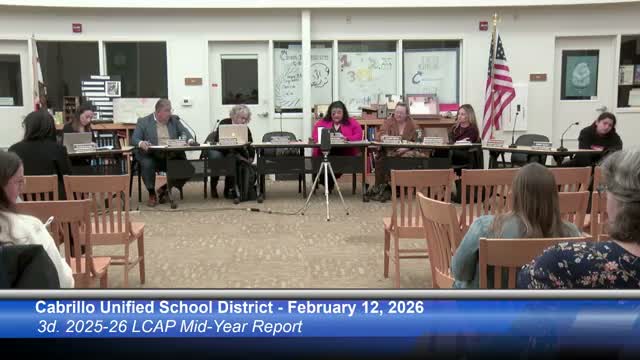
Summary
The district’s midyear LCAP update found persistent achievement and access gaps for English learners, students with disabilities and low-income students and described interventions including literacy blocks, increased ELD staffing, math-curriculum pilots and data-cleaning efforts.
Cabrillo Unified School District officials presented a midyear review of the district’s Local Control Accountability Plan (LCAP) on March 1, highlighting progress and persistent gaps for identified student groups.
Assistant/lead presenter Israel Castillo summarized four LCAP goals—academic improvement, equity, whole child supports and district sustainability—and described targeted actions: literacy implementation (DIBELS, early literacy blocks), expanding ELD staffing (increase from 0.6 to 1.0 FTE for ELD support), piloting new math programs (InovaMath, Imagine Learning) and expanding multi-tiered systems of support (MTSS). Castillo reported local data showing improvement in some grades but continuing shortfalls for English learners, students with disabilities and socioeconomically disadvantaged students; he said reclassification (English learners gaining proficiency) stood at about 11.8% so far this year.
The board and public discussed data clarity and monitoring; public commenters urged early-warning systems for A–G progress and clearer benchmarks for literacy by subgroup so gaps are identified before high school. Board members asked for further data clean-up (noting CALPADS inconsistencies), closer monitoring of a-through-g and AP-course alignment to support college readiness, and stronger real-time interventions.
What’s next: Staff will continue refining LCAP actions, pursue clean-up of state data reporting, pilot math curriculum adoptions next year and return with more granular progress metrics and implementation timelines.