State Controller outlines SB 822 implementation plan for unclaimed digital assets
Loading...
Summary
State Controller Malia Cohen told the Assembly Banking Committee that SB 822 creates a legal framework for reporting, safeguarding and returning unclaimed digital assets held by custodial third parties, outlined outreach rules, custodian requirements, projected claim volumes and an implementation timeline targeting custodian procurement by mid‑2027.
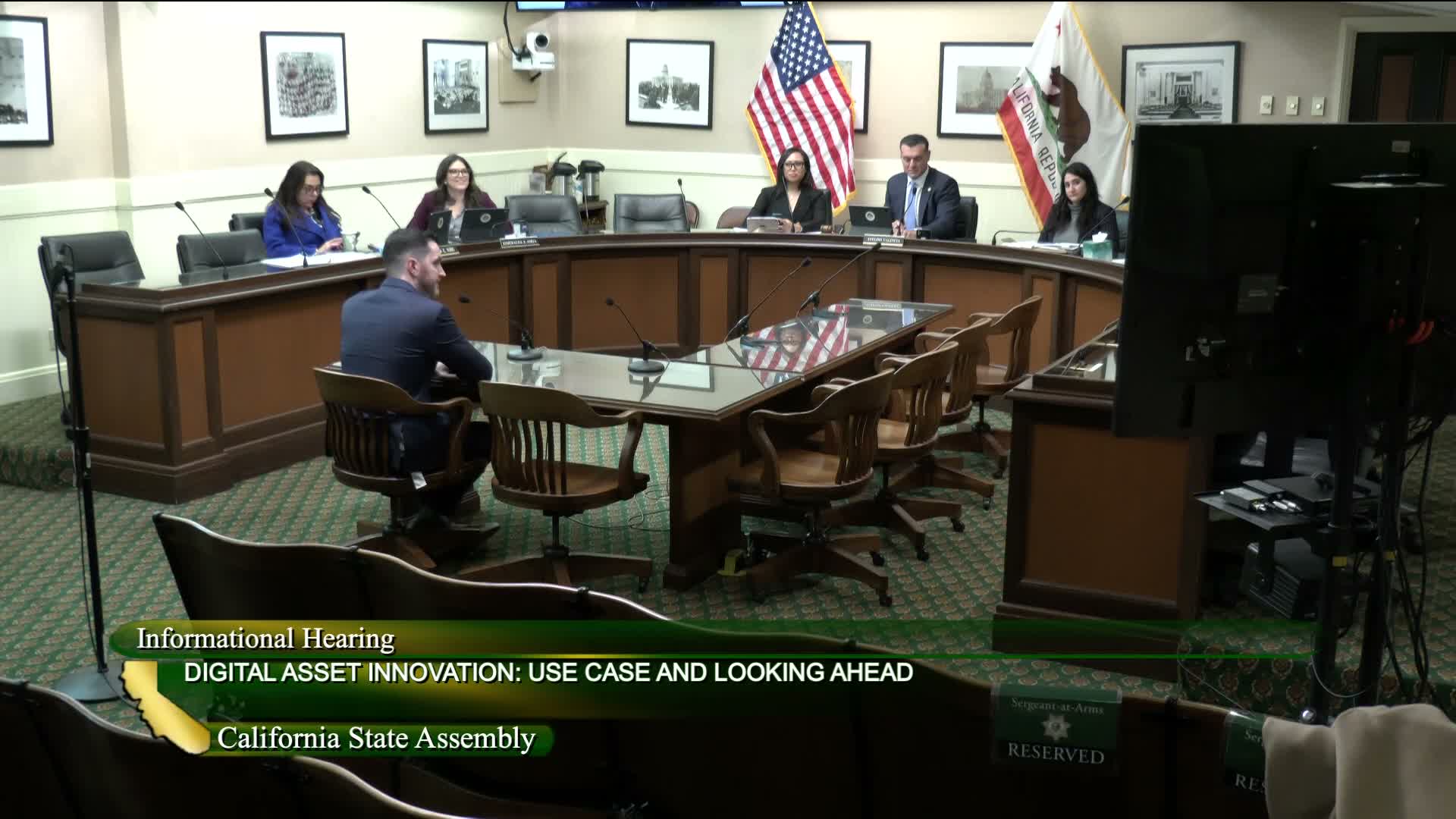
State Controller Malia Cohen told the Assembly Banking Committee on digital asset innovation that Senate Bill 822 establishes clear procedures for reporting, safeguarding and returning unclaimed digital assets held by third‑party custodians.
"The bill created a clear legal framework for how abandoned digital assets were reported, how they were safeguarded, and most importantly, how they were returned," Cohen said. She emphasized the law treats virtual currency as unclaimed intangible property and applies only to custodial arrangements such as exchanges and banks, not private wallets.
Under SB 822, an account that shows owner‑initiated activity within a three‑year lookback cannot be deemed abandoned. Cohen said the statute defines "contact" broadly and that a single log‑in can reset the inactivity clock. Holders (the custodial exchanges and institutions) have the primary responsibility for locating missing owners and must undertake outreach before reporting assets to the state. The controller's office will perform additional due diligence, coordinating with the Franchise Tax Board for address verification, and will not accept transfers until those steps are complete.
Cohen gave preliminary figures from exchanges' account records showing more than 1,000,000 California accounts had no owner‑initiated activity during the three‑year period ending 06/30/2025, with an aggregate dormant value cited at about $100,000,000. She cautioned those numbers are "preliminary" and will change as holders conduct outreach.
Implementation steps and timeline outlined to the committee include: a Request for Information (RFI) process already completed; a competitive bid to select a contracted custodian pending budgetary approval; notices to holders planned for January–March 2027; and a remittance period targeted for June 1–14, 2027. The controller's office and staff said they are projecting to have a custodian in place by June 2027.
Cohen described custodial selection as one of the more complex components. She said custodians must meet California contracting standards and be licensed by the Department of Financial Protection and Innovation. The controller's office plans to require regulatory oversight, insurance protections, indemnification of the state and full compliance with evidence standards developed for digital property claims.
The controller's office requested roughly 19 positions to handle reconciliations, claim reviews and processing tied to expected increases in claims activity. Staff estimated operational costs in early projections in the range of $10 million–$15 million annually, noting per‑claim validation costs in the newly implemented electronic unclaimed property system could range from about $0.35 to $1.25 depending on verification procedures.
Cohen said the office is building reporting instructions, training materials, claim workflows and database adaptations and is coordinating with other states to leverage lessons learned. "No state has fully implemented a comprehensive unclaimed digital asset program," she told the committee, describing California's efforts as "on the cutting edge." The office also noted that social security numbers are on file for about 80% of the dormant accounts identified, which should aid owner location efforts.
The controller stressed that the goal is to keep assets with owners whenever possible through rigorous outreach and due diligence. "If it belongs to Californians, we will safeguard it and we will work tirelessly to reunite it back to its rightful owners," she said. The committee asked for additional briefings and copies of the staff slides to inform ongoing oversight and next steps.
The hearing concluded with committee appreciation for the controller's update and a request for continued coordination as the state executes procurement and outreach plans.