
Senate committee advances bill to regulate stem-cell and birth-tissue therapies; criminal penalties, consumer disclosures included
Get AI-powered insights, summaries, and transcripts
Subscribe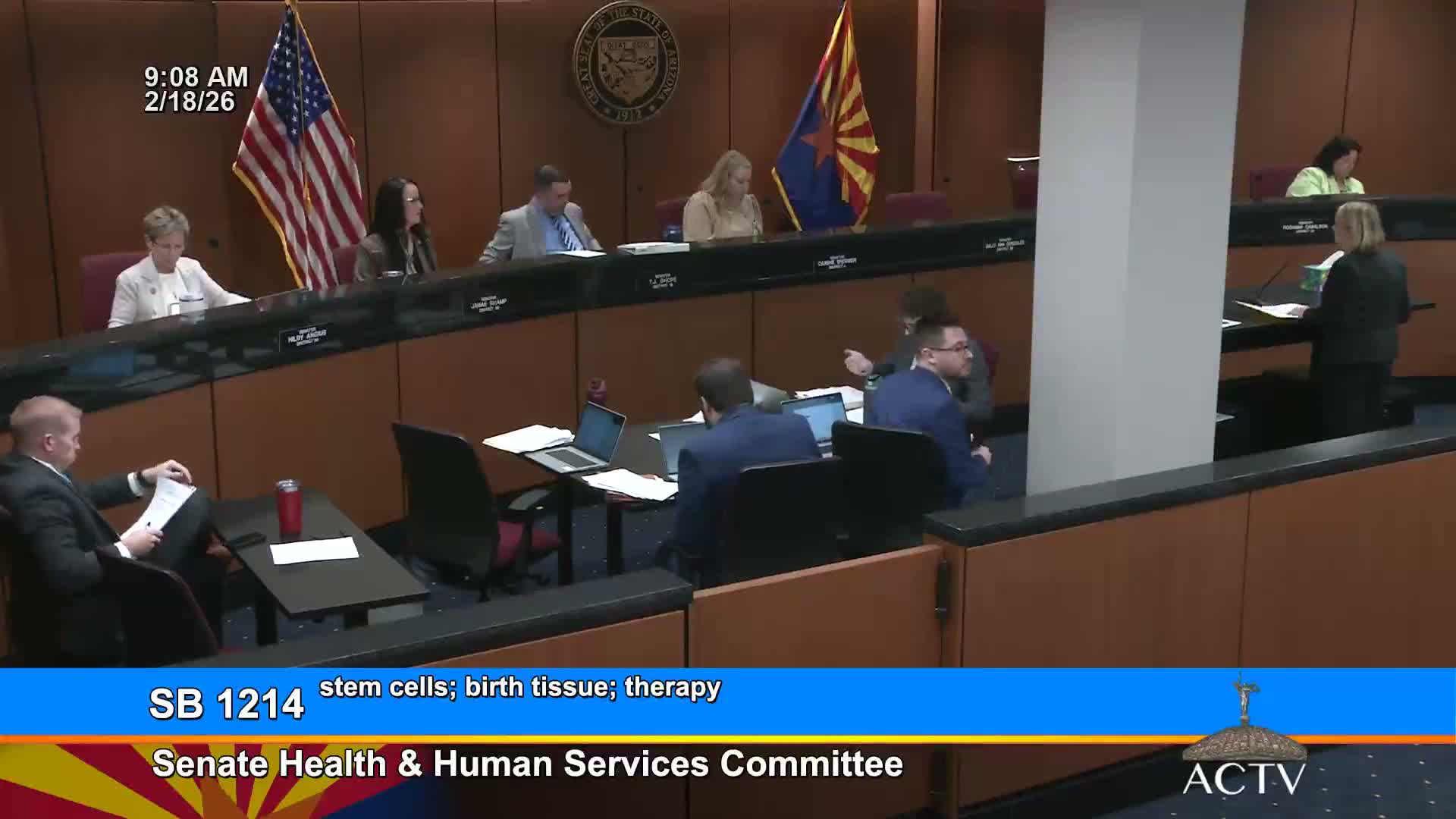
Summary
The Senate Health & Human Services Committee advanced SB 12 14, the Arizona Stem Cell Therapy Act, after expert testimony urging patient safeguards and proponents touting economic benefits. The bill requires certified sourcing, informed consent and allows civil suits with statutory damages; it passed the committee 4–3.
The Arizona Senate Health and Human Services Committee voted 4–3 to give Senate Bill 12 14 a due-pass recommendation after a day of testimony and questions about clinical standards and patient protections.
SB 12 14, presented to the committee as the Arizona Stem Cell Therapy Act, would establish requirements and restrictions for the use of stem cell and birth-tissue therapies in the state. The measure would bar therapies or research using cells or tissues “derived from an aborted fetus or embryo,” require physicians to obtain products only from federally compliant or certified facilities, and mandate specific disclosures and signed informed-consent forms for therapies not approved by the U.S. Food and Drug Administration.
The bill also includes civil remedies. At the hearing a presenter read the statutory-damages provision: "an individual who receives stem cell or birth tissue therapy that violates requirements for cellular tissue use, to bring a civil action to recover statutory damages in an amount of $10,000 per violation, plus attorney fees and costs." Supporters described those penalties as guardrails to deter unsafe, profit-driven practices.
Physician witness Pradeep Albert, who identified himself as practicing and teaching in the field, told the committee that birth-derived tissues such as placental tissue and cord blood are the standard for regenerative therapies. “We don’t use aborted tissue,” Albert said, arguing the bill would “codify what you can do and what you can’t do from a medical point of view.” He described clinical risks he attributes to embryonic-derived cells—citing teratomas as a theoretical risk—and urged regulations to ensure tissues are processed and certified.
Bridal Bueller, founder of Ways to Well, described patient cases and clinical experience, saying his practice has treated thousands of patients and reported a low rate of major adverse events. He told the committee that donated after‑birth tissue is routinely discarded by hospitals and that donation or storage options already exist. “This should be affordable for everybody,” Bueller said, arguing that state policy could reduce cross‑border care and attract biotech investment.
Opponents and some senators questioned the bill’s criminal penalties and whether the measure could unintentionally criminalize physicians. Senator Gonzalez said he opposed the bill in part because it “makes it a classified felony for physicians” in certain circumstances and flagged the bill’s association with particular policy groups. Supporters responded that the bill is focused on “guardrails” to protect patients and preserve access to emerging therapies.
The committee adopted a motion to give SB 12 14 a due-pass recommendation. The measure will move to the next step in the legislative process. The committee hearing included technical questions about accreditation, the role of the Arizona Medical Board and the Board of Osteopathic Examiners in adopting rules, and possible economic impacts if Arizona seeks to grow a regenerative-medicine sector.