
Speaker at India AI Summit announces UN panel appointment and urges $3 billion global AI fund
Get AI-powered insights, summaries, and transcripts
Subscribe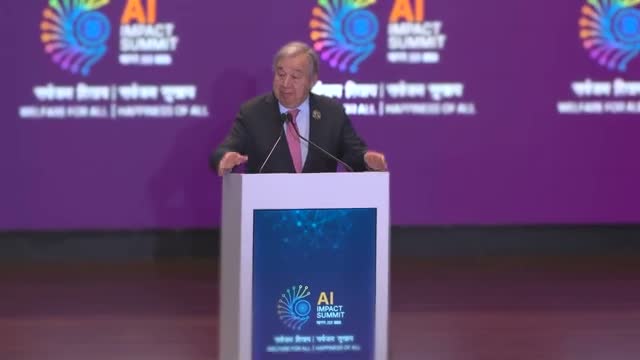
Summary
At the AI Summit in the Global South in India, an unidentified speaker announced the UN-appointed 40-member international scientific panel on AI and called for a $3,000,000,000 global fund to build capacity in developing countries, alongside a UN-led global dialogue beginning in Geneva in July.
An unidentified speaker at the AI Summit in the Global South in India announced that the United Nations has appointed a 40-member independent international scientific panel on artificial intelligence and called for a $3,000,000,000 global fund to build AI capacity in developing countries.
The speaker thanked Prime Minister Modi for hosting the summit and said the meeting ‘‘brings this conversation closer to the realities shaping much of the world.’’ The speaker said the UN General Assembly took ‘‘two decisive steps’’: creating the independent scientific panel and launching a global dialogue on AI governance within the United Nations.
‘‘These 40 leading experts from across regions and disciplines embody a clear message: AI must belong to everyone,’’ the unidentified speaker said, and urged member states, industry, and civil society to contribute to the panel’s work. The speaker added that the first session of the UN dialogue will be held in Geneva in July to ‘‘align efforts, uphold human rights, and prevent misuse.’’
As part of capacity building, the speaker proposed a dedicated global fund for AI that would support skills, data, affordable computing power, and inclusive ecosystems in developing countries. ‘‘Our target is 3,000,000,000 US dollars,’’ the speaker said, adding that amount is ‘‘less than 1% of the revenue of a single tech company.’’ The speaker said member states have responded to the call by forming a global network for exchange and cooperation on AI capacity building.
The remarks set out both potential benefits and risks. The speaker listed possible gains if AI is deployed inclusively—advances toward sustainable development goals, medical breakthroughs, broader learning opportunities, stronger food security, climate action, disaster preparedness, and improved access to public services. At the same time, the speaker warned that AI ‘‘can also deepen inequality, amplify bias, and fuel harm’’ and noted rising energy and water demands from data centers and supply chains, calling for a shift to clean power and for investments in workers so ‘‘AI augments human potential, not only replaces it.’’
On safety and ethics, the speaker said ‘‘AI must be safe for everyone’’ and urged protections ‘‘from exploitation, manipulation, and abuse,’’ adding that ‘‘no child should be a test subject for unregulated AI.’’ The closing appeal framed the summit’s goals: build AI that ‘‘improves lives and protects the planet’’ and make ‘‘dignity the default setting.’’
The announcement did not include details on funding commitments, a timeline for the fund’s establishment, or which member states have pledged money. The UN dialogue’s first session in Geneva in July was presented as the next significant convening for countries and stakeholders to align governance and safety efforts.