
Kansas committee hears wide debate on HB 24‑83, TRUE Act, over transmission costs and third‑party PPAs
Get AI-powered insights, summaries, and transcripts
Subscribe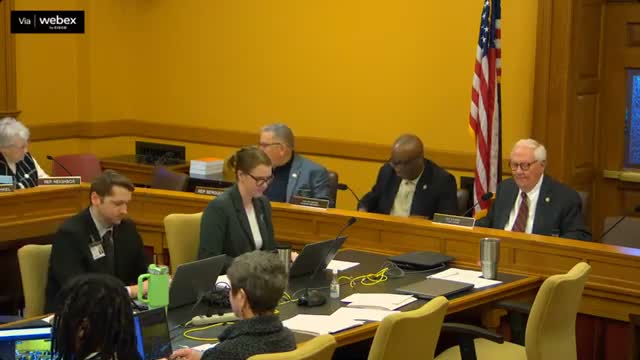
Summary
Supporters told the House Energy, Utilities and Telecommunications Committee that HB 24‑83 (the TRUE Act) would rein in transmission spending, increase transparency and allow third‑party PPAs; opponents including the Kansas Corporation Commission and Evergy warned of federal preemption, higher costs, and risks to reliability and economic development. No vote was taken.
The House Energy, Utilities and Telecommunications Committee heard nearly four hours of testimony Feb. 19 on House Bill 24‑83, the Transparency and Reform of Utility Expenditures (TRUE) Act, a broad package of changes that would impose new reporting requirements on the Kansas Corporation Commission (KCC), require competitive bidding for many Southwest Power Pool (SPP) transmission projects and allow third‑party power purchase agreements (PPAs).
The bill’s reviser, Mr. Myers, told the committee the measure would require an annual KCC report on the SPP Integrated Transmission Plan, include a provision that treats transmission delivery charges as subject to general rate proceedings, and add new limits such as a prohibition on participation by utilities with more than 5,000 retail customers in SPP‑directed projects above 300 kilovolts unless those projects are competitively bid. He also summarized provisions that would ban local land‑use restrictions that forbid nuclear development (except for reactors buried more than 500 feet), and a 365‑day post‑employment restriction for KCC employees and commissioners.
Proponents said the bill is aimed at lowering costs for Kansans. Paul Snyder of Kansans for Lower Electric Rates said the measure would increase oversight of SPP spending and cited his group’s comparisons showing Evergy Central’s residential rates higher than neighboring states. "Evergy Central's rates are 29% higher than Oklahoma rates for residential customers," Snyder said, adding that SPP’s 2025 spending totals about $8.6 billion and that Kansas would bear roughly 16 percent of that cost over time. Eric Stafford of the Kansas Chamber and others urged the panel to pursue competitive bidding and reforms to the transmission delivery charge as ways to slow rate increases.
Opponents, speaking for state regulators, utilities and construction firms, urged caution. Justin Grady, director of the utilities division at the KCC, described the commission as "technically opposed" to several sections and warned that elements of the bill likely would be preempted by federal law and prompt lengthy litigation. Grady said much of the requested information is already publicly available and cautioned against the bill’s recommended numeric thresholds — including a 150 percent cap tied to a 10‑year average — calling them arbitrary and potentially unworkable for long‑range planning.
Chuck Kaisley of Evergy said the bill targets his company and disputed the claim of a statewide affordability crisis. "Over the last eight years, residential rates in Kansas have only increased by 5.5% — compared to a regional average of 23%," Kaisley said, and he warned that subjecting transmission siting to the Legislature would discourage investment and economic development. Several municipal utilities, cooperatives and contractors echoed worries that adding legislative approval steps or new uncertainty to transmission siting and procurement would raise project costs or make projects unbid.
Testimony also focused on third‑party PPAs. Supporters — including Jessica Lucas of the Clean Energy Business Council and Mac Morris of Americans for Prosperity — argued PPAs are a common tool nationally that can lower costs and expand options for customers. Opponents from municipal utilities and Evergy said allowing third‑party PPAs would be tantamount to deregulation that risks shifting costs to residential customers and undermines integrated resource planning. "If half of our large consumers got half of their energy through purchase power agreements, that would result in a $120,000,000 annual increase in every single other customer on our system," Kaisley said.
Neutral witnesses raised related concerns and alternatives. Dorothy Barnett of the Climate and Energy Project said she was neutral on the bill but highlighted growing energy affordability problems in Kansas — she estimated roughly 16% of households are behind on utility bills and urged the committee to consider complementary changes such as all‑source bidding and binding integrated resource plan requirements to ensure least‑cost choices.
No committee vote was taken. The chair closed the hearing and said the panel would not need the previously reserved Thursday session; the committee adjourned.
What’s next: The bill received extensive oral and written testimony from industry, regulators, consumer advocates and local utilities. Committee members asked several detailed questions and signaled further work may be needed to reconcile concerns about federal preemption, municipal and cooperative impacts, and the practical effects of the bill’s numeric thresholds.