Get Full Government Meeting Transcripts, Videos, & Alerts Forever!
Get email alerts on the Water Quality topic
No spam. Unsubscribe anytime.
Committee advances bill to relocate Bob Oak Game Farm after nitrate detections threaten Centralia water
Summary
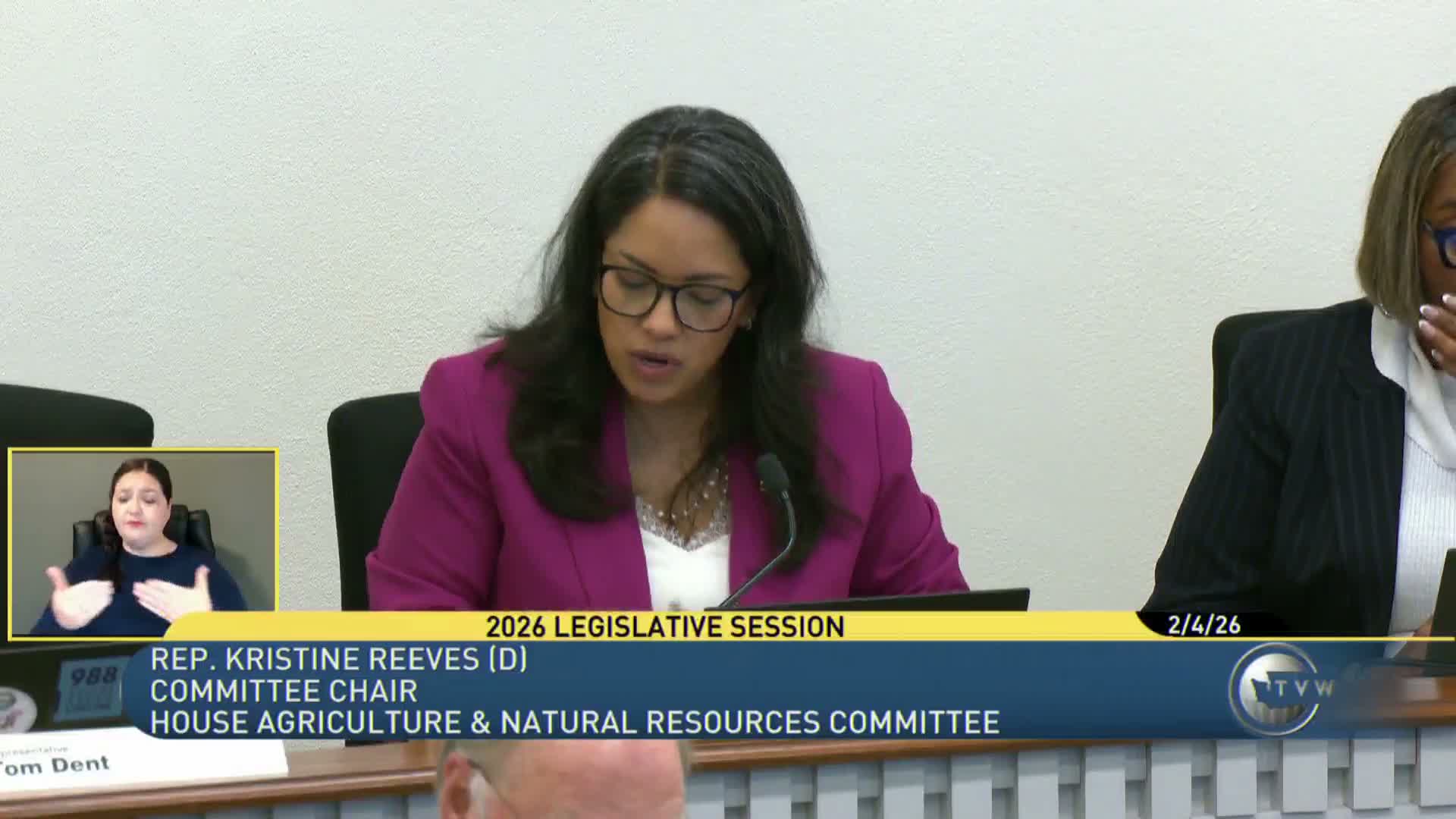
After testimony from local officials, tribal members and public-health experts about nitrate contamination of private wells and a sole-source aquifer, the House Agriculture and Natural Resources Committee reported a substitute to House Bill 2668 out of committee with a due-pass recommendation.
The House Agriculture and Natural Resources Committee on Feb. 4 advanced a substitute to House Bill 2668 directing the Department of Fish and Wildlife to identify and pursue relocation options for the Bob Oak Game Farm after officials described elevated nitrate concentrations in wells near the facility that threaten Centralia’s drinking water.
Representative Ed Orcutt, the bill’s sponsor, told the committee the bill is intended to relocate the state-run pheasant rearing and release facility rather than close it. "This is very much a public health issue," Orcutt said, citing downstream wells that measured multiple times the federal drinking-water standard.
Why it matters: County and city officials described a nitrate plume in the Centralia Outwash Gravel Aquifer, which supplies drinking water to about 20,000 residents. Centralia water operations manager Chris Stone warned that without action the city could be forced to install a "$50 million-plus" nitrate treatment facility. Lewis County environmental-health staff said several private wells in late 2024 exceeded the federal standard of 10 milligrams per liter.
Testimony and evidence: City Manager Mike Thomas told the committee the contamination affects roughly 50 households nearest the farm and that temporary fixes such as point-of-use filters protect only a single tap. "If you can move this game farm in the near future, you'll be providing clean safe potable drinking water to 20,000 people for the next 30 to 40 years," Thomas said. Public health director Meja Hanlon and retired pediatrician and county public health officer Joe Wiley described health risks—particularly for infants—from nitrate exposure. Jeff Landrum, the county's drinking-water lead, cited RCW 90.54.140 and said the aquifer meets the statute’s definition of a sensitive sole-source aquifer.
Mitigation and timeline: Witnesses described a three-tiered response: immediate point-of-use filtration for affected households, an intermediate extension of water and sewer lines (Centralia said a $5,000,000 state grant is funding planning to extend service to roughly 50 homes with construction targeted for 2026 and completion by about 2027), and long-term relocation and remediation under the bill. City public-works director Andy Owen said the hydrogeologic problem is structural and cannot be solved only with management changes at the existing site.
Legislative action: Committee staff briefed a proposed substitute (H3401.1) that requires the Department of Fish and Wildlife to identify alternate sites that do not pose a material risk to municipal or residential drinking sources, report potential locations to the legislature and request predesign and design funding in the 2027–29 and subsequent capital budgets. The committee first added HB 2668 to its executive calendar and then, after the public hearing and discussion, reported the substitute out of committee with a due-pass recommendation (staff announced 11 ayes, 0 nays).
What’s next: The substitute now moves to the next committee or the floor process described by House rules for consideration of capital budget requests and funding in future biennial cycles. The bill’s timelines in the substitute set deadlines for reporting and funding requests but do not appropriate the full relocation cost; the Department of Fish and Wildlife must continue seeking capital appropriations until the move and remediation are funded.
Sources: Testimony in the Feb. 4 committee hearing from Representative Ed Orcutt, Centralia city officials (Mike Thomas, Andy Owen, Chris Stone, Norm Chapman), Lewis County public health staff (Meja Hanlon, Jeff Landrum, Joe Wiley), and public sign-in records read into the record (52 pro, 1 con).