Lifetime Citizen Portal Access — AI Briefings, Alerts & Unlimited Follows
Experts brief Senate committee on new standards for portable and plug‑in solar devices
Loading...
Summary
A Pacific Northwest National Laboratory expert told the Environment, Energy and Technology Committee that new supplemental standards (including a recently published UL standard) are intended to enable safe plug‑in/balcony solar while NEC and other codes are revised; certification and NEC adoption timelines were discussed.
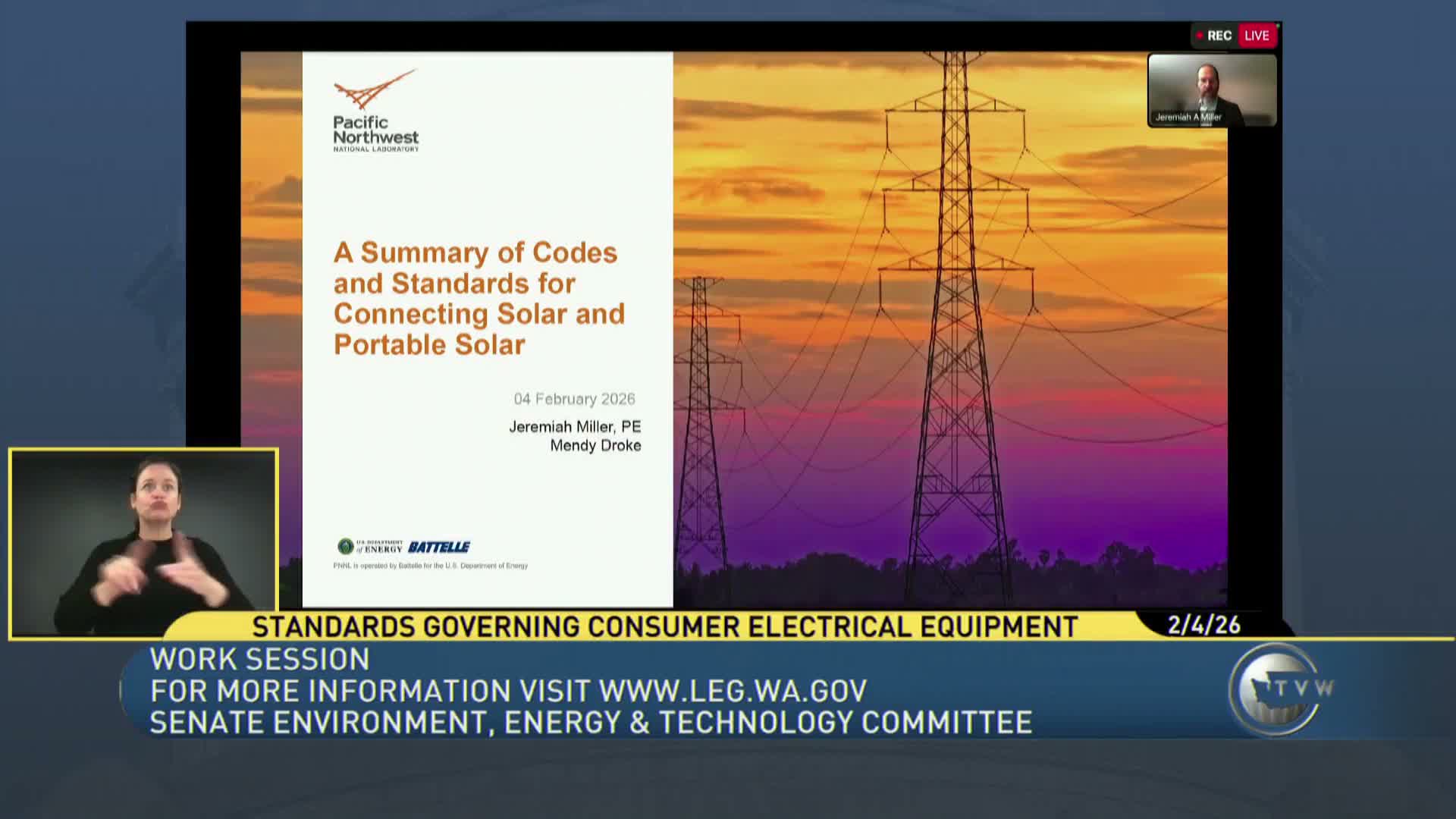
The Senate Environment, Energy and Technology Committee concluded its meeting with a technical work session on codes and standards for connecting portable, plug‑in and balcony solar to homes and the electric grid.
Jeremiah Miller of the Pacific Northwest National Laboratory told the committee these devices sit at the intersection of three main regimes: the National Electric Code (NEC), product‑level safety/listing standards administered by UL, and grid‑interconnection standards (IEEE 1547). He said the NEC and UL listing processes focus on safety (fire, shock) and installation practices, while IEEE 1547 governs how distributed devices interact with grid reliability and operator requirements.
Miller walked through a sequencing issue that matters for legislators: UL's product certifications can be published and used by manufacturers before corresponding NEC language is adopted in a future code cycle. He explained three specific standards discussed in the session: UL 1741 (inverter/solar certification commonly referenced in NEC work), UL 3741 (a power control systems certification addressing limited export/no‑export modes and device controls that prevent inadvertent export), and the very new UL 3700, a supplemental certification tailored to portable or balcony‑style plug‑in solar systems; publication of UL 3700 occurred this month, Miller said, and he was not aware of any completed device certifications using it yet.
Committee members asked whether uncertified or low‑quality imports present consumer safety risks. Miller said unscrupulous vendors and some web‑market products have historically posed risks across a range of consumer electronics; UL listing and proper use reduce but do not eliminate misuse by consumers. He emphasized that in practice, major retailers and installers face liability and typically avoid selling plainly unsafe products.
Lawmakers also asked about other jurisdictions. Miller said Europe uses IEC standards and different outlet/protection regimes and that Utah had recently authorized certain plug‑in solar installations; he cautioned that when legislation moves ahead of widely available certifications there may be a narrow window where vendors are operating without completed listings until certifications finish, but vendors can seek UL listing once test procedures are published.
Miller recommended the committee be explicit about whether legislation would require listed/certified products and noted the NEC revision cycle runs on roughly a three‑year schedule, so code incorporation is a multi‑year process. The committee thanked the presenters and adjourned.