Get Full Government Meeting Transcripts, Videos, & Alerts Forever!
Get email alerts on the Waste Management topic
No spam. Unsubscribe anytime.
Senate committee hears mixed views on mattress extended‑producer‑responsibility bill
Summary
Supporters told the Senate Environment, Energy and Technology Committee that mattress recycling could relieve landfills and create jobs, while retailers and the mattress industry cautioned the bill needs more stakeholder work; no committee action was taken.
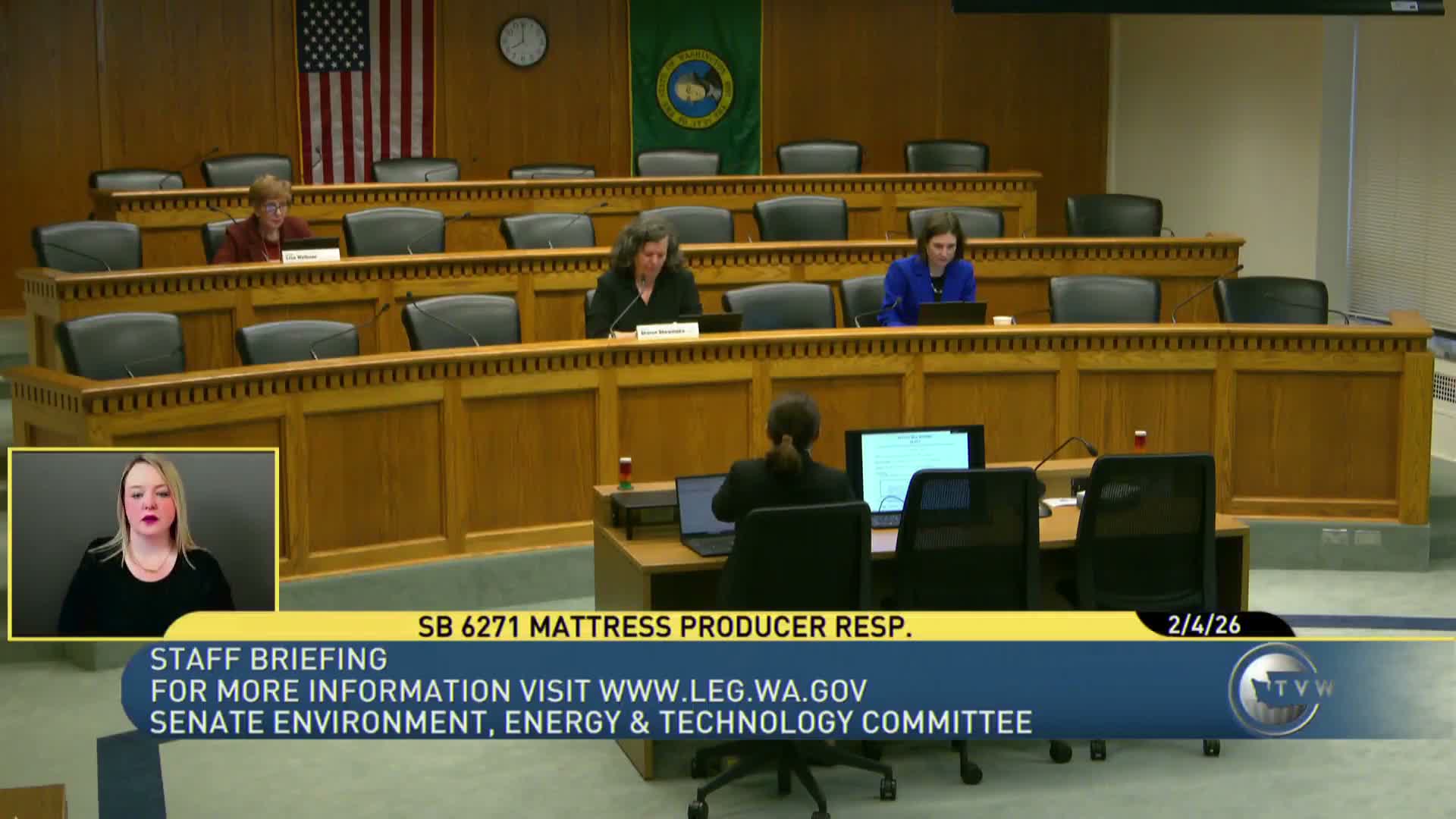
A Senate committee heard hours of testimony Wednesday on Senate Bill 6,271, a proposal to create an extended producer responsibility (EPR) program for mattresses intended to fund collection, reuse and recycling across Washington.
Alicia Kinney Clausen, staff to the committee, told members the bill would require mattress producers to form and register a Producer Responsibility Organization (PRO) by Jan. 1, 2027, and to register with the PRO by Jan. 1, 2031 in order to sell or distribute mattresses in the state. The PRO would set producer fees (prohibited from appearing as a separate point‑of‑sale charge to consumers), prepare a plan that includes collection for illegally dumped mattresses, and meet a performance goal of at least a 70% recycling rate. Clausen said the bill also requires reporting, enforcement, outreach and the establishment of an advisory committee.
Supporters said the bill responds to a growing waste and budget problem for local governments. Preston Peck, senior sustainability analyst for the City of Tacoma Environmental Services, said Tacoma currently lacks accessible mattress recycling options, is transporting mattresses long distances and spent between $250,000 and $300,000 in 2025 disposing of more than 8,000 mattresses collected through curbside bulky‑item pickup, illegal dumping programs and transfer stations. "Our county landfill is nearing capacity and estimates have it closing in the next 5 to 10 years," Peck said, urging a program that would internalize manufacturer costs and expand in‑state infrastructure.
Heather Trim of 0 Waste Washington used a vivid image to describe the landfill problem: "In the landfills, mattresses are called zombies," she said, explaining that compressed mattresses can spring back and reappear on the landfill surface. Trim cited Washington's 2020 waste characterization showing 50,403 tons of mattresses disposed that year and described how that tonnage translates into hundreds of thousands to more than a million individual mattresses annually, depending on assumptions about mattress sizes.
Amy O'Grilliter, government relations manager for King County Solid Waste Division, told the committee King County sends roughly 320,000 mattresses to its landfill each year and can recycle only a fraction of that supply — about 25,000 units annually at present — warning the landfill could reach capacity by 2040. "We need an extended producer responsibility program for mattresses that requires companies to fund and coordinate the reuse, renovation, recycling and disposal of their own products," she said.
Operators in the mattress‑recycling business described viable markets for material recovery and job creation. Mike Sackman, who operates a recycling facility in the Everett area, said his facility processes tens of thousands of mattresses a year and recovers metal, foam, wood and textiles, with roughly 90% of material streams being recyclable in his operations. Sackman described current per‑unit fees at private facilities and existing contracts with county partners.
Industry and retail groups urged more time to refine the proposal. Allison, president of the International Sleep Products Association and the Mattress Recycling Council, said the associations have run stewardship programs in other states and "this bill just doesn't have, as it's positioned, the template that we know has proven success"; she and other trade witnesses said several key design details remain unresolved. Rose Gunderson of the Washington Retail Association said the state's framework differs from other states' approaches and stressed the need for a unified multistate approach so compliance is operationally efficient and affordable for multistate retailers.
Carrie Dolan of the Washington Hospitality Association opposed the bill as drafted, arguing the measure assigns producer responsibility to brand or trademark owners rather than manufacturers and risks imposing administrative burdens on small businesses.
Committee members asked about lifecycle emissions from transporting mattresses to distant recyclers; Preston Peck acknowledged that without in‑state infrastructure transport costs can make recycling currently cost‑prohibitive and could have environmental tradeoffs, which supporters said is a reason manufacturers should help fund in‑state capacity.
No committee vote occurred. The chair closed the public hearing after reading sign‑in tallies of supporters and opponents. The bill will remain in the stakeholder and legislative process for further refinement.