Get Full Government Meeting Transcripts, Videos, & Alerts Forever!
Get email alerts on the Higher Education Finance topic
No spam. Unsubscribe anytime.
Students, colleges urge restoring Washington College Grant funding for private nonprofits
Summary
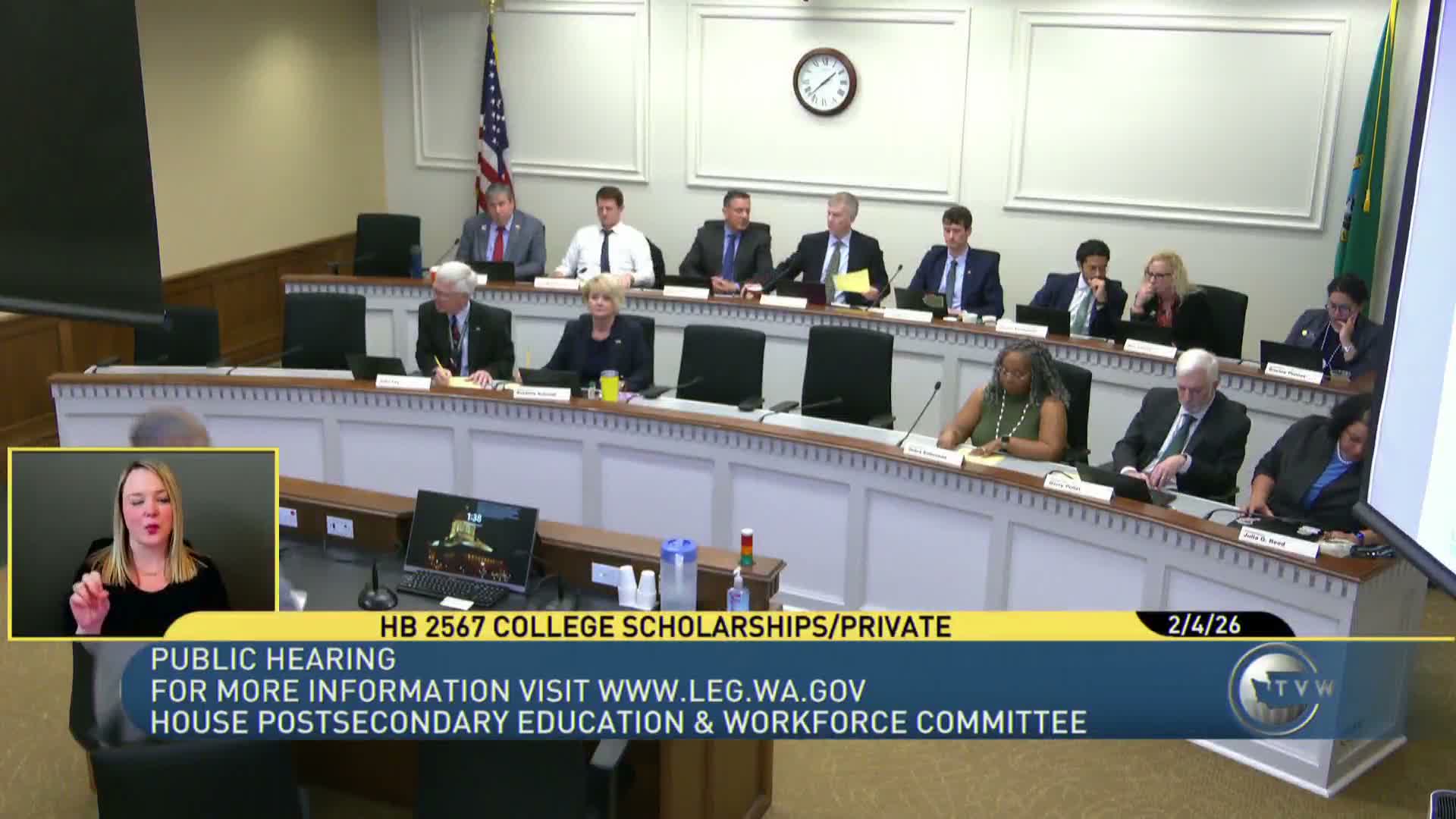
Students, college leaders and counselors urged the House Postsecondary Education & Workforce Committee to restore Washington College Grant and College Bound scholarship award levels for students attending four‑year private nonprofit colleges, arguing last year’s cuts disproportionately hurt low‑income and first‑generation students and threaten degree completion.
Rep. Paula Street told the committee Wednesday that House Bill 25‑67 is aimed at honoring a promise to low‑ and middle‑income students and restoring state aid cut last session.
“Said cuts were strictly a financial decision,” Rep. Paula Street said, arguing private nonprofit students are not less deserving and should have the same opportunity to choose the institution that fits their needs. “We want to make sure that they continue to have funding through tuition.”
Saranda Ross, counsel to the committee, described HB 25‑67 as modifying maximum Washington College Grant and College Bound Scholarship award amounts for students attending four‑year private nonprofit institutions. Ross said the Washington College Grant is the state’s largest means‑tested financial aid program and an entitlement for qualifying students.
Student speakers gave the issue a personal frame. Josiah Tiblo, student senator at Saint Martin’s University, said about 47% of his campus receives the grants and estimated that proposed changes could mean losing roughly $10,000 a year for some students. Mercedes Garcia, student government president at Heritage University, said 88% of Heritage students depend on financial aid and predicted higher tuition would force many students to work more, take fewer credits, delay graduation or drop out.
Institutional leaders and advocacy groups pushed similar themes. Alan Belton, president of Pacific Lutheran University, said the prior cuts shifted the fiscal burden onto students and that the state has sufficient funds in the dedicated account to restore aid. Catherine Mahoney of the Independent Colleges of Washington emphasized that the College Grant pays students, not institutions, and urged an equitable approach.
Witnesses also tied the question of aid to workforce needs. Julie Walter, dean at Gonzaga’s School of Health Sciences, said private institutions host programs critical to health‑care workforce capacity and that limiting student choice can worsen shortages.
Vice Chair Nance reported 1,584 people had signed in on HB 25‑67 (1,572 pro, 7 con, 5 other) and limited oral testimony to 90 seconds to allow more speakers. The committee concluded the public hearing and will consider the bill further as it moves to appropriations and other work sessions.
The committee did not take a vote on HB 25‑67 at this hearing.