Lifetime Citizen Portal Access — AI Briefings, Alerts & Unlimited Follows
Lawmakers weigh bill to require embodied carbon limits for large projects; industry raises sourcing and cost concerns
Loading...
Summary
House Bill 2273 would require the State Building Code Council to adopt embodied‑carbon reduction standards for large projects (100,000 sq ft+), phased implementation, a public database, and random audits; supporters argued health and climate benefits, while industry groups warned a blunt 30% target could cause material shortages, delays, and price increases.
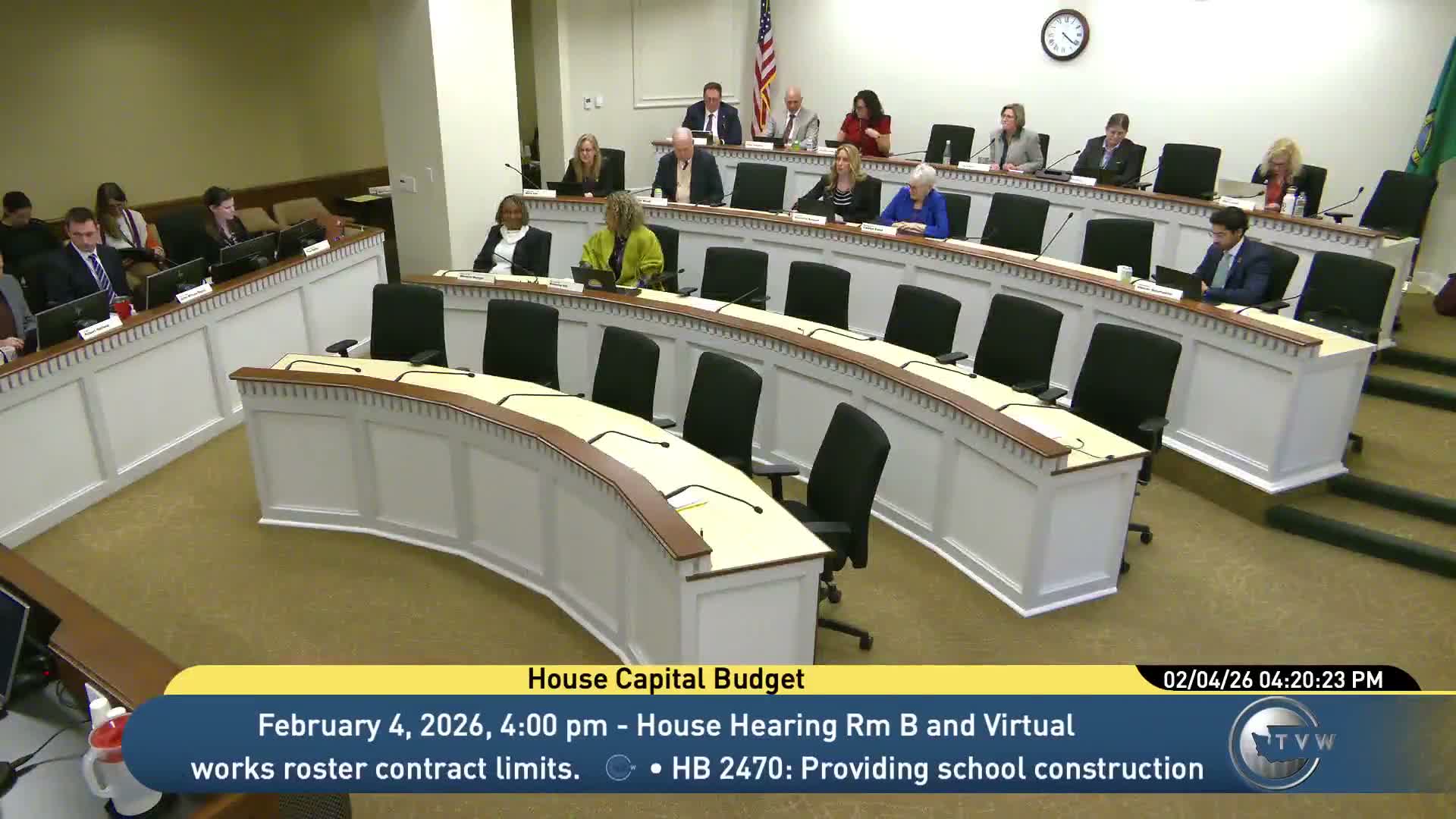
The Capital Budget Committee heard testimony Tuesday on House Bill 2,273, which would require the State Building Code Council to adopt rules reducing embodied carbon emissions in new construction, additions and renovations of 100,000 square feet or larger, excluding school-district projects.
Staff told the committee that embodied carbon is the greenhouse‑gas emissions associated with production and manufacture of building materials and that the bill directs the council to implement phased rules — starting with data collection and reporting and followed by incremental code updates — and to report progress beginning Dec. 31, 2028 and every three years thereafter.
Ingrid Lewis, staff to the committee, said the bill establishes a 30% reduction target from a project‑wide baseline for projects permitted under the 2030 state building code and requires design professionals to enter embodied‑carbon data into a public database maintained by the Department of Commerce. Commerce would also conduct random audits of 3% of projects each year, Lewis said.
Representative Durer, the bill sponsor, told members that buildings account for roughly 40% of greenhouse gases and that embodied carbon accounts for a substantial share tied to manufacturing and construction. He argued that accounting for embodied carbon could create tradeoffs that lower overall building costs and encourage innovation in domestic wood and other product markets.
Industry representatives urged caution. Corey Shaw, Executive Director of the Washington Aggregate and Concrete Association, said the bill as drafted — in particular a blanket 30% requirement — could produce unintended consequences: "Some of the materials that it's required for us to meet some of those carbon reductions are very hard to source," he told the committee, arguing that material constraints could drive price increases and project delays. Shaw said his association has submitted proposed amendments and is participating in Commerce working groups studying materials and product category rules.
By contrast, architects and environmental justice advocates urged passage. Chell Anderson, an architect testifying remotely, said her firm routinely uses embodied‑carbon analysis on projects covered by the bill and that reductions have often been cost neutral. Alexandra Johnson of the Duwamish River Community Coalition framed the bill as environmental justice policy that would reduce localized pollution and health disparities in communities disproportionately affected by industrial emissions.
Jeff Pack, representing Washington Citizens Against Unfair Taxes, opposed the bill on affordability grounds and questioned why school projects were exempted.
Staff presented a fiscal note describing capital budget impacts to the Department of Enterprise Services and operating costs to Commerce and Enterprise Services: a one‑time capital cost of about $54,600 in the 2025–27 biennium and operating costs of approximately $940,000 (Commerce) and $23,000 (Enterprise Services) in that biennium, with higher operating estimates in subsequent biennia; Lewis said there was an outstanding revised fiscal note request and an indeterminate capital cost for the University of Washington.
The committee closed the hearing after public testimony and did not take a committee vote at this session. Members asked staff to continue stakeholder conversations and amendments were expected to be circulated before the next scheduled session.