
Committee hears bill to ease childcare staffing rules, require fentanyl‑free licensed spaces
Get AI-powered insights, summaries, and transcripts
Subscribe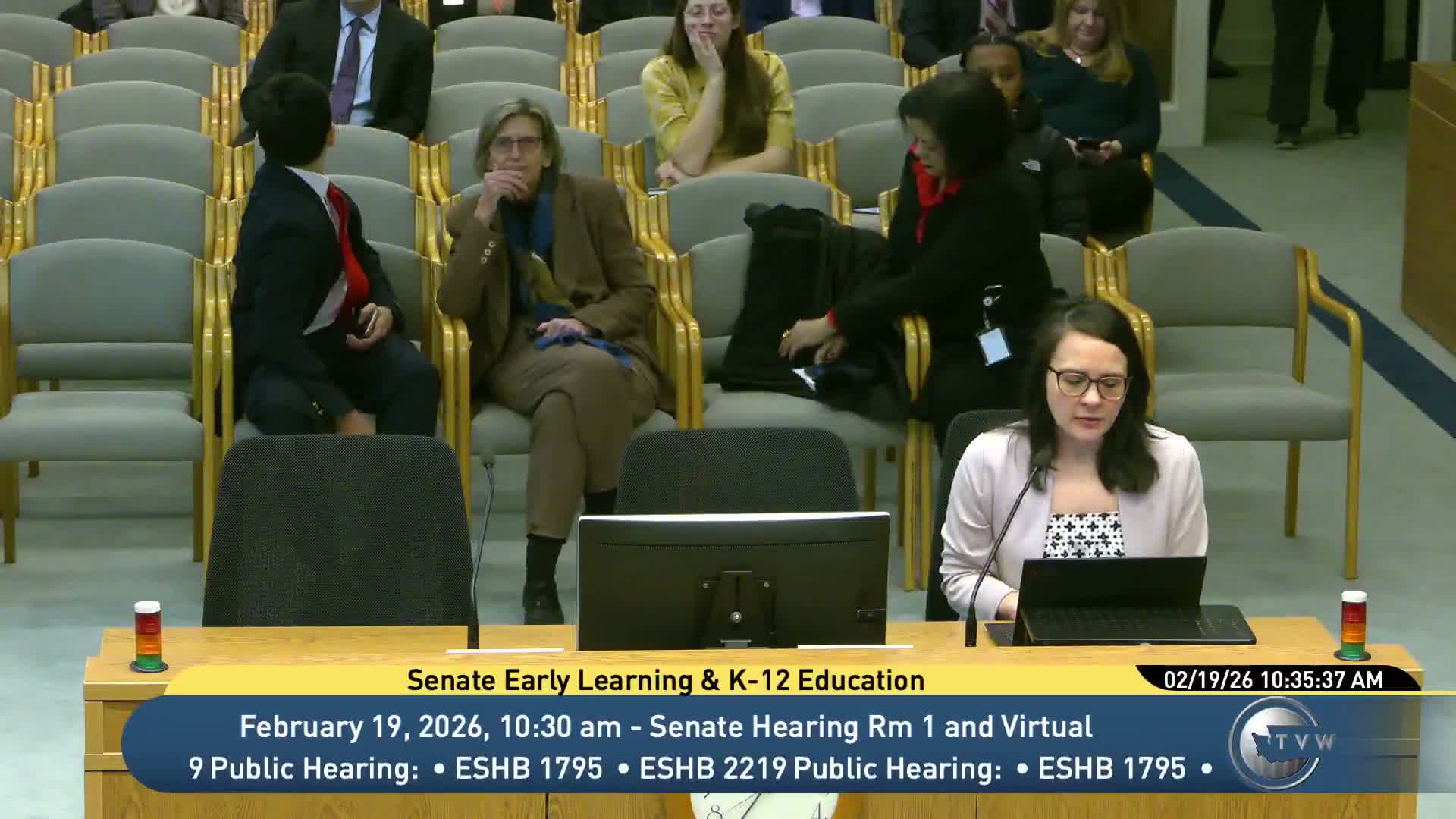
Summary
A bill to let childcare centers extend mixed‑age grouping during staff meal and rest breaks, waive duplicate orientation for recently trained staff, and require licensed spaces be free of fentanyl and paraphernalia was presented to the Early Learning K‑12 Education Committee; advocates and providers said the modest changes would help retention and compliance.
The Early Learning K‑12 Education Committee on Thursday heard Engrossed Substitute House Bill 2219, which would ease certain licensing rules for childcare providers to help staff take legally required meal and rest breaks and reduce duplicative licensing requirements.
Committee staff described three components of the bill. First, licensing rules would allow longer periods during which children of different ages may be combined: up to 2.5 hours per day, or up to 4 hours per day if at least 90 minutes of that time is reserved for meal and rest breaks. Second, the bill would waive a DCYF‑provided orientation requirement for center directors and supervisors who completed the orientation less than five years earlier, provided the orientation content has not substantially changed and the person has not had a break in service. Third, licensing standards would be revised to include a zero‑tolerance policy for “imminent physical harm” tied to the presence of high‑potency synthetic opioids; the bill expressly requires licensed premises to be free of high‑potency synthetic opioids, fentanyl residue and drug paraphernalia, according to committee staff.
"We have childcare deserts all over our state right now," Representative Ortiz Self, sponsor, said in opening comments, arguing the measure would make it easier for providers to retain staff and comply with labor laws by allowing predictable breaks. "They came to us and said this will make a difference if we can make some of our ratios, so our providers can take a lunch break," Ortiz Self said.
Advocates and providers who testified said the changes are modest but meaningful. "This bill came out of the House with a 95 to 1, nearly unanimous bipartisan vote," said Alex Galliano of the Children's Campaign Fund Action, urging committee support. A West Seattle childcare director who testified said his center serves about 160 children and that expanded mixed‑age periods with at least 90 minutes reserved for breaks would allow staff to take legally required meal and rest breaks while keeping children safe.
Committee staff said a fiscal note is available and that DCYF estimates no fiscal impact. The chair closed the hearing on HB 2219 and moved on to consider Engrossed Substitute House Bill 17‑95 on restraint and isolation in public education.
The committee did not take final action on HB 2219 at this hearing; staff said the bills that had been delayed were expected to be rescheduled and that paperwork was anticipated soon.