Get Full Government Meeting Transcripts, Videos, & Alerts Forever!
Get email alerts on the Pollution Control Appeals topic
No spam. Unsubscribe anytime.
Bill would let parties consent to smaller Pollution Control Hearings Board panels to speed appeals
Summary
House Bill 2,426 would allow permit appeals to the Pollution Control Hearings Board to be handled by alternative, smaller panels or a qualified administrative law judge with party consent and unanimous board approval; sponsors say the change targets less controversial cases and carries no fiscal impact in the current draft.
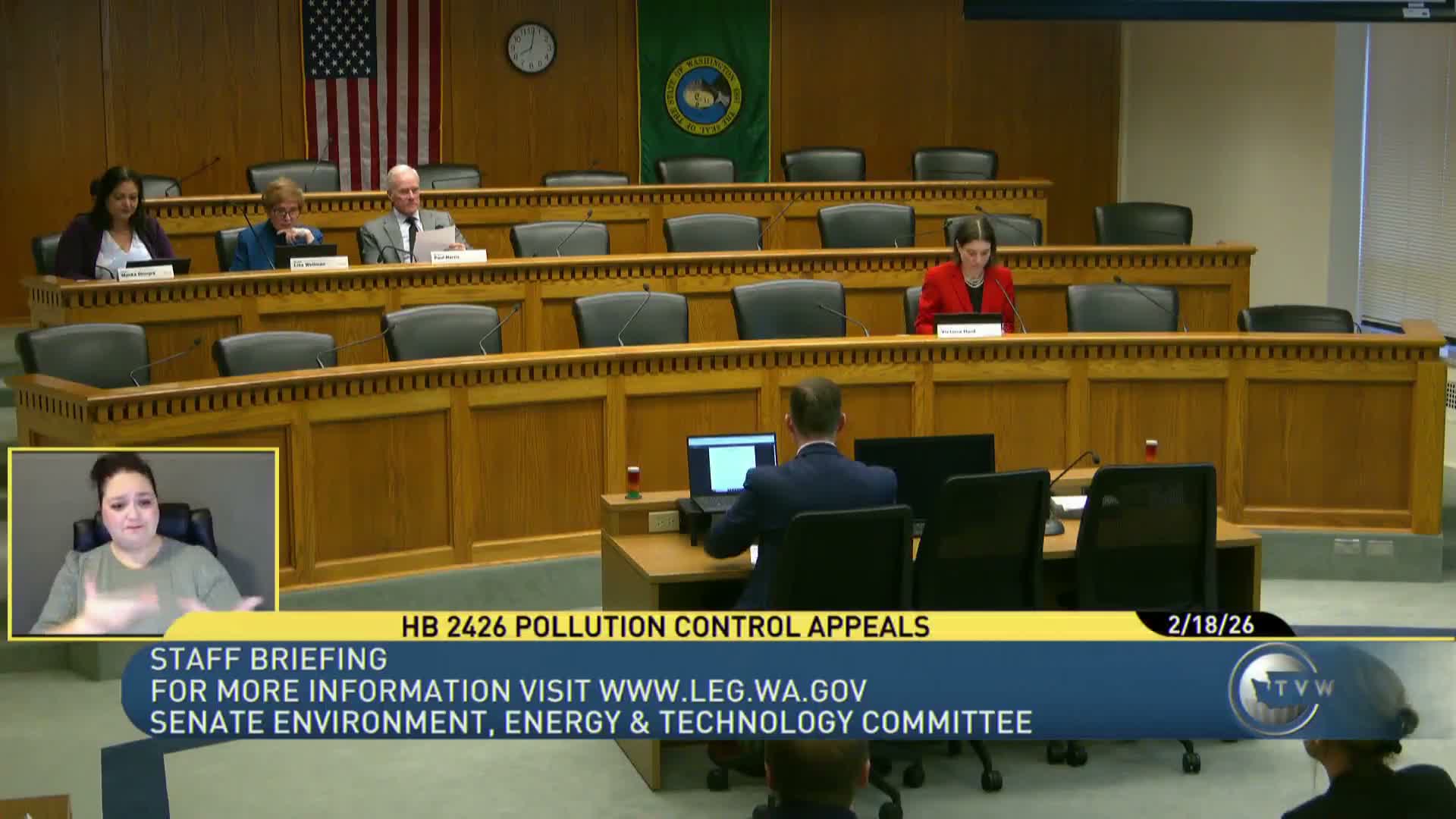
House Bill 2,426, presented to the Senate Environment, Energy and Technology Committee, would give parties and the Pollution Control Hearings Board (PCHB) the option to use alternative panel compositions to hear permit appeals in order to reduce delays.
Committee staff summarized the bill as permitting an administrative law judge, a single qualified board member, or a mixed composition drawn from the PCHB, Growth Management Hearings Board, or Shoreline Hearings Board to hear certain appeals "if all parties consent and the Board unanimously approves," with priority language to "efficient use of administrative resources." Staff said the fiscal note on the current version shows no fiscal impact.
Representative Birnbaum, sponsor of the bill, said the measure arose from stakeholder negotiations including conservation groups and the Grays Harbor business community and is designed mainly for smaller or less controversial permit appeals that now can take about a year to reach hearing. "If you have a small permit, it could be heard by one board member, and it should meaningfully speed up the process," Birnbaum said.
Supporters at the public hearing argued the approach preserves full‑board capacity for complex cases while shortening timelines for simpler matters. FutureWise and local economic development groups testified in support; industry and conservation representatives were listed among those who helped negotiate the bill. Opponents did not press for substantive changes during the committee hearing but committee members asked about the bill's scope and parallels to other hearings processes.
The committee set aside the bill for further consideration after the hearing.