
Senate committee hears victims urge mandatory DOC supervision for stalking convictions
Get AI-powered insights, summaries, and transcripts
Subscribe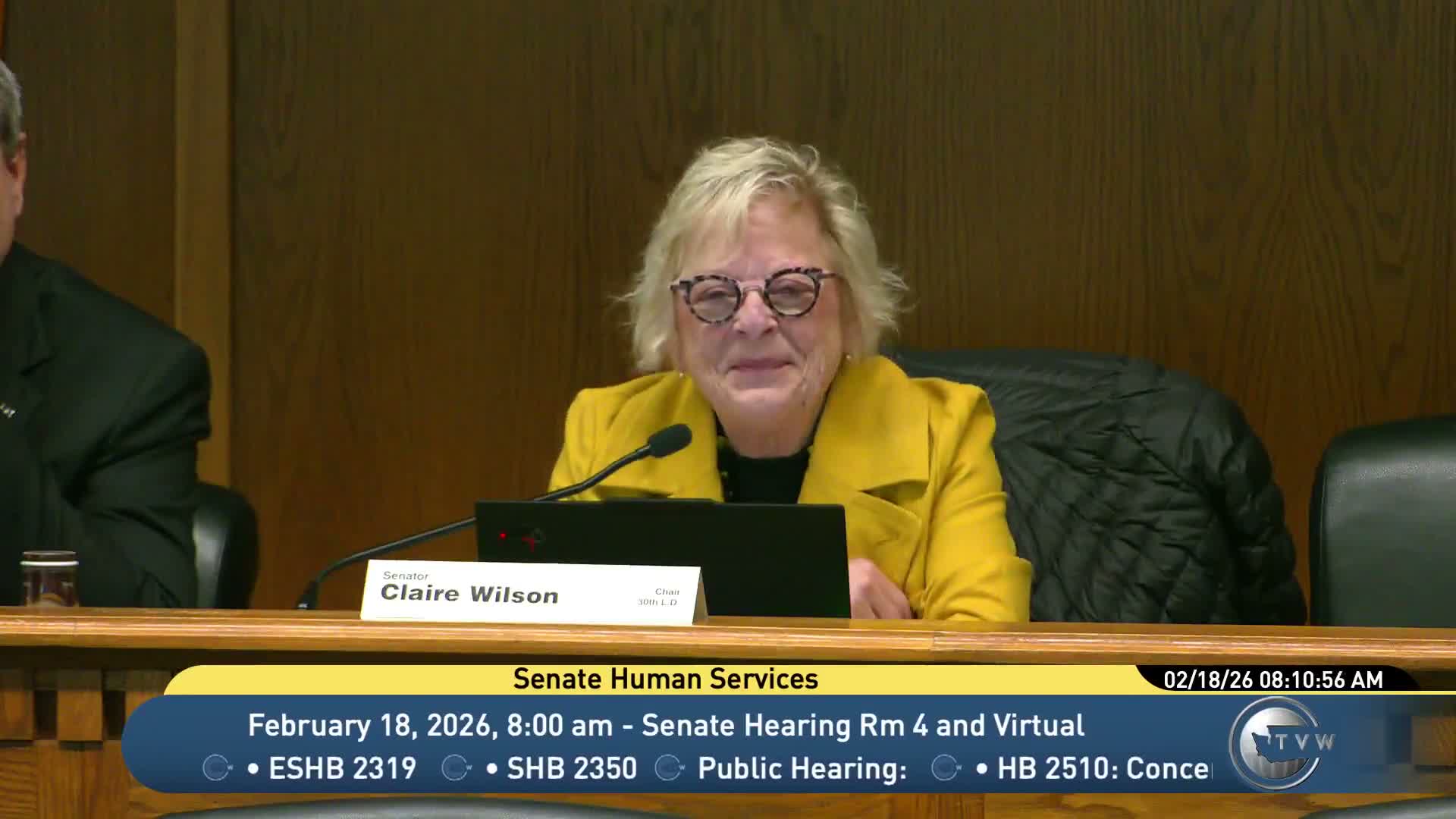
Summary
Witnesses and the bill sponsor told the Senate Human Services Committee HB 2510 would close a supervision gap by requiring the Department of Corrections to supervise anyone sentenced to community custody for stalking, regardless of how the case proceeded, arguing the change improves victim safety.
Representative Brian Burnett introduced House Bill 2510 to the Senate Human Services Committee on Feb. 18, saying the measure requires the Department of Corrections to supervise any person sentenced to community custody after a stalking conviction, regardless of risk classification or whether the case was diverted through mental-health pathways.
The bill was briefed by committee staff, who noted the House passed the measure 96–0 and that caseload-forecast counsel and DOC estimate minimal fiscal impact for newly supervised individuals. Burnett framed the bill as a victim-safety proposal informed by his law-enforcement background: "This bill will save lives," he said, urging the committee to close a procedural gap that can leave survivors unprotected.
Survivors and victim advocates formed two panels of testimony. Chris Bonnington, a victim advocate, said stalking convictions are relatively rare but high risk and cited 34 felony stalking convictions in 2024 to show the crime’s seriousness. He described a case in which a survivor who cooperated with police was later murdered, saying the bill is "accountability" rather than further punishment.
Linden Rhodes detailed a case where diversion to mental-health court removed a criminal conviction that would have otherwise triggered DOC supervision, leaving her family exposed after the offender resumed fixation and threats. "Stalking is stalking," Rhodes said, urging the committee to prevent safety from depending on procedural technicalities.
Other survivors recounted long-term harassment, property damage, doxxing, and physical threats. Cheyenne Ross described two years of escalating stalking that included threatened violence and social-media harassment; Desiree Doane recounted an attack at her workplace involving a crowbar and a knife that law enforcement interrupted. Anna Nasset, an instructor at the Washington State Criminal Justice Training Center who testified from out of state, described a case that resulted in aggravated stalking and cyberstalking convictions and a 10-year sentence, arguing the bill gives families "at least one step of protections."
Committee members asked whether the bill mandates specific technology such as electronic monitoring; Rep. Burnett said it does not prescribe tools but that supervision orders could include monitoring as ordered. Staff clarified the difference between this bill and other stalking proposals: HB 2510 applies when a person is sentenced to community custody and thus falls under DOC supervision, whereas prior measures attempted broader triggers.
The hearing closed after survivor panels; there was no committee vote recorded during the session. The next procedural step was not announced during the adjournment of the Feb. 18 meeting.