
House committee hears bill to create statewide wildlife‑connectivity strategy, accounts for crossings
Get AI-powered insights, summaries, and transcripts
Subscribe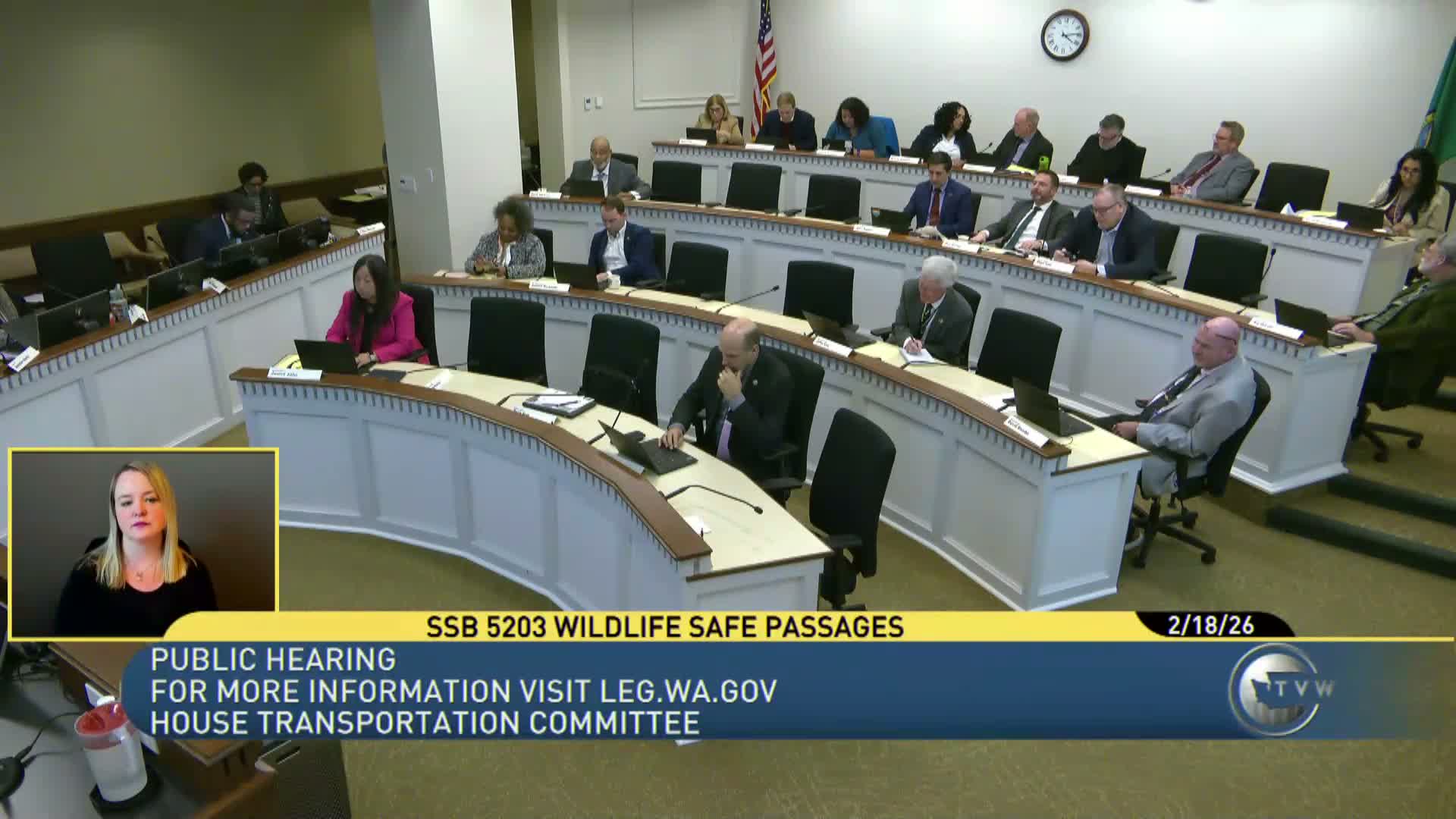
Summary
The House Transportation Committee heard ESSB 5203, which would require WSDOT and WDFW to develop an integrated wildlife habitat connectivity strategy, create two dedicated accounts for corridors and crossings, and report to the legislature by Dec. 1, 2026; testimony ranged from conservation groups urging passage to rural landowners and local officials raising concerns about outreach and cost.
The House Transportation Committee took testimony Feb. 18 on ESSB 5203, a bill that would direct the Washington State Department of Transportation and the Department of Fish and Wildlife to develop an integrated wildlife habitat connectivity strategy and create two accounts to fund wildlife corridors and highway crossings.
Committee staff David Meneke told members the measure would formalize coordination between WSDOT and WDFW, require consultation with tribal governments and federal agencies, establish objectives for prioritizing projects and oversight, and require reporting to the legislature and governor by Dec. 1, 2026 and biennially thereafter. Meneke said the bill is intended to implement the Washington Habitat Connectivity Action Plan.
Sponsor Sen. Sarah Solomon said the bill would bring “More animals, more hunting, and more safety,” and emphasized the scale of the problem: she cited roughly $74 million spent annually on vehicle repairs and injury when deer and elk collide with cars and argued that targeted fencing and overpasses or underpasses reduce collisions and preserve genetic diversity.
Supporters from conservation and industry groups said implementation would leverage federal and private matches. Dan Wilson of Backcountry Hunters & Anglers told the committee the state already has data and interagency collaboration and needs an implementation pathway, while Morgan Carlson of WDFW said the action plan identifies priority locations and that making those priorities actionable will improve competitiveness for federal grants.
Opponents and skeptical testifiers raised two recurring concerns: outreach to local landowners and counties, and cost. Mike Norden of the Pacific Conservation District said Southwest Washington landowners and local governments had not been adequately engaged and described the bill as a "poor use of state funds" given budget constraints. Pacific County Commissioner Lisa Olsen said her county had not been consulted and opposed the measure. WSDOT and WDFW witnesses said priority corridors emerge from mapped data in the action plan and offered to follow up with feasibility studies, cost estimates and maps to address local questions.
Staff described a modest operating cost for WDFW — roughly $61,000 per fiscal year to coordinate and update the action plan — and said project implementation would be subject to legislative appropriation. Agency staff also noted federal grant programs, including the wildlife‑crossings pilot and several large transportation grant programs, can be used to finance crossings when projects are competitive.
The committee closed public testimony after a mix of scientific, industry and local perspectives. No formal action or vote was recorded during the hearing; sponsors and staff said they would follow up with members on maps, corridor selection and possible amendments to address stakeholder concerns.
The committee is expected to caucus and consider next steps following the scheduling process.