Senate committee clarifies sewer rules so rural counties can use large on‑site systems for middle housing
Loading...
Summary
A bill before the Senate Housing Committee would clarify that middle housing in rural counties may rely on large on‑site sewage systems (3,500–100,000 gpd), while nonrural counties must use public sanitary sewers; sponsor and planners said the change provides certainty for county comp plans.
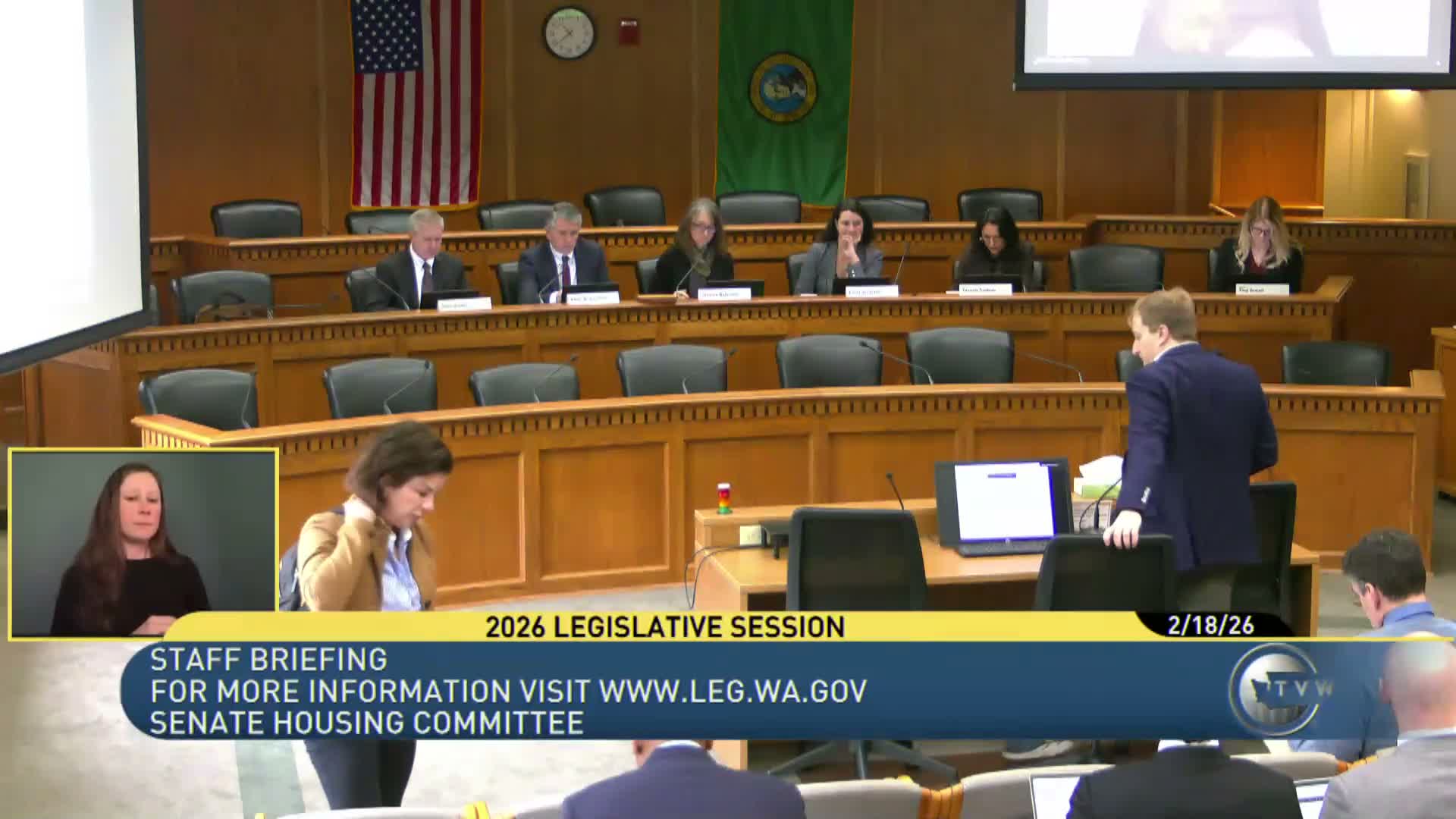
The Senate Housing Committee on Feb. 18 heard Substitute House Bill 2269, which clarifies whether 'existing sewer systems' can include large on‑site sewage systems for middle‑housing developments in rural unincorporated areas.
Staff told the committee the Growth Management Act framework limits middle housing and that counties can authorize middle housing such as duplexes and townhouses with a cap on units per lot; SHB 2269 would explicitly allow middle housing and limited areas of more intensive rural development (LAMIRD/Lammers) in rural counties to be served by publicly owned sanitary sewers or by large on‑site sewage systems. Staff defined "large on‑site sewage system" as flows between 3,500 and 100,000 gallons per day.
Sponsor Representative Birnbaum said the language clarifies an ambiguity left after last session's middle‑housing bill. "In this bill, we clarify that you can build on a large on‑site septic system that's that 3,500 units or greater," he said, adding that planners have asked for certainty about which systems qualify. Committee members queried whether the bill effectively requires a 3,500 gpd system and whether developers would be expected to install large systems or use existing infrastructure.
Supporters from county planning directors, Futurewise, and housing advocates testified that the bill balances rural flexibility with regulatory oversight. Futurewise and county planners noted that large on‑site systems are regulated and can support multiple units and even small commercial uses in remote areas.
The committee closed public testimony on the bill after several proponent witnesses and moved the bill forward with a due‑pass recommendation during the day's business. Sponsors said the change is a narrow technical clarification intended to help counties plan and finance infrastructure for middle‑housing in appropriate rural locations.
What happens next: SHB 2269 will continue through the Senate process with the committee’s recommendation; planners and local governments may need to address permitting and financing pathways for large on‑site systems.