Committee hears support and implementation questions for required community custody in unlawful firearm-possession cases
Loading...
Summary
2ESSB 52 68 would require one year of community custody for any unlawful possession of a firearm, removing the current gang-member requirement; supporters said supervision aids reentry while the Sentencing Guidelines Commission urged more individualized application to avoid over-supervision.
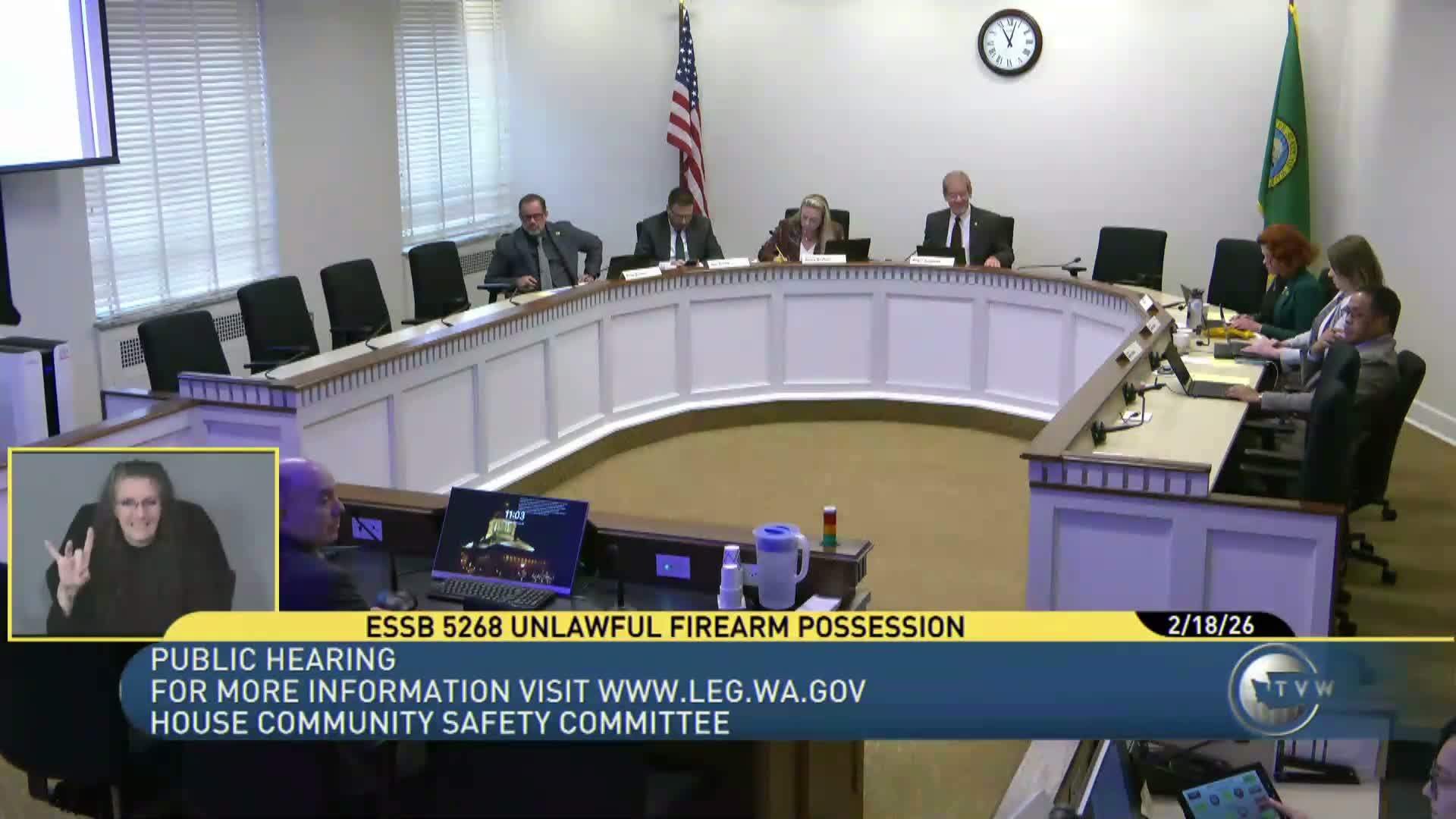
Committee staff briefed members on 2ESSB 52 68, which would require courts to impose one year of community custody when sentencing persons for offenses involving unlawful possession of a firearm, regardless of gang affiliation. Staff noted the bill extends current mandatory supervision previously tied to gang-related offenses.
Sponsor Sen. Keith Wagner described the bill as a response to prosecution and backlog issues and said community custody provides reentry supports and accountability. James McMahon (Association of Sheriffs and Police Chiefs) and Russell Brown (Washington Association of Prosecuting Attorneys) testified in support; McMahon asked the legislature to consider an amendment to ensure Department of Corrections (DOC) actually provides the ordered supervision, citing a "magic statute" (RCW 9.94A.0501) that can allow DOC to screen out and not deliver supervision.
Carrie Ann Yesler, coordinator for the Sentencing Guidelines Commission, supported change in principle but recommended greater specificity—she said unlawful-possession offenses can be tied to low-level, nonviolent offenses and that blanket supervision risks over-supervising people for whom supervision causes more harm than benefit.
Members questioned whether the state has resources to implement additional supervision; witnesses pointed to underfunding and workload studies that showed heavy caseloads in DOC supervision and urged legislative funding and prioritization. The committee closed the public hearing and scheduled executive action for the next day.
Ending: No votes were taken; the committee will consider amendments and resource questions during executive action.