
Senate Government Committee advances package of bills on precinct appointments, permit delays, utilities and homeowner protections
Get AI-powered insights, summaries, and transcripts
Subscribe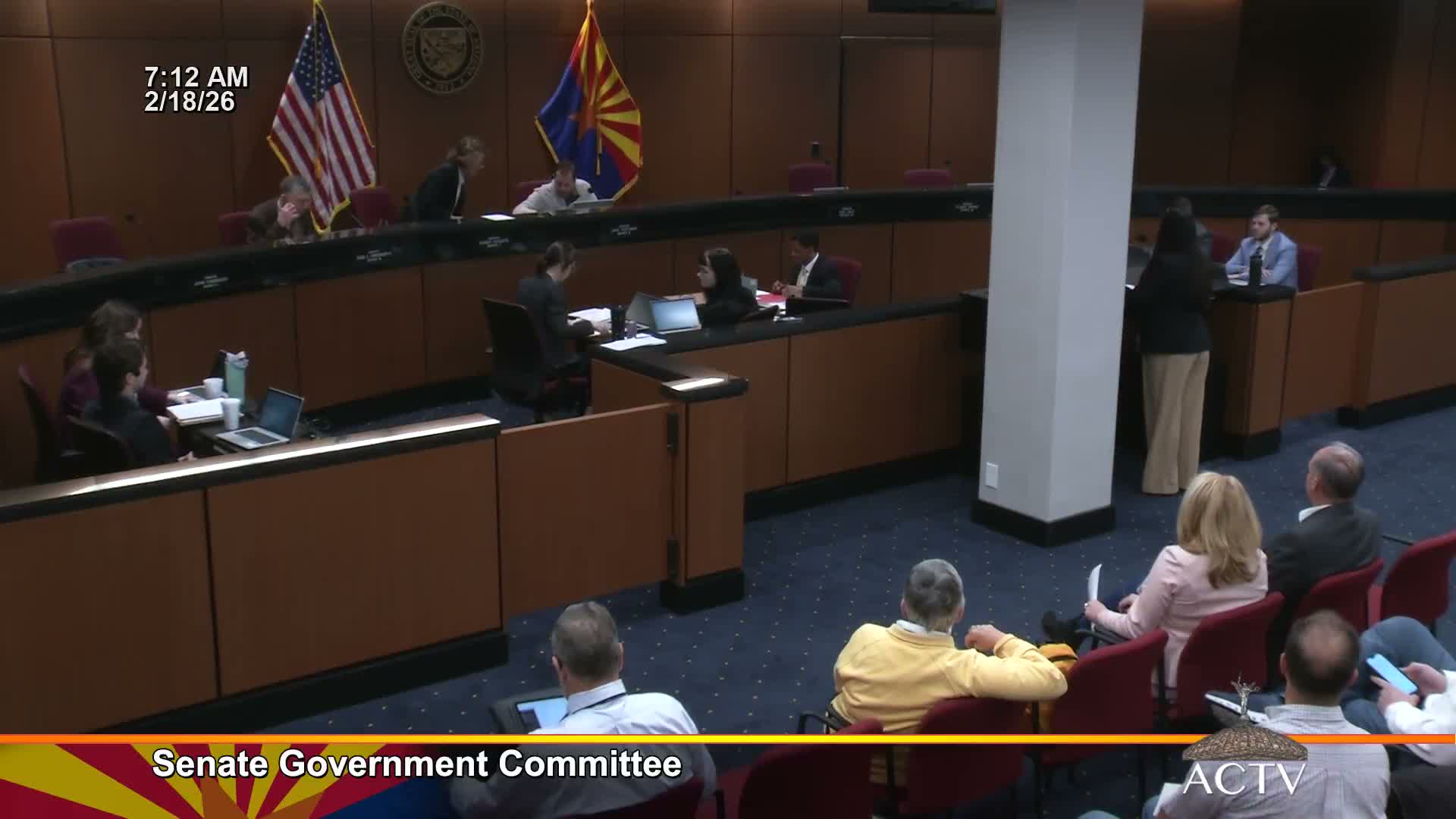
Summary
The Senate Government Committee on Feb. 17 advanced multiple measures, including SB 18‑25 to let legislative district chairs submit precinct committee vacancy lists, SB 15‑66 (malicious delay) to penalize deliberate permit slowdowns, SB 15‑71 limiting monopoly utilities’ ability to pass marketing costs to ratepayers, and changes to HOA foreclosure thresholds; all received 'due pass' recommendations after testimony and amendments.
The Arizona Senate Committee on Government advanced a slate of measures on Feb. 17 that would change how parties fill precinct committee vacancies, create a civil remedy for malicious permitting delays, restrict monopoly utilities from passing certain marketing costs to ratepayers, and raise foreclosure thresholds for condominium and homeowners associations.
Senate Bill 18‑25, sponsored by Senator Farnsworth, would allow legislative district chairs in specified cases to submit lists of nominees for precinct committee vacancies directly to county boards of supervisors instead of routing through county party chairs. "This bill will streamline things," Farnsworth said, noting recruiting and appointment delays he saw as an LD chair. Multiple LD chairs and precinct captains testified in support, arguing the change would keep decision‑making closer to voters; Jacob Emnet of the County Supervisors Association asked the sponsor to adjust the bill’s five‑day timeline for boards to act because many boards meet biweekly.
The committee moved SB 18‑25 and gave it a due‑pass recommendation after discussion and testimony. Staff cited section 16.823 of Arizona law when describing existing LD committee structures referenced by supporters.
Senate Bill 15‑66, introduced by President Peterson and amended in committee, would prohibit municipalities, counties or state agencies from "maliciously" delaying responses to license or permit applications and allow the attorney general to seek enforcement, including a $5,000 civil penalty per violation. Peterson described the measure as adding an accountability remedy at a "very high" standard: "Malicious is the highest standard that there is," he said. The committee approved a Hoffman amendment narrowing the city provision to statutory time frames for single‑family residential construction and clarifying that certificate‑of‑occupancy authority is unaffected; the amended bill received a due‑pass recommendation.
SB 15‑71 (as amended) targets monopoly utilities with defined customer bases and would bar passing marketing, sponsorship, advertising and similar community‑relations costs to captive customers while requiring annual public reports and attestations about those expenses. Supporters argued ratepayers should not underwrite promotional spending when a utility cannot acquire new customers; opponents — including representatives of small, nonprofit rural utilities — warned the language as written could sweep in legitimate customer‑education or emergency communications. The committee adopted a strike‑everything amendment and gave the bill a due‑pass recommendation as amended.
The committee also advanced consumer‑protection and transparency items. SB 18‑05 would require county recorders to verify an appearing notary’s active commission in the Secretary of State’s notary database before recording quitclaim deeds and to reject documents notarized by inactive notaries; recorders could refer suspected fraud to county attorneys. SB 15‑01 would expand the Administrative Rules Oversight Committee’s scope to review whether agency rules exceed statutory authority.
On housing‑adjacent measures, SB 12‑46 (as amended) raises the delinquency floor that can trigger a COA/HOA foreclosure from $1,200 to $10,000 and extends the delinquency period from 12 months to 18 months for certain liens and special assessments; the amendment preserved existing statutory account‑statement requirements and an exemption for associations with fewer than 50 units. Dennis Legere of the Arizona Homeowners Coalition recounted cases in which homeowners faced large, allegedly unlawful special assessments; other stakeholders including Community Association Institute counsel raised concerns about the 18‑month special‑assessment limit for condominiums and potential impacts on emergency repairs.
The committee also approved SB 16‑88 (disclosure of membership association dues paid with public funds), several governance bills including SB 14‑28 (which would increase the size of county boards for large counties), and SCR 10‑23 (a constitutional referral to expand the Independent Redistricting Commission from five to nine members and tighten population deviation rules). Senator Mesnard argued the measures would spread representation and reduce concentrated power on county boards and the IRC; some members raised concerns about cost and Voting Rights Act implications for a fixed 5,000‑person deviation threshold.
Votes at a glance (committee action and reported roll calls): - SB 18‑25 (precinct committee nominations): due pass recommendation (committee recorded 5 ayes, 0 nays, 2 not voting). - SB 15‑66 (malicious delay; amended): due pass recommendation (committee recorded 3 ayes, 2 nays, 0 not voting as recorded in committee transcript). - SB 15‑71 (monopoly utility marketing/pass‑throughs; amended): due pass recommendation (committee recorded 4 ayes, 2 nays, 1 not voting). - SB 15‑01 (administrative rules oversight expansion): due pass recommendation (committee recorded 4 ayes, 2 nays, 1 not voting). - SB 18‑05 (notary verification for quitclaim deeds): due pass recommendation (committee recorded 4 ayes, 2 nays, 1 not voting). - SB 18‑08 (HOA flags for allied nations; amended): due pass recommendation (committee recorded 5 ayes, 1 nay, 1 not voting). - SB 16‑88 (membership association disclosure; amended): due pass recommendation (committee recorded 5 ayes, 1 nay, 1 not voting). - SB 12‑46 (COA/HOA foreclosure/account statements; amended): due pass recommendation (committee recorded 6 ayes, 0 nays, 1 not voting). - SB 14‑28 (increase county supervisors for large counties): due pass recommendation (committee reported 5 ayes, 1 recorded alternative vote, 1 not voting as noted in the transcript). - SCR 10‑23 (IRC expansion to 9 members, constitutional referral): due pass recommendation (committee recorded 4 ayes, 2 nays, 1 not voting). - SB 16‑45 / SB 16‑46 (auditor performance audits; designated survivor): both received due pass recommendations. - SB 13‑38 (public benefit eligibility amendment; amended): due pass recommendation (committee recorded 4 ayes, 2 nays, 1 not voting).
What’s next: measures that received a "due pass" recommendation will go to the Senate floor for further consideration; sponsors and stakeholders flagged technical fixes and drafting clarifications (for example the five‑day deadline in SB 18‑25 and carve‑outs for emergency or educational communications in the utility bill) that committee members asked to resolve before floor action.
Reporting notes: this article quotes committee members and witnesses verbatim from the committee transcript. Vote tallies and roll‑call statements are reported as recorded in the committee transcript and in committee statements; where transcript wording was ambiguous the article reflects the committee’s stated outcome ("due pass recommendation"). The committee adjourned and will reconvene the following day at the posted time to consider a remaining resolution.