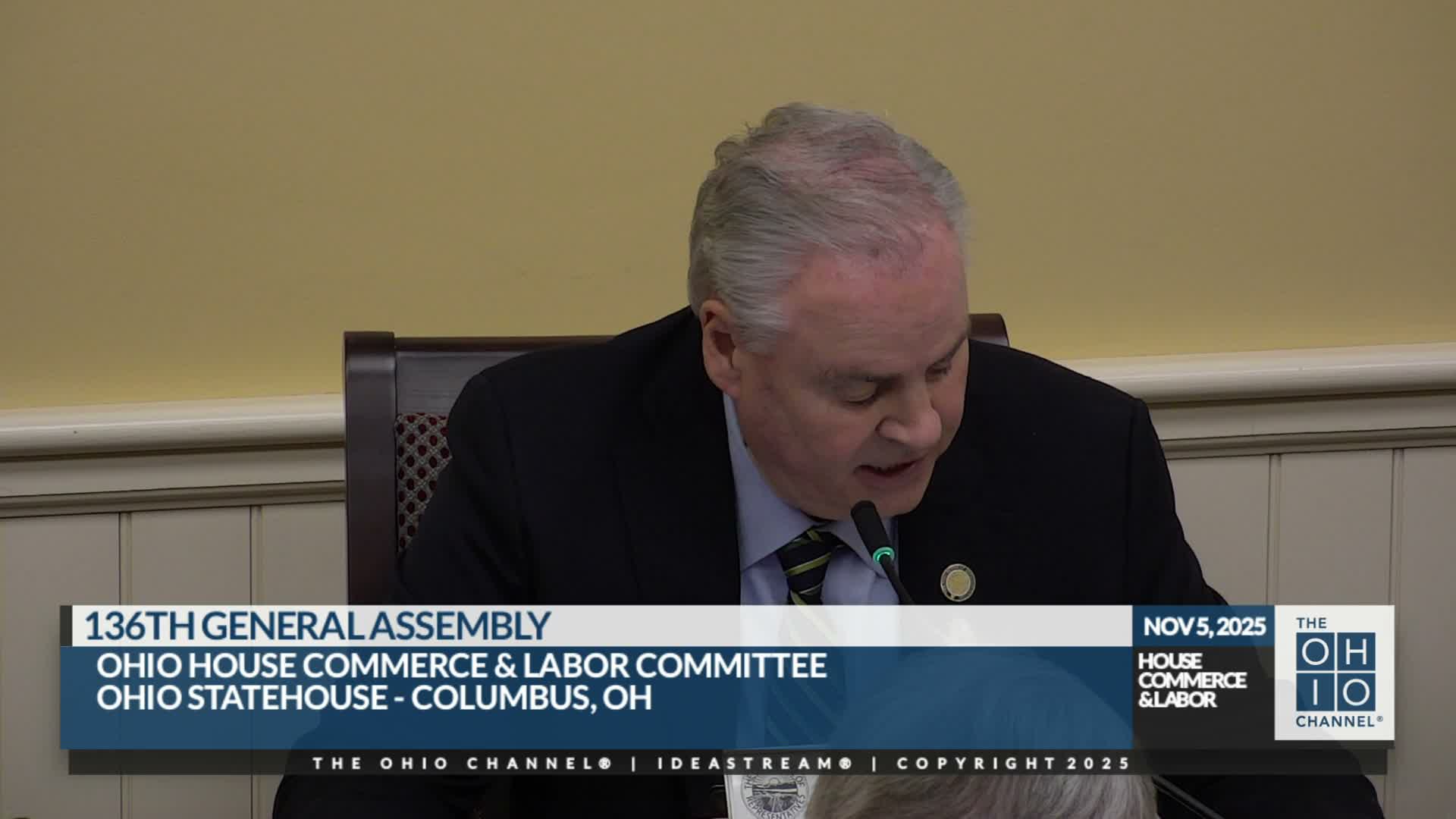
House committee advances measure asking Congress to loosen teen work-hour limits; advocates warn of educational and safety risks
Loading...
Summary
The House Commerce and Labor Committee voted to favorably report Senate Concurrent Resolution 3 and Senate Bill 50, which would ask Congress to change federal limits allowing 14- and 15-year-olds to work later on school nights. Child-advocacy groups and worker centers told the committee the change risks students' education, safety and increased exploitation.
The House Commerce and Labor Committee voted to favorably report Senate Concurrent Resolution 3 and Senate Bill 50 after testimony and debate that split advocates and some members.
Advocates for children urged the committee to reject the bills, saying they would allow 14- and 15-year-olds to work later on school nights and could harm educational outcomes. "Put very simply, children should not have to be the solution to adult problems," Brianna Booker, a policy associate with the Children's Defense Fund of Ohio, told the committee in opposition to SCR 3 and SB 50.
Heather Smith, a researcher with Policy Matters Ohio, said SB 50 would permit employers to schedule 14- and 15-year-olds as late as 9 p.m. on school nights and could undermine the protections in the federal Fair Labor Standards Act. "It's never worth compromising kids' education or safety to boost employer profits," Smith said, citing Department of Labor enforcement actions and fines in Ohio.
Isabel Alvarado, a case manager for the Central Ohio Worker Center, described client cases involving wage theft and child-labor violations under current law and warned that extending allowed hours would increase vulnerability and enforcement challenges. Alvarado told the committee Ohio's Department of Commerce Wage and Hour Division has only a handful of investigators statewide and said weaker state limits would make violations harder to detect and stop.
Committee members questioned witnesses about whether parents were seeking the change, whether the proposal could displace adult workers and whether the bills include whistleblower or other safeguards. Witnesses and several members said the bills do not include whistleblower protections and that any change that conflicts with federal law would create confusion for employers and enforcement bodies.
Sponsor and committee discussion noted that the concurrent resolution asks Congress to change the Fair Labor Standards Act, and several members said such a federal change would be unlikely in the current Congress. Vice Chair Lear moved to favorably report SCR 3; the clerk recorded the roll call and the committee reported the concurrent resolution out of committee.
Vice Chair Lier later moved to favorably report SB 50 and the committee voted to report the bill out as well.
What happens next: both measures were reported out of committee and may proceed through additional legislative steps. Advocates urged stronger enforcement resources at the state level and named alternatives such as structured youth apprenticeships and supervised work-study programs rather than expanding allowable hours.