Get Full Government Meeting Transcripts, Videos, & Alerts Forever!
Get email alerts on the Legislation topic
No spam. Unsubscribe anytime.
Ohio Senate unanimously passes bills on nurse anesthetists, excavation rules and EV charging; concurs on competency-timeline change
Summary
The Ohio Senate on Feb. 17 unanimously approved measures to modernize nurse-anesthetist practice rules, update excavation and utility-notification law, and regulate EV charging-station ownership. Lawmakers also concurred on amendments to a competency-restoration bill and confirmed gubernatorial appointments.
COLUMBUS — The Ohio Senate on Feb. 17 passed a slate of bipartisan measures aimed at clarifying health-care practice, improving excavation safety and encouraging private investment in electric vehicle infrastructure.
Senators recorded unanimous roll-call approvals for several bills and resolutions during a session that opened with a prayer and a series of ceremonial recognitions for students and community groups.
Senate action on House Bill 52: House Bill 52, described by Senator Huffman as a measure that “simply modernizes and clarifies the language in [the] Revised Code for certified registered nurse anesthetists,” removes an explicit supervisory requirement and replaces it with a collaboration standard. Huffman said the bill “provides a clear clinical framework for CRNAs to care for patients within their full scope of practice” and noted it would authorize CRNAs to perform activities such as epidurals and spinal anesthesia already within their scope. Senator Liston also spoke in support. The Senate approved the bill on a roll call of 32 yays, 0 nays; the clerk recorded “With 32 yays and 0 nays, the bill is passed and entitled.”
Why it matters: Supporters said the change is intended to reflect modern practice and remove outdated supervisory language that limited CRNA autonomy, while requiring notification to patients about who will administer anesthesia.
Substitute House Bill 227: Senator Wilkin urged passage of substitute House Bill 227 as a modernization of Ohio’s excavation and underground utility protection laws. He said the bill strengthens public safety by reinforcing participation in the 811 call system, requiring marking of underground facilities to be completed within two working days (not counting the day of the call), standardizing color codes, requiring documentation of training, and increasing the public availability of damage-reporting data. Senator DeMora backed the bill, calling it “a simple no-brainer.” The Senate passed the measure by roll call; the clerk announced “With 32 yeas and 0 nays, the bill is passed in title.”
Why it matters: Sponsors said the bill clarifies responsibilities for public authorities, developers, contractors and utilities before excavation begins and is intended to reduce utility damage and improve safety.
Substitute Senate Bill 106 (EV charging stations): Senator Reineke described Substitute Senate Bill 106 as legislation to “facilitate the development of a prosperous EV fast-charging infrastructure in Ohio” by creating a predictable regulatory landscape that encourages private investment while guarding against monopolistic control. Senator DeMuro and others expressed support. The bill was approved unanimously; the clerk recorded “With 32 yays and 0 nays, the bill is passed and entitled.”
Why it matters: Backers said clearer rules will help attract private companies to build charging stations across the state, improving access for drivers and supporting the transition to electric vehicles.
Concurrence on amended Senate Bill 295 (competency restoration timelines): The House asked the Senate to concur in amendments to amended Senate Bill 295, which changes timelines for restoration of competency in certain criminal cases. Senator Manning, noting a recent case in Cuyahoga County, urged concurrence and said a one-year restoration window was insufficient in some violent-felony cases; the House amendment shortened an original five-year proposal to three years and sponsors reported local prosecutors had been consulted. The Senate concurred and retained an emergency clause by a recorded vote of 30 ayes, 0 nays, meaning sponsors sought immediate effect.
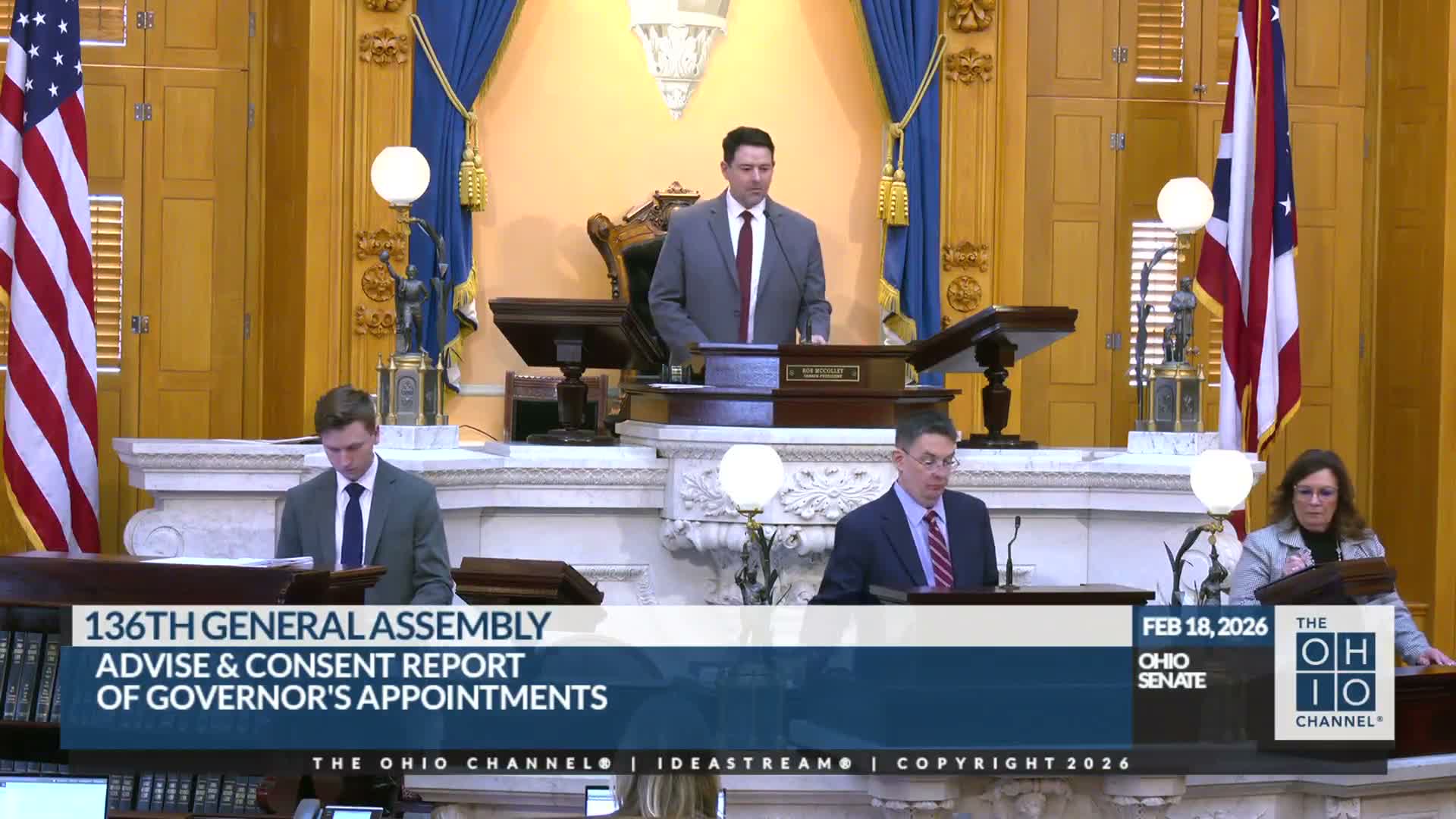
Appointments, resolutions and other business: Earlier in the day the Senate advised and consented to a slate of gubernatorial appointments (recorded as 32 yeas, 0 nays). The chamber also adopted resolutions authorizing youth groups to use the Senate chamber and committee rooms for upcoming events (both adopted by unanimous roll calls). Several ceremonial recognitions and tributes — including Black History Month acknowledgments and awards for schools and student-athletes — punctuated the session.
What’s next: The Senate adjourned and will reconvene Monday, Feb. 23 at 9:30 a.m. Several sponsors said they expect to seek the governor’s signature where applicable; for the competency-restoration bill, sponsors argued the emergency clause was time-sensitive.
Quotes used in this story are taken from the Senate transcript of the Feb. 17 session.