
Findlay committee reviews Heartland Forward dashboard pilot; council questions local control and cost
Get AI-powered insights, summaries, and transcripts
Sign Up Free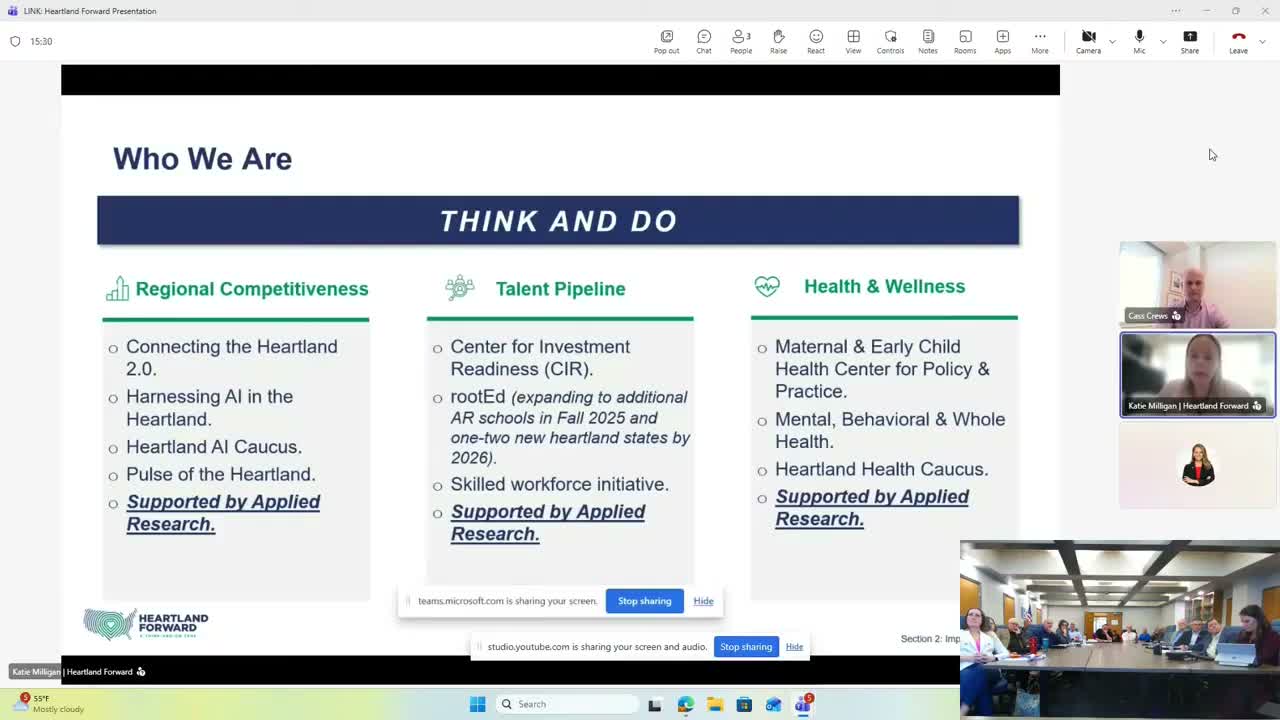
Summary
Findlay City’s Committee of the Whole heard a demonstration from Heartland Forward of a prototype community dashboard to track economic, workforce and quality‑of‑life metrics. Council members asked who will participate in the 10‑week program, how the data are sourced and why the mayor’s office would pay roughly $7,500 for buildout and access.
Findlay City’s Committee of the Whole on Feb. 17 heard a presentation from Heartland Forward on a prototype Center for Investment Readiness (CIR) dashboard intended to give the city live, customizable economic and social metrics and peer benchmarking.
The Heartland Forward presenters described the dashboard as a "one‑stop shop" that pulls live updates from sources such as the Census Bureau, Bureau of Labor Statistics and the Bureau of Economic Analysis, and that it can benchmark Findlay against structurally similar and aspirational peer communities. "As soon as the source updates the data with us … all of those data points in here are then gonna get updated immediately," a Heartland Forward presenter said during the demo.
Council members pressed presenters on how national trends translate to Findlay’s needs, who would participate in the 10‑week CIR engagement and who would pay for the service. Speaker 7 (who identified herself as Nicole in questions) asked how the tool improves outcomes for Findlay residents rather than simply showing national patterns. A presenter replied the CIR process is customized: "We do this 10 week process to kind of go through this data and say, does this also feel like it relates to what you're seeing on the ground?" The demonstration highlighted local figures such as median household income (shown in the demo at roughly $73,000) and a county jobs‑to‑worker ratio the presenters described as about 1.25 jobs per resident who works.
Council members also raised concerns about perceived policy connections. Speaker 4 said, "They did a policy paper as it can do for us on topics that a community requested to provide guidance. Not everything that they do is going to apply for us." He clarified that Heartland Forward is a nonpartisan nonprofit and that separate ‘‘Heartland visa’’ programs are not the organization’s policy offerings.
Several council members asked who would take the 10‑week sessions and how council priorities and constituent requests would be incorporated. Council leadership said the mayor’s office would lead the local CIR engagement and would likely involve members of the strategic planning committee and other council members. On cost, a council member asked whether tax dollars would be used; speakers confirmed the expense would come from the mayor’s office budget and noted the city is already budgeting for it. One council member summarized the outlay referenced in the meeting as about $7,500 to cover access and dashboard buildout.
Presenters demonstrated features intended for local planning and economic development: peer identification (examples shown included Eau Claire and Lewiston, Ohio), sector drilling from broad industry shares to subsectors (the demo showed manufacturing at about 24.1% of private employment in the prototype for Findlay), and custom metrics such as mapped soft‑surface trail miles. Presenters said the dashboard can both surface where the city is performing ahead of peers and expose pockets needing attention, and that the team can produce case studies showing how peer communities moved particular metrics.
No formal motion or vote took place during the Committee of the Whole. Council members agreed to continue the conversation; Speaker 4 said staff would collect council priorities and constituent concerns to feed into the CIR process. The meeting concluded with a note that staff would work to resolve livestream audio and add captions for the public record.