Get Full Government Meeting Transcripts, Videos, & Alerts Forever!
Get email alerts on the School Behavioral Health topic
No spam. Unsubscribe anytime.
Committee hears bill to formalize technical assistance for school behavioral health supports
Summary
Second substitute to HB 16‑34 would direct OSPI and Educational Service Districts to develop a statewide technical assistance and training framework to coordinate behavioral health supports for students. Supporters said schools lack resources; OSPI staff said development could be done with existing collaborations.
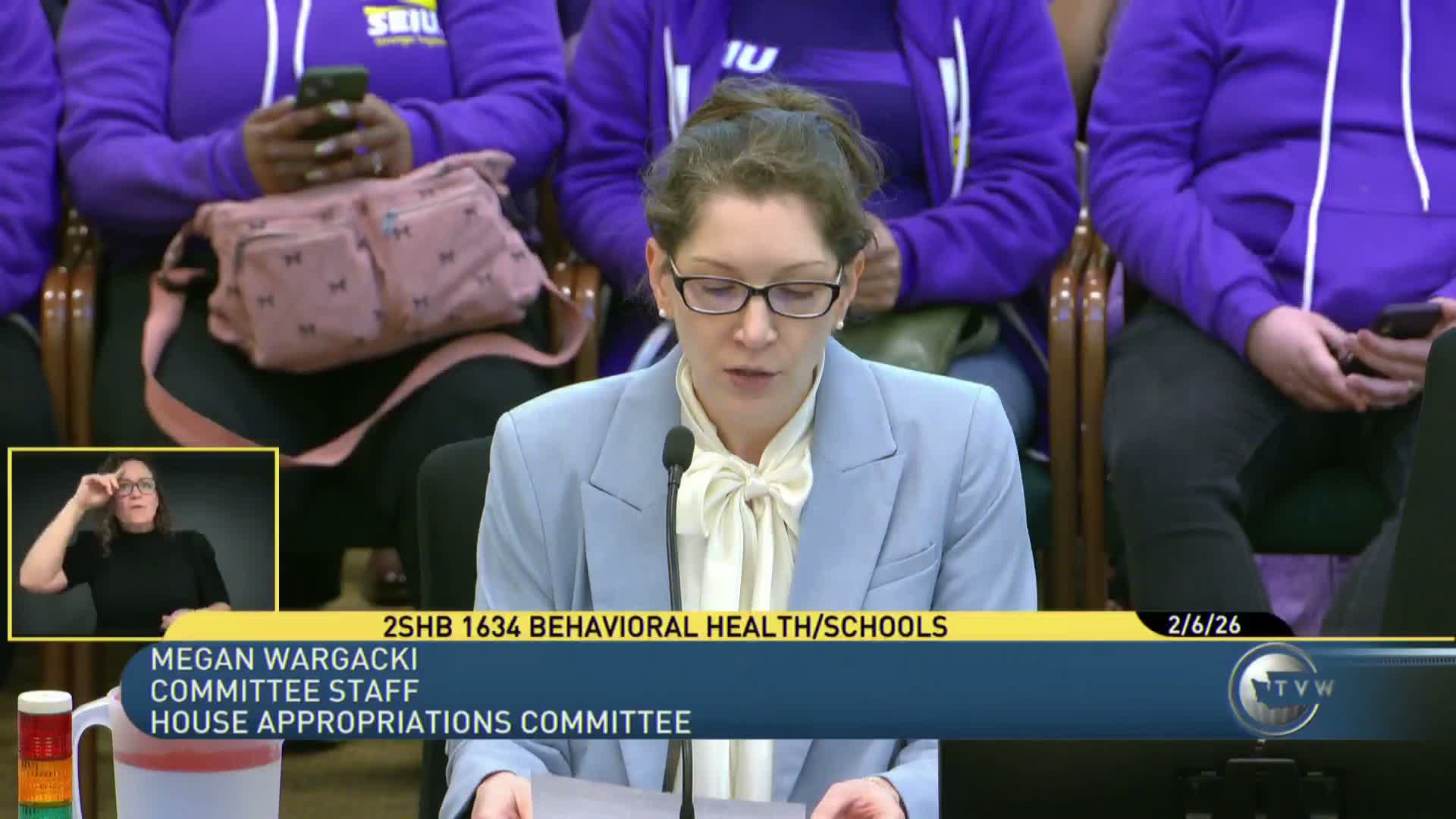
A second substitute to House Bill 16‑34 drew staff briefings and public testimony focused on expanding support for student behavioral health. Committee staff explained the bill requires the Office of the Superintendent of Public Instruction and Educational Service Districts to collaborate with behavioral health agencies and community partners to develop a technical assistance and training (TAT) framework. The framework — to be reported to the Legislature by Nov. 1, 2027 — is intended to reduce duplication, improve early identification and intervention, and increase access to behavioral health prevention and crisis services for students from birth through age 25.
Jordan Clark and Megan Wargacki told the committee OSPI and ESDs currently work with the University of Washington’s collaborative community and behavioral health policy team and that OSPI assumes no fiscal impact to develop the framework in the substitute, though additional funding could be requested after the framework is completed to optimize delivery. The Department of Health noted a small administrative support need of about 0.2 FTE (~$30,000/year) for their role.
Public testimony included school counselors, mental‑health clinicians, and advocacy groups urging passage. Mabel Thackery, a licensed mental‑health counselor working in schools, told lawmakers that rising rates of youth suicidal ideation and anxiety mean schools need consistent expertise and resources. OSPI, through counsel Misha Tranisky, expressed support and noted some elements may be achievable with current grants and partnerships.
Supporters said the bill would scale best practices, including crisis response and school‑based screenings, and cited cost‑benefit evidence for early screening and intervention. No formal committee action was recorded at the hearing; staff and witnesses emphasized coordination and the potential need for future appropriation to fully implement the training and technical assistance network.
The staff briefing and testimony foregrounded the bill’s focus on systems coordination rather than immediate new regulatory mandates.