Get Full Government Meeting Transcripts, Videos, & Alerts Forever!
Get email alerts on the Fiscal Notes And Elections topic
No spam. Unsubscribe anytime.
Secretary of State outlines three‑day fiscal‑note process and election cost drivers
Summary
Secretary of State Steve Hobbs and budget manager Tim Gallivan briefed the committee on the office’s three‑day fiscal‑note process, workload-based FTE calculations, litigation-cost practices and election-related costs — including upgrades for ranked‑choice voting and risks tied to litigation trends.
Secretary of State Steve Hobbs and staff told the State Government Tribal Relations Committee that the office uses a structured, three‑day process to produce fiscal notes and that early engagement with legislators can reduce uncertainty and large, assumption-driven estimates.
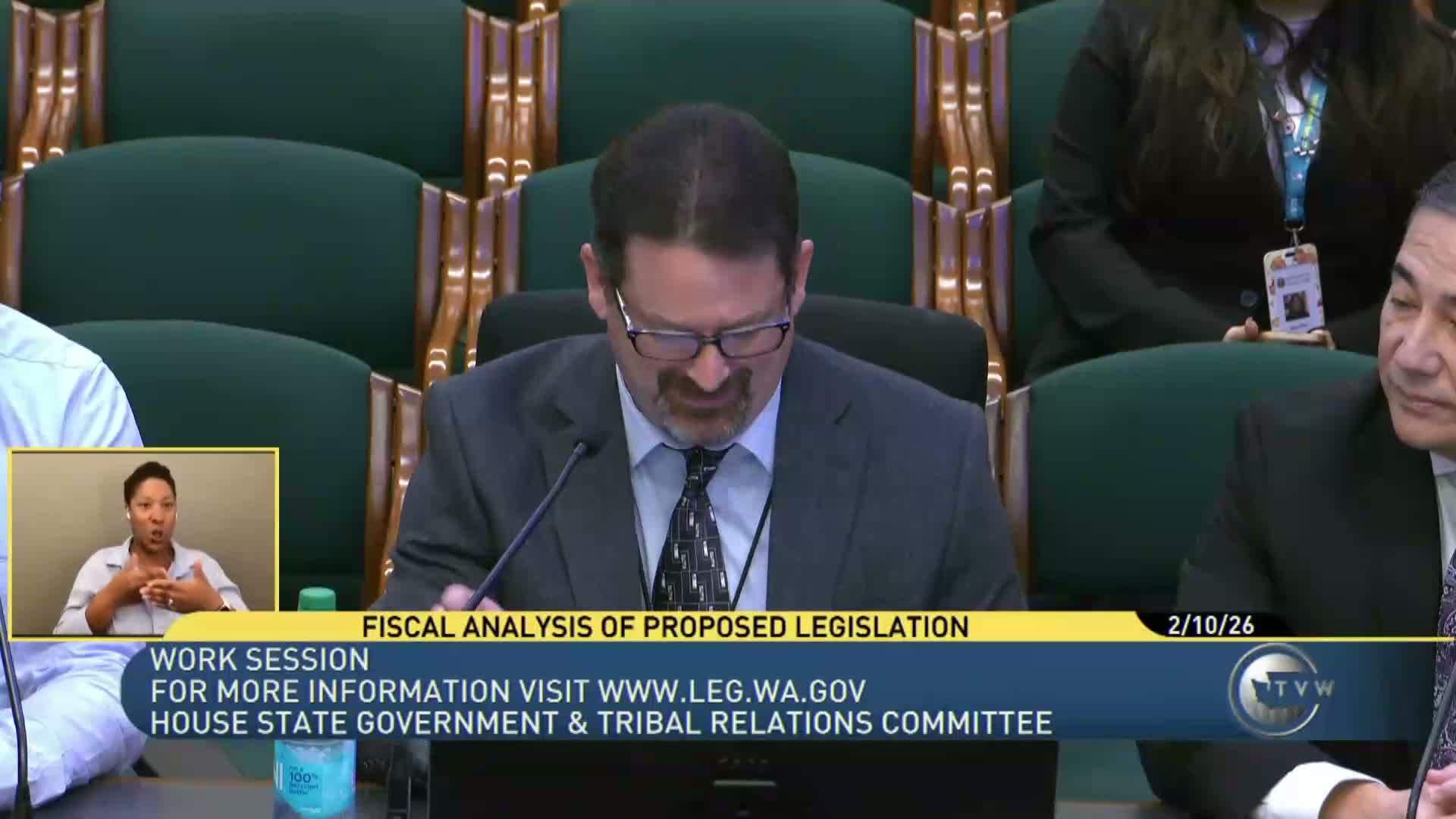
Tim Gallivan, the Secretary of State’s budget and procurement manager, described the central budget office’s workflow: OFM sends a fiscal-note assignment (day 1), subject-matter experts coordinate and build worksheets (day 2), divisional review and submission occur on day 3. Gallivan said the office translates workload into FTE counts, then converts annual hours into fully loaded costs that include salaries and benefits plus a ‘‘backpack’’ of standard goods-and-services (about $28,000 per FTE) and an admin allocation (about 15% of salaries and benefits) to produce consistent and auditable estimates.
Gallivan also explained how litigation costs are estimated in coordination with the Attorney General’s Office. He described three scenarios: concurrent AGO assignments (where AGO costs mirror agency estimates), adding AGO-provided costs after submission, or marking costs ‘indeterminate’ when uncertainty is too broad and documenting the rationale.
Hobbs said his office has had gaps in civic-engagement funding (including tribal outreach) and that fiscal notes are a key tool to ensure new legislative requirements are fundable. He urged members to contact the office early when drafting bills so analysts can align assumptions with legislative intent and avoid mismatches that can increase fiscal estimates.
Committee members pressed the office on perceived variability in fiscal notes across agencies. Representative Walsh said there is a perception that agencies sometimes ‘‘run up’’ fiscal notes for proposals they distrust; Hobbs said differences typically reflect communication gaps and differences in how a bill is interpreted, not intentional bias.
Stuart Holmes, director of elections for the Secretary of State, outlined litigation concerns tied to the Washington Voting Rights Act (House Bill 1750) and said the office accounted for risks such as a shift in legal strategy—e.g., signature‑verification challenges being argued under different statutes in other states. Holmes pointed to litigation developments in Colorado, Mississippi and Louisiana as examples that affect the office’s assumptions about potential future cases.
The committee also discussed ranked‑choice voting (House Bill 2210). Holmes and Gallivan said the office has made election-night reporting upgrades and invested in systems to display ranked‑choice results; Gallivan said the primary cost drivers would be system updates and public‑education efforts. Holmes noted county auditors procure voting systems locally while the state certifies equipment for use.
The hearing closed after members and staff agreed earlier engagement and clearer bill drafting would help produce more precise fiscal notes.