
Seattle committee hears Indigenous planning update, outlines neighborhood and economic projects
Get AI-powered insights, summaries, and transcripts
Subscribe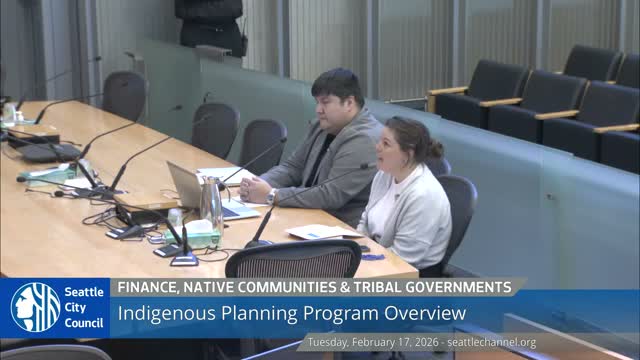
Summary
City tribal-relations and planning staff detailed Indigenous planning work including comp-plan policy recommendations, regional-center outreach (University District, Ballard, Northgate), a native food forest, and a proposed Indigenous economic development center; staff committed to ongoing tribal outreach and monthly updates to council.
The Seattle City Council Finance and Native Communities & Tribal Governments Committee received a presentation Feb. 17 on Indigenous planning and ongoing work with tribal governments and Native communities.
Francesca Murnan, the city’s tribal relations director, and Tim Laymon of the Office of Planning & Community Development described a multi-year effort to incorporate Indigenous narratives and priorities into city planning. Laymon said outreach during earlier comprehensive-plan work produced roughly 43 policy recommendations for Indigenous communities and tribes, and that the 2026 work plan focuses on the University District and Ballard regional centers, with the goal of integrating cultural narratives such as the “story of salmon” into public-realm design.
Laymon described a concept called 'native neighborhoods'—distributed nodes intended to provide housing, services, programming, spaces of healing and cultural anchor points—and said the city is working with community partners (including the Seattle Indian Health Board and the Seattle Indigenous Services Coalition) on housing and program plans. He cited specific projects in early stages: a native food-forest at Barton Woods with North Seattle College, protective approaches for culturally sensitive sites, coordination with Chief Seattle Club on low-income housing and programming, and plans for an indigenous economic development center that would function as an incubator with workspace, equipment and vendor spaces.
On implementation and outreach, Laymon emphasized cross-department collaboration and community leadership: the city can provide funding, planning support and contracting, but community ownership of these spaces is essential. In response to Chair Dan Strauss’s question about visibility, staff agreed to provide regular updates to council and suggested monthly briefings or newsletter items to share milestones and successes.
Council members praised the relational approach and urged careful attention to waterways, cultural protections and community-led design. Council president Hollingsworth relayed tribal feedback urging the city to treat waterways as food sources and protect them accordingly, not just as transportation corridors.
Staff said a summary report from the 2025 Tribal Nations Summit is expected soon and that they plan to return to the committee with additional milestones and markers of success.