
Committee hears bill to require non-biometric access options, tenant privacy disclosures for smart locks
Get AI-powered insights, summaries, and transcripts
Subscribe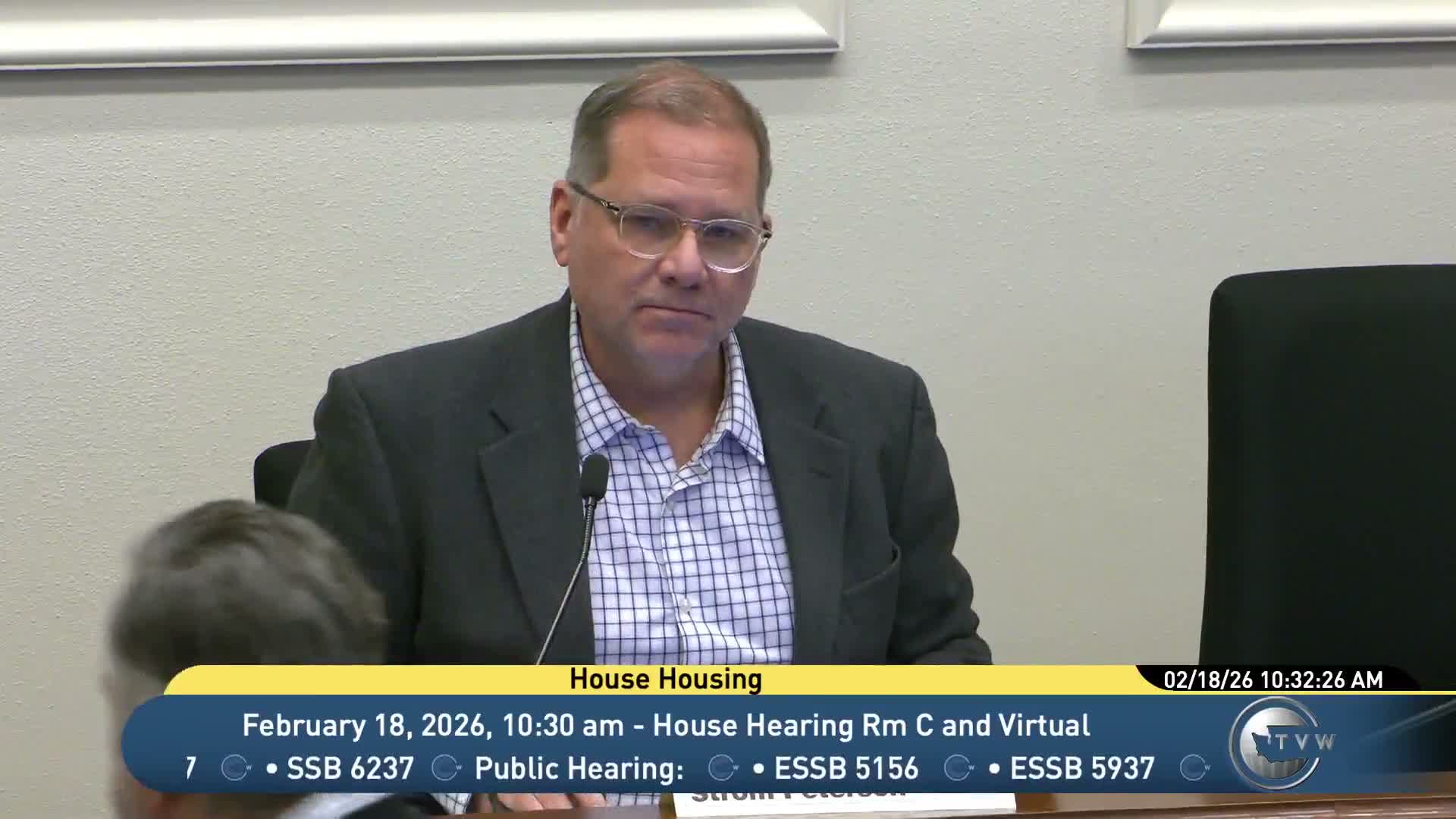
Summary
The House Housing Committee heard testimony on ESSB 5937, which would require landlords to offer alternative access methods (key, fob, card) on tenant request and provide plain-language privacy policies for smart access systems used in RLTA-covered properties, effective Jan. 1, 2027.
The Washington State House Housing Committee on Feb. 18 heard Engrossed Substitute Senate Bill 5,937, which would add smart access systems to the Residential Landlord Tenant Act and require landlords to offer non-biometric alternatives when a tenant requests one.
Audrey Vacek, staff to the committee, told lawmakers the bill defines a "smart access system" to include RFID cards, mobile-phone applications and biometric identifiers and excludes systems that rely solely on manual keypads. Under the bill, landlords of smart access buildings must make the system developer's privacy policy available to tenants and, if required information is missing, provide a written plain-language policy at lease signing or within five days of installation.
Senator Jamie Peterson, the bill's sponsor, said the proposal grew from a constituent complaint about being forced to download an app to enter her apartment. He said the bill requires landlords "upon tenant request to offer tenants alternative keys that do not use biometric identifier information or mobile phone software applications." Peterson said the measure aims to protect tenant privacy while minimizing burdens on landlords.
A tenant, identified to the committee as Maddie Studhoft, described a building where smart locks that tracked entry and exit were installed on the unit door and an app also collected "Internet browsing history, connecting to social media, etcetera." Studhoft urged the committee to adopt protections similar to New York City's rule requiring an alternative physical key or card.
Christel Perkey, testifying for the Washington Multifamily Housing Association, said her group is neutral on the engrossed substitute after amendments that allow landlords to provide a link to a vendor's privacy page rather than embedding long privacy text in every lease. Perkey said the substitute also allows five days after move-in for landlords to provide policies and clarifies operational access for maintenance, emergency entry and compliance purposes.
In questioning, a committee member asked whether keypad-only access would trigger the bill's documentation requirement; witnesses said keypad-only systems that do not collect biometric data are excluded from the bill's smart access definition.
The chair closed the hearing on ESSB 5937 without a formal vote and moved to the committee's next item.
The bill references the Residential Landlord Tenant Act and would take effect Jan. 1, 2027. The committee did not take final action during the Feb. 18 hearing; sponsors and stakeholders said they would continue to refine implementation details.