
Bill would restrict government use of license-plate readers, set retention limits and vendor rules
Get AI-powered insights, summaries, and transcripts
Subscribe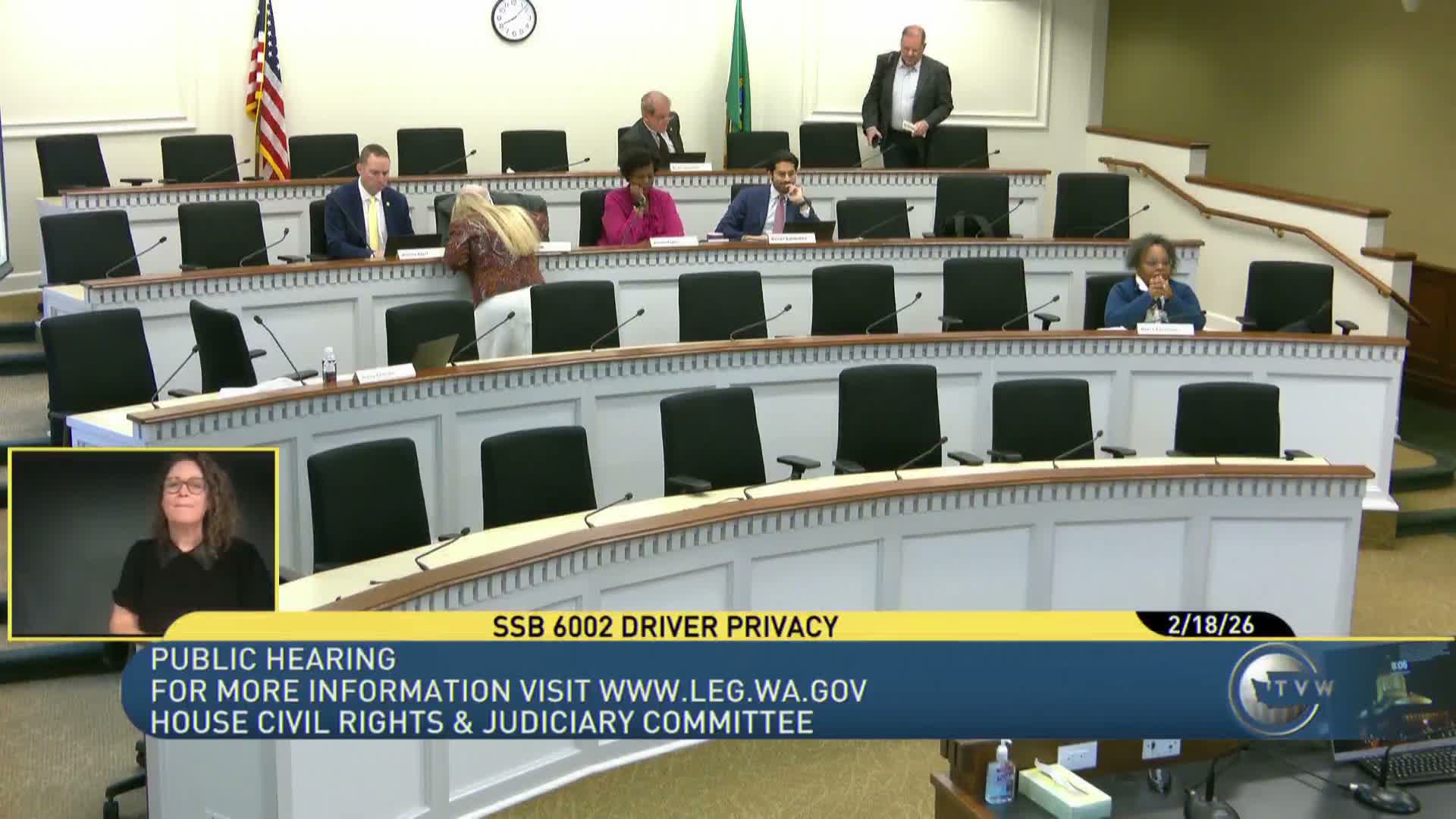
Summary
ESSB 6002 would broadly prohibit state and local use of automated license-plate reader systems by entities not explicitly authorized, set limits on disclosure and vendor access, and establish a Senate default retention period of 21 days (House version: 72 hours); bill drew sharply divided testimony on privacy, retention, and public-safety carve-outs.
Lawmakers in the Civil Rights & Judiciary Committee considered ESSB 6002 on Feb. 18, a bill that would regulate automated license-plate reader (ALPR) systems across Washington.
Committee staff summarized the bills as generally prohibiting ALPR use by state and local agencies except for explicitly authorized law-enforcement, parking-enforcement, and transportation agencies; the Senate version also authorizes Department of Enterprise Services and higher-education institutions for parking enforcement and removes toll-enforcement agencies from authorization. Staff said authorized agencies may use systems only for purposes specified in the bill, the bills prohibit unauthorized disclosure or direct access to ALPR data, and the Senate adds vendor prohibitions on selling or leasing ALPR data.
Sponsor Sen. Yasmin Trudeau (27th Legislative District) described constituent complaints and a University of Washington report that showed some cameras operated with or without full jurisdictional knowledge. "We have no regulation on these systems. None," she said, arguing for transparency and public trust. Trudeau called the measure "balanced and important" and said it is not a ban but a regulatory framework.
The hearing turned into an extended debate between public-safety officials, civil-liberties advocates, municipalities, and privacy groups. Law enforcement witnesses and city representatives warned the bill’s technical definitions and limits — including a proposed restriction to felony investigations and a 21-day (Senate) default retention — could cripple investigative uses; Spokane County and sheriff representatives said some language would make ALPR technology unusable. By contrast, privacy advocates (ACLU, EFF, Legal Voice) urged tighter limits — including seven days or shorter retention, a felony-warrant standard before cross-jurisdictional sharing, and strict third-party-access rules — citing risks of tracking, data-sharing with hostile jurisdictions, and misuse.
Lawmakers queried tradeoffs between privacy and policing: some asked for carve-outs for gross misdemeanors such as domestic-violence assaults; advocates and community groups stressed harms to immigrants, people of color, reproductive-health patients and LGBTQ people if ALPR data were widely available. Cities and police urged technical fixes and clearer watch-list definitions to preserve effective crime investigations. Several witnesses proposed targeted amendments rather than rejecting the bill outright.
The committee took no final vote; sponsors and stakeholders were encouraged to work on clarified language, technical fixes, and potential carve-outs.