Get Full Government Meeting Transcripts, Videos, & Alerts Forever!
Get email alerts on the Attorney General Tools topic
No spam. Unsubscribe anytime.
Bill would let Washington attorney general issue civil investigative demands for constitutional and select statutory violations
Summary
Sen. Drew Hansen and staff told the Civil Rights & Judiciary Committee ESSB 5925 would allow the attorney general to issue civil investigative demands (CIDs) to gather documents and identities in investigations of possible state or federal constitutional and specified statute violations; supporters described it as a narrower, civil discovery tool while opponents warned about oversight.
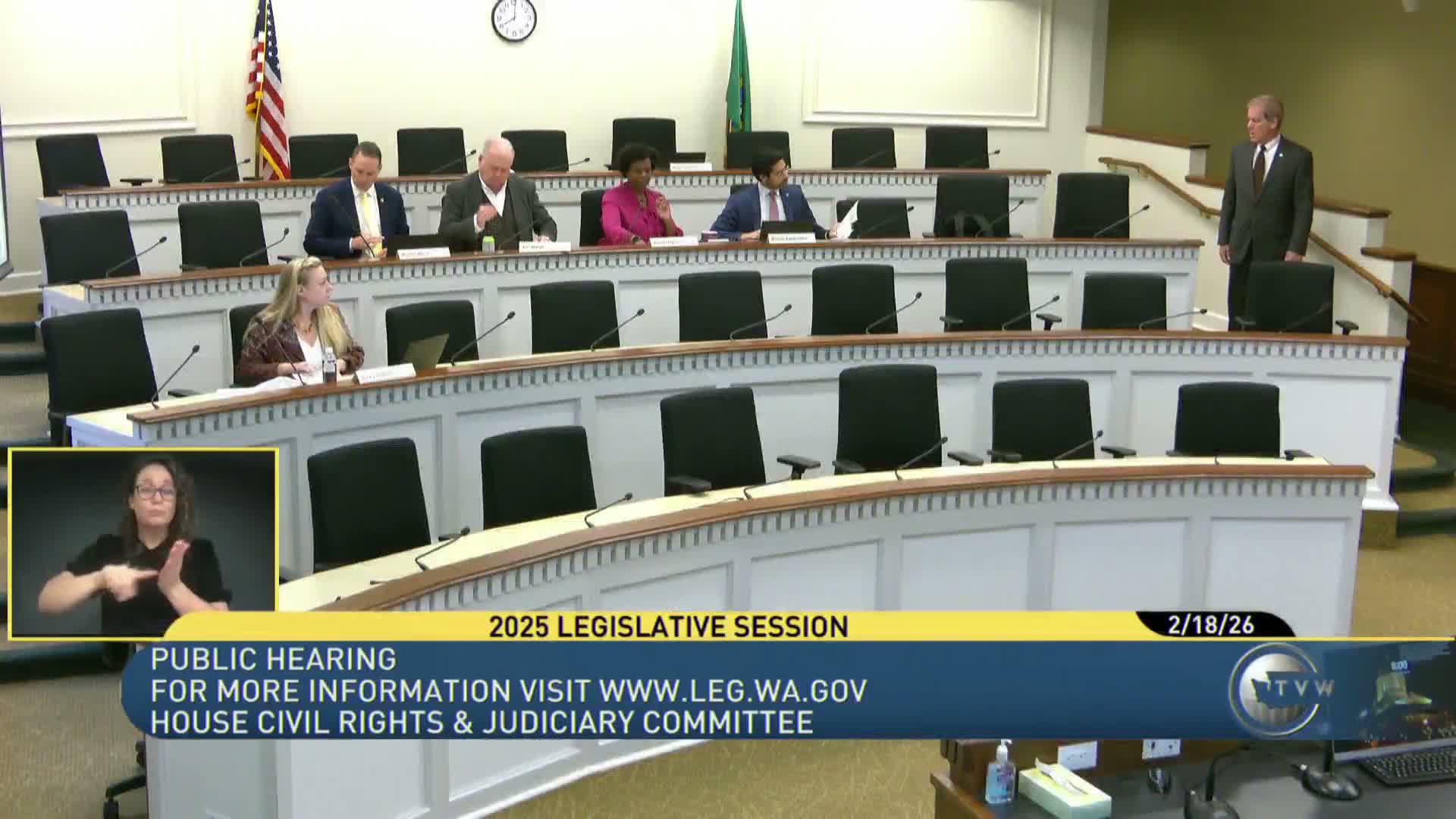
The Civil Rights & Judiciary Committee heard testimony on ESSB 5925 on Feb. 18, a bill that would authorize the Washington attorney general to issue civil investigative demands (CIDs) in certain civil investigations.
Sen. Drew Hansen (23rd Legislative District), the bill’s prime sponsor, told the panel the tool is "a written request for documents, identities of people, [and] written discovery" and is used in civil investigations to improve enforcement efficiency. Committee staff described the measure as a companion to HB 2161 and said it sets standards for CID contents, service, production, confidentiality, and court processes to contest or modify a demand.
Hansen said the measure is narrower than historical proposals: the Senate version permits CIDs when "facts and circumstances would reasonably lead to possible violations" of the state or federal constitution or certain specified statutes, and requires an assistant attorney general in the investigating division to review and approve the demand. "This is not a search," Hansen said, drawing a distinction between civil discovery and Fourth Amendment criminal-search warrants.
During questioning, lawmakers raised concerns about administrative subpoenas and oversight. Ranking Member Walsh asked why an administrative mechanism is appropriate in some contexts but not others; Hansen reiterated that CIDs are a civil discovery tool and not a search into private premises. Staff explained the bill allows a recipient to petition a court to contest, modify or set aside a demand and prescribes court proceedings when a demand is challenged.
No formal action was recorded in committee that day. The committee suspended the hearing on ESSB 5925 to take up other bills.
The bill references existing statutes and enforcement authorities; staff noted it is substantially similar to the House substitute bill with specific differences on scope and professional-conduct language. The attorney general’s office indicated it will send witnesses to testify and that internal approval procedures would apply to demands.