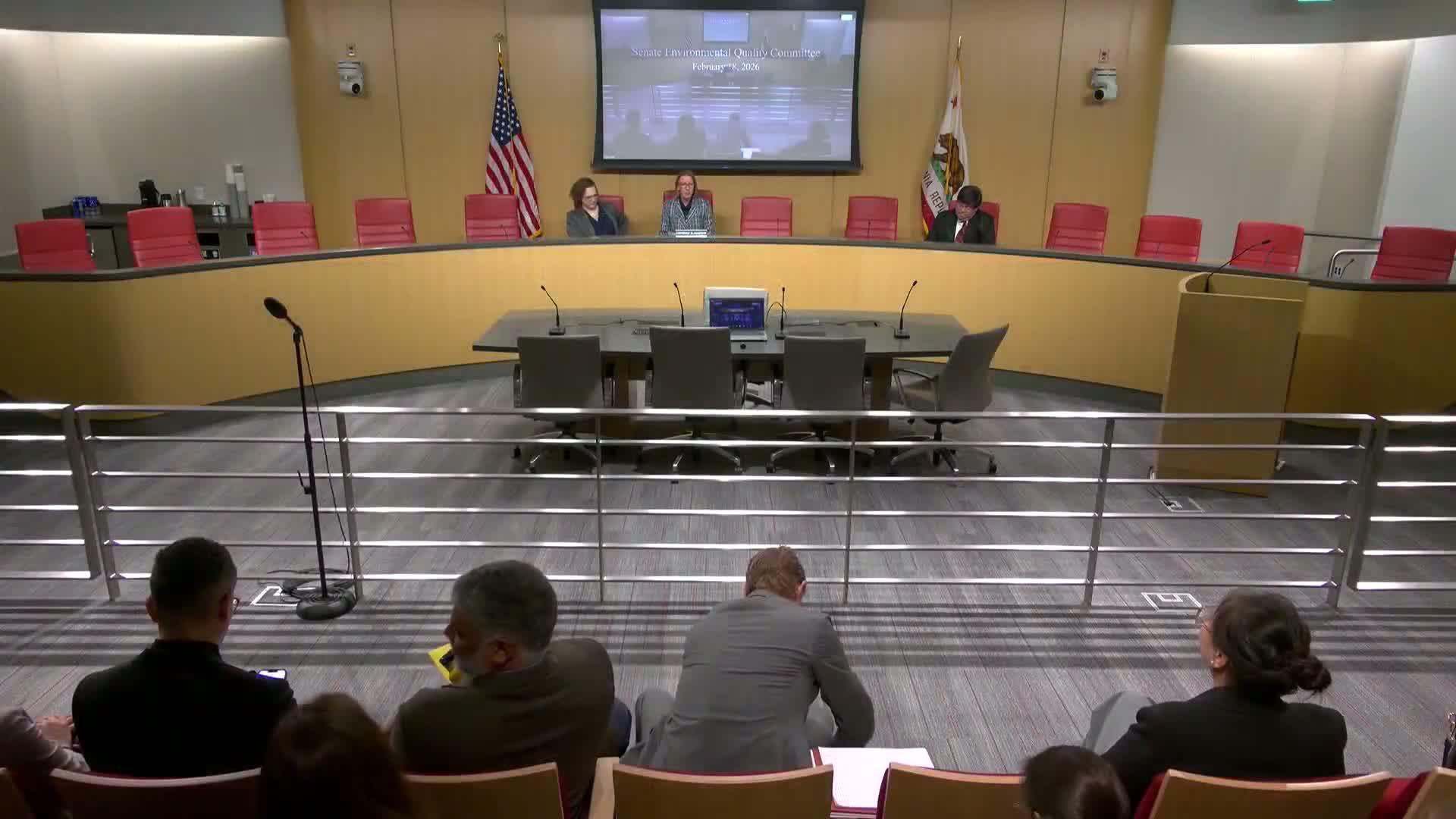
Senate hearing on refinery closures spotlights cleanup costs, worker risks and fuel‑supply tradeoffs
Loading...
Summary
State agencies, researchers, labor and community groups told the Senate Environmental Quality Committee that California must plan proactively for refinery closures to avoid large cleanup bills, protect workers, and preserve fuel reliability; industry blamed state policy for closures and urged action to preserve in‑state refining.
The California State Senate Environmental Quality Committee on March 1 held a multi‑panel informational hearing on the environmental and community impacts of refinery closures, with witnesses urging clearer data, mandatory disclosure of end‑of‑life costs, and state planning to limit social and fiscal shocks.
Committee Chair Blakespear opened the hearing by restricting the panel’s scope to environmental considerations and asked agency officials to lay out what is known and what is not. Siva Gunda, vice chair of the California Energy Commission, said the state is in a ‘‘mid‑transition’’ phase: gasoline demand is beginning to decline but remains substantial, and every refinery departure would create a “double‑digit percent” drop in refining capacity that must be met by imports or storage. ‘‘You cannot collapse one energy system before the next one is built,’’ he said, urging coordinated, long‑term planning.
Why it matters: Panelists warned that unplanned or poorly managed closures can create three linked risks — sudden loss of local tax revenue and jobs, long and costly site cleanups, and interruptions or price spikes in fuel supply if import and storage capacity is inadequate.
Speakers from state agencies described existing authorities and gaps. Annalisa Kihara of the State Water Boards reviewed Water Code authorities (Sections 13267, 13304, 13263) used to require assessment and cleanup and listed common remediation tools such as excavation, soil‑vapor extraction and pump‑and‑treat systems. Kihara said many refinery areas are inaccessible until deconstruction begins, which creates information gaps and can make post‑closure assessment expensive and time consuming.
Researchers and community advocates pressed for stronger up‑front disclosure and financial assurance. Emily Grubert, a researcher at Notre Dame, and Anne Alexander, an environmental attorney who co‑authored a case study of Phillips 66, said industries routinely underestimate end‑of‑life costs and that refinery operators often do not report reasonable asset‑retirement obligations under current accounting practices. Alexander cited examples — including multilayered subsurface contamination at some sites — and recommended that operators disclose decommissioning plans and cost estimates and that the state adopt default cost standards and financial‑assurance requirements.
Labor and community testimony emphasized human and fiscal impacts. Josh Sonnenfeld of the UC Berkeley Labor Center and Julia Sebastian of California Labor for Climate Jobs highlighted worker dislocation, long unemployment spells after mass layoffs, and the fiscal exposure of cities that rely on refinery tax revenue. The Contra Costa partnership study cited in testimony estimated thousands of direct and indirect refinery‑connected jobs in the Bay Area and called for expanded displaced‑worker supports, tax‑stabilization funds and proactive economic diversification.
Industry pushed a different framing. Zach Leary, chief lobbyist for the Western States Petroleum Association, said state policy choices have made California refining less economical and warned that stricter future regulations—if designed without attention to competitiveness—could accelerate closures and shift production, jobs and emissions abroad. ‘‘If California wants to keep fuel production within its borders under its environmental standards, then the state policy must reflect that reality,’’ he said.
Panelists converged on some common prescriptions: increase transparency about site conditions and likely cleanup costs; require earlier and standardized decommissioning planning and financial assurance; expand and make permanent displaced worker funding and local fiscal stabilization tools; and coordinate state planning for storage, imports and other infrastructure to preserve resilience during transitions.
Next steps: Committee members signaled interest in further legislative action on disclosure, financial assurance, worker supports and interagency coordination. The hearing closed with a public comment reiterating community demands for transparency about contamination and remediation timelines.