Insurance commissioner: California’s sustainable insurance strategy showing early signs of stabilizing market after urban wildfires
Loading...
Summary
Insurance Commissioner Ricardo Lara told the Assembly Insurance Committee the department’s Sustainable Insurance Strategy has produced faster claims payments, five approved SIS filings and other indicators of market stabilization; he said visible consumer relief could appear in 12–24 months, with structural recovery over 3–5 years.
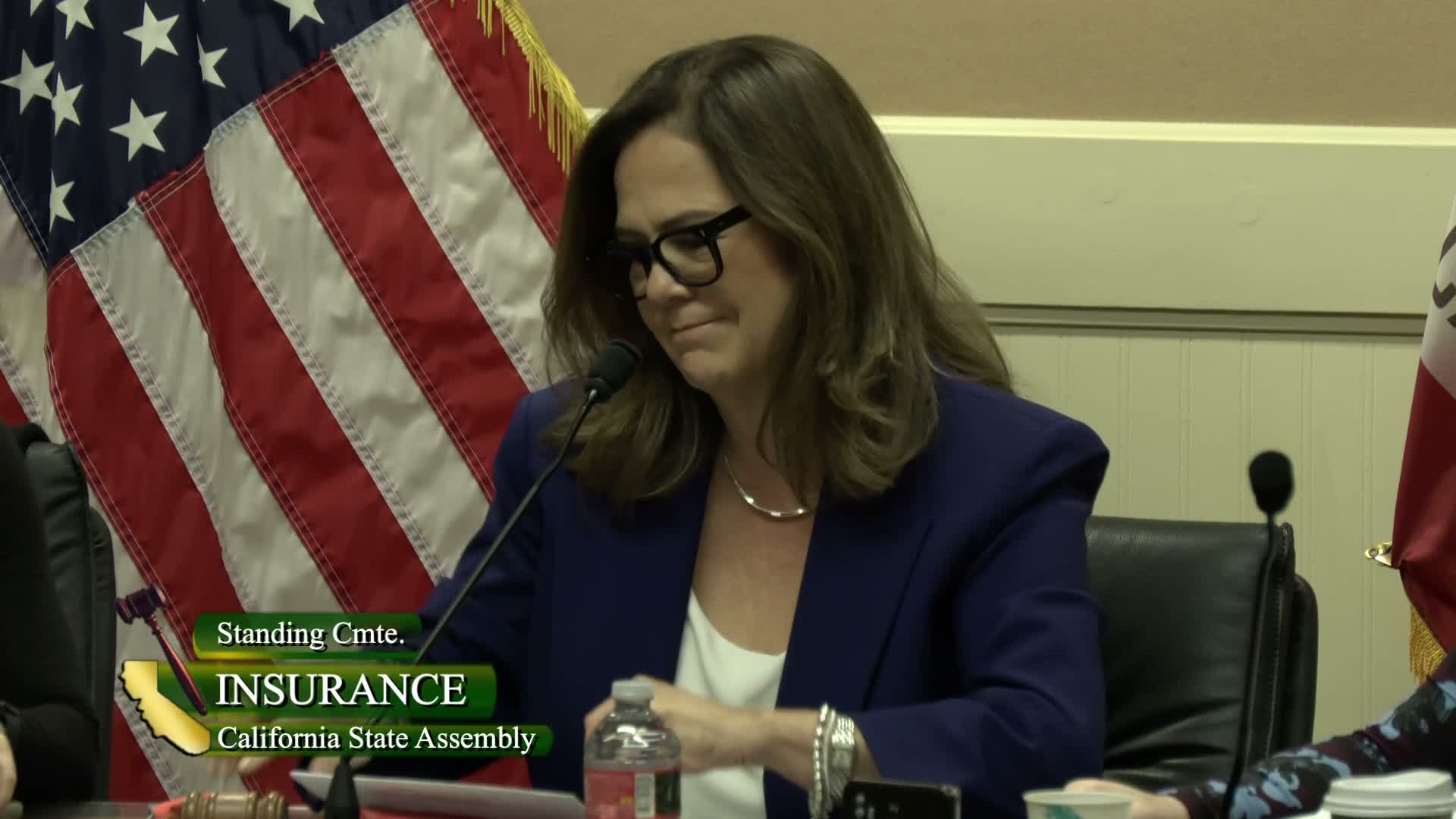
Insurance Commissioner Ricardo Lara told the California State Assembly Insurance Committee that the department’s Sustainable Insurance Strategy (SIS) is producing measurable progress after the state’s recent urban wildfires, citing faster claims handling, billions in payments to survivors and new insurer commitments to write in high‑risk areas.
"Insurance cannot do it alone," Lara said, adding that the SIS gave the department "the tools, the authority, and the commitments we needed" to prevent a deeper market collapse. Lara said insurers have paid about $22.4 billion to wildfire survivors, compared with roughly $6 billion from federal, state and local sources, and that 94% of 4,121 claims have been paid fully or partially. He also told the committee that claim closure time is down 27% since mid‑2025 and that $210 million has been returned to consumers through department investigations.
Lara highlighted that five SIS homeowner filings have been approved since the last hearing and named several participating insurers: Mercury Insurance, CSAA Insurance Group, USAA group companies, Pacific Specialty and California Casualty. He said the approved filings include binding commitments to expand underwriting in designated wildfire‑distressed ZIP codes and described the approvals as "the fastest, most transparent, and most accountable rate review environment California has ever had." He added that every approved SIS filing to date was completed within the public‑notice timeline the department set, with only a single specialty filing taking 133 days.
On rate‑review reforms, Lara said the department has launched a reconciliation tool to reduce incomplete submissions and will release a draft regulation to require department rate‑review staff to complete reviews within 60 days of the public notice date (with up to a 30‑day documented extension). "This reform will significantly increase the transparency and speed up the rate review and approval," he said.
Lara also urged the committee to back federal bills he described as complementary to state mitigation efforts — the Disaster Mitigation and Tax Parity Act and the Disaster Resilience and Coverage Act — and he warned that mitigation must be coordinated across local, state and federal actors. He described work on a public statewide wildfire risk model developed with Cal Poly Humboldt and academic partners and reiterated calls for the Board of Forestry to finalize "zone 0" defensible‑space rules.
On timing for consumer relief, Lara said visible relief is likely in 12–24 months as more insurers reopen or expand in California, with "more structural" market stabilization expected in three to five years as reinsurance and mitigation trends normalize.
Committee members pressed Lara on data and transparency. Assemblymember Samuel Menherabedian asked for ZIP‑code and district analyses of nonrenewals since moratoria ended; Lara and Mike Peterson, the department’s senior deputy on climate and sustainability, agreed to provide follow‑up district‑level data and to analyze any anomalies in FAIR Plan movement. Vice Chair Wallace asked whether layering additional coverage mandates could destabilize the nascent market; Lara said legislative deliberation is the proper forum to weigh costs and tradeoffs and that the SIS was designed to strike a balance between consumer protections and incentivizing insurer participation.
Lara summarized several bills in his package that he said operationalize the SIS: SB 876 (authored by Sen. Padilla), which he said would require insurer disaster recovery plans, double certain penalties in declared emergencies, require status reports and expand additional living expense coverage; AB 1795 (the Smoke Damage Recovery Act), which he said would set science‑based standards for smoke testing and restoration; and AB 1680 (Make It Fair Act), which he said would modernize FAIR Plan governance and require a comprehensive homeowners policy and annual reporting.
The hearing closed with Lara reiterating that the department has enforcement authority to hold insurers to commitments and that the department will publish ongoing data on implementation and insurer progress by ZIP code, district and county. "We are not declaring victory by far, but we are moving decisively, transparently, and with measurable progress," he said.
The committee requested additional district‑level data and follow‑up analyses; Lara agreed to return with updates during the implementation phase.