Assembly committee hears industry leaders describe California’s ‘medtech’ edge and policy needs
Loading...
Summary
Industry witnesses told an Assembly select committee that medical technology differs from biopharma, relies on manufacturing clusters and mid‑skill workers, and needs state policy attention on workforce training, supply chains and translational funding to keep production and jobs in California.
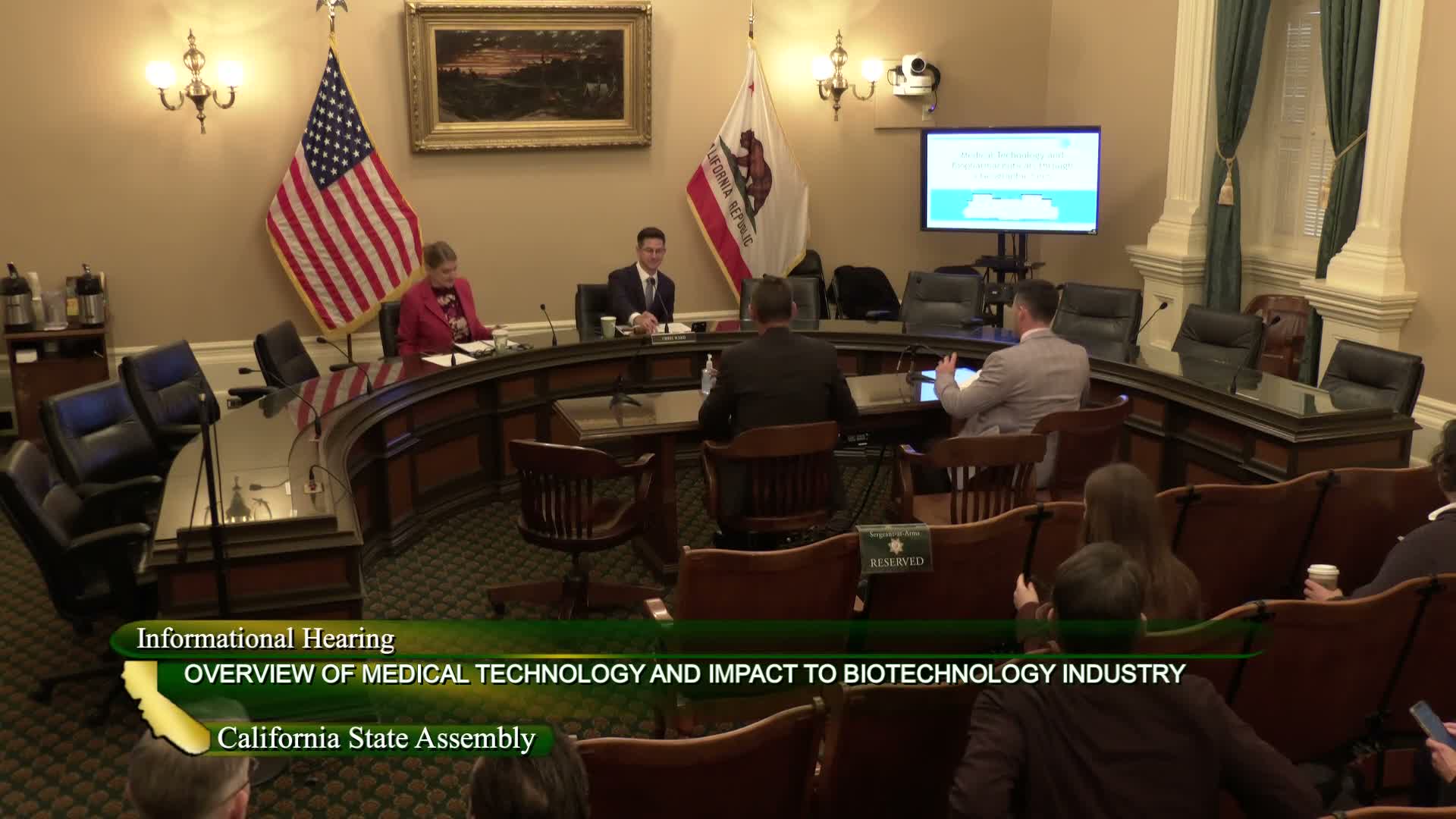
California’s Assembly Select Committee on Biotechnology and Medical Technology heard industry representatives on Feb. 18 explain how medical technology — or medtech — operates differently from biopharma and why that difference matters for state policy. Chair Ward convened the hearing in Room 127 of the State Capitol with two panels of industry witnesses.
Medtech, Gregory Theil, director of the Biomedical Manufacturing Network, told the committee, is ‘‘hardware’’ in many forms — from implanted devices such as pacemakers and stents to surgical robots and wearables — and typically follows an incremental development path with much shorter regulatory timelines than many drugs. ‘‘When you think med tech, think hardware,’’ Theil said, arguing that manufacturing, supply‑chain proximity and mid‑skill jobs make medtech a distinct economic sector from lab‑based biopharma.
The difference matters for land use, training and incentives. Theil and other witnesses pointed to clusters in Fremont, Carlsbad, Irvine and Silicon Valley and several firms that have chosen to keep or reshore manufacturing in California: Penumbra retained manufacturing in Alameda after acquisition by a larger company, and Varian Medical Systems has moved some work back to Palo Alto and Manteca. Those firms, they said, rely on community colleges and two‑year training programs for much of their workforce.
John Wenger of the Advanced Medical Technology Association (AvaMed) told the committee that device regulation is primarily federal and urged caution about state rules that could create ‘‘layered’’ requirements. ‘‘Medical devices are heavily regulated by the FDA and should not be included in broader state policy,’’ Wenger said, adding that the association worries additional state rules could interfere with patient access.
Committee members pressed witnesses on specific risks and opportunities: cybersecurity requirements and packaging can be part of FDA review, Rob Monroe and Wenger said, and rapid adoption of AI in some uses (Wenger noted about 1,000 FDA‑authorized AI‑enabled medical devices) is reshaping diagnostics and manufacturing. Members and witnesses also linked medtech workforce needs to the recent elimination of California’s R&D tax credit and to the case for re‑establishing targeted supports for advanced manufacturing.
The hearing did not produce formal legislation; witnesses said the committee could help by convening FDA experts, aggregating data on tax‑credit ROI, and exploring targeted, non‑dilutive translational funding to bridge ‘‘valley of death’’ gaps for early stage firms. The committee closed the public comment period with no speakers and adjourned.
The committee said it will follow up with stakeholders and experts as it considers budget and policy options.