Assembly subcommittee weighs speed versus oversight for HAP homelessness funds
Loading...
Summary
Legislators and witnesses at a California State Assembly subcommittee hearing debated whether stricter accountability for the Homelessness Assistance and Prevention (HAP) program is slowing disbursement and undermining local services — and whether consolidated reporting and multi‑year funding could preserve impact while improving transparency.
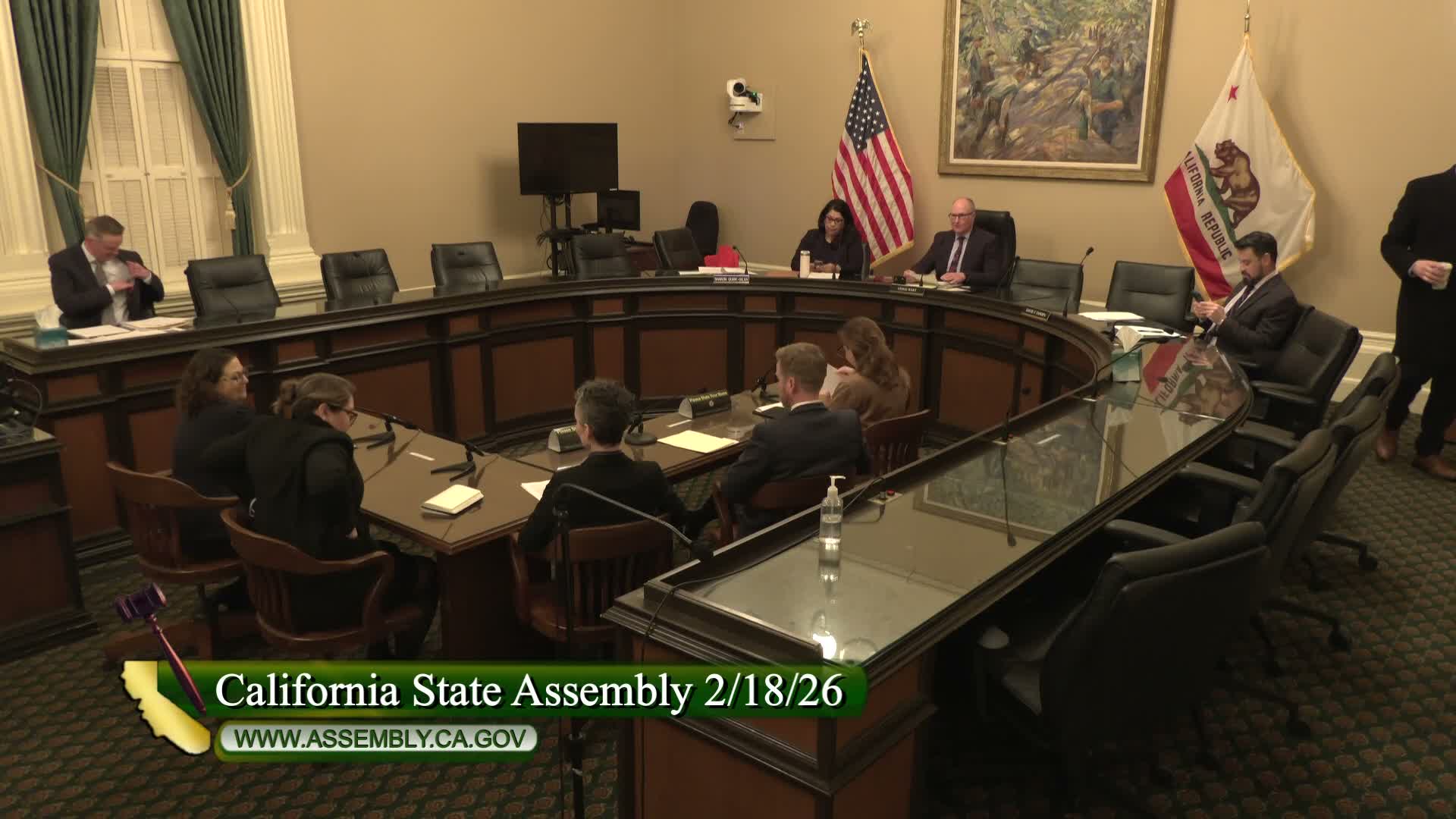
SACRAMENTO — The Assembly Budget Subcommittee on Accountability and Oversight spent a day-long hearing testing competing priorities for the Homelessness Assistance and Prevention (HAP) program: getting money quickly into local programs and ensuring that state dollars produce measurable results.
Chair Hart opened the session by saying the subcommittee would examine how state dollars addressing homelessness are being spent and whether those investments are producing measurable results. "The public deserves to know where these funds are going and what outcomes they're producing," he said, citing an estimate that "more than 181,000 people in California are experiencing homelessness on any given night."
The hearing brought testimony from academics, the Legislative Analyst's Office, the Department of Housing and Community Development (HCD) and county and city officials. Dr. Margot Kushel, director of the UCSF Center for Vulnerable Populations, told the panel that HAP "has been absolutely essential" but warned that measurement must focus on actions within a jurisdiction's control. "Accountability demands that we have an agreement on what problem we're trying to solve, that we have clear timelines, and that we have appropriate ways to determine this," Kushel said.
Paul Steenhausen of the Legislative Analyst's Office reviewed HAP's evolving accountability structure and noted a practical trade-off: as the state has added application requirements and performance measures, the time between appropriation and award has increased — from roughly nine months in round 1 to about 19 months in round 6.
Megan Kirkeby, deputy director at HCD, said the department has expanded transparency — posting anonymized program data and building the HDIS interface that imports HMIS data — while trying to direct funds toward evidence-based housing solutions. "Our North Star with accountability has to be impact," she told the committee, and added that technical assistance, not automatic withholding of funds, can unlock disbursements when grantees fall behind on metrics.
County and city officials described different on-the-ground trade-offs. Jonathan Russell, Alameda County's director of housing and homelessness services, credited HAP with helping more than 6,000 county residents move into permanent housing and urged consolidated reporting to reduce administrative burdens. Oakland representatives said HAP's flexibility is crucial for operating shelters and interim housing; they cautioned against treating system-wide homelessness reduction as the sole accountability metric because inflows — people becoming unhoused — can obscure program-level success.
Heidi Marshall of Riverside County described a recent 19% reduction in unsheltered homelessness and said HAP supported a 57% increase in shelter capacity there. "If HAP funds, especially future rounds, are cut or its flexibility is reduced, we're not going to be able to continue to sustain the very beds that delivered that 19% reduction," she said.
Legislators pressed officials on data gaps and cadence issues in the point-in-time (PIT) counts; witnesses explained that federal rules require biannual unsheltered counts, COVID disrupted the odd-year cadence, and some Continuums of Care altered schedules, creating mismatches that complicate comparisons and allocations.
Committee members and panelists coalesced around several possible reforms: consolidating reporting across HAP rounds to reduce duplication, moving from monthly to quarterly fiscal reporting where appropriate, increasing technical assistance so grantees can meet metrics without losing funds, and considering multi-year or ongoing funding to reduce the annual planning pressures created by one-time appropriations.
The hearing also highlighted a larger fiscal risk: multiple witnesses warned that proposed federal cuts — including the sunsetting of 15,000 emergency housing vouchers and other changes to HUD funding — could push tens of thousands of Californians back into homelessness, increasing the stakes for any state funding decisions.
Chair Hart closed by saying the informational hearing will inform budget deliberations in the coming months and urged the legislature and administration to calibrate round 7 trailer bill language to both protect grantees and speed disbursements.
The subcommittee did not take formal votes during the hearing. Public commenters representing counties and statewide housing advocates urged maintaining or expanding HAP funding, consolidating reporting and avoiding requirements that would delay local access to funds.