Minn. education hearing spotlights ICE operations’ damage to school attendance, learning and mental health
Loading...
Summary
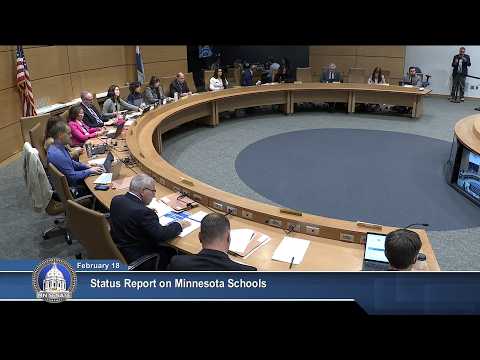
Educators and parents told a Minnesota Senate committee on Feb. 18 that recent ICE enforcement—described as masked agents in unmarked vehicles and detentions—has driven widespread absenteeism, moved hundreds of students online, and created urgent mental-health and budget crises for districts.
ST. PAUL, Minn. — At a Feb. 18 hearing of the Minnesota Senate Education Finance Committee, educators, parents and school leaders described how recent federal immigration-enforcement operations have disrupted schooling across the state, leading to sharp drops in attendance, emergency shifts to virtual learning, mounting mental-health needs and looming budget shortfalls.
Chair Sen. Mary Kunish opened the session by telling the panel she had “witnessed my first ICE raid” about 10 weeks earlier and that the committee would focus on the impact those operations have had on students, staff and school communities. “These raids are disturbing and disrupting not only individual families, but entire communities,” Kunish said.
Fridley Public Schools Superintendent Brenda Lewis said unmarked ICE vehicles circled the roundabout outside an elementary school, prevented students from crossing, and followed a board member and other parents from home to daycare. Lewis said Fridley — which serves roughly 2,700 students — has seen more than 400 students switch to virtual learning and that 112 students who were present in December are not currently attending in person.
Columbia Heights Superintendent Zaina Stenbic told the committee her district of about 3,400 students had “massively” been affected: seven students were taken during the surge, several were flown to the Dilley Detention Center in Texas, and two remained detained as of last week. She said the district’s reported enrollment decline will result in “a nearly $2,000,000 funding loss,” while compensatory revenue shortfalls already total roughly $3.6 million.
Teachers and school staff described similar scenes. Teacher Mandy Jung recounted students whose parents had been detained and said community volunteers are paying rent and groceries for dozens of families. Multilingual teacher Josh Hammerding and interventionist Alex Samuelson said class sizes have shrunk dramatically — reporting some small groups with only a handful of students present — and that students frequently arrive to school carrying passports or ID because of fear.
Union representatives and charter leaders warned of long-term fiscal stress. SEIU policy director Chris Stinson said the union had helped file habeas petitions for a detained member who a judge later found had been unlawfully detained. The Minnesota Association of Charter Schools’ testimony said some schools reported 40–50% absence rates in recent weeks.
School leaders pressed the Legislature for immediate relief: requests included restoring the prior compensatory-aid formula (a state law change in 2023 was cited as having reduced aid for some districts); emergency funding for trauma-informed mental-health services and permanent school-based counselors; flexibility on testing and attendance reporting; and stabilization grants for schools that face sharp enrollment swings.
Experts on special education said the effects are especially severe for students with disabilities. Saint Paul assistant superintendent Heidi Nissler reported that special-education vans have been stopped en route to school and that more than 1,000 students with disabilities had requested virtual services because families feared leaving home.
Lawmakers expressed a mix of emotion and policy intent after hours of testimony. Several senators described the testimony as “heart-wrenching” and urged the committee to explore compensatory-aid relief, attendance-policy adjustments, and targeted mental-health funding. Other senators asked for opportunities to bring additional witnesses, including law-enforcement perspectives.
The committee did not hold a vote. Chair Kunish said the panel will continue collecting data, consider follow-up hearings and examine attendance pilots and funding options. The committee also noted an upcoming Student Attendance Day to gather more information.
Reporting notes: Testimony included firsthand accounts of detentions, students transferred to remote learning, and district-level fiscal projections. Where testimony quoted numeric figures that appeared ambiguous in the transcript (for example a reported ‘‘9 36’’ daily-absence figure), this article flags those values as stated in testimony rather than independently verified totals.
The committee heard extensive public testimony but took no immediate formal action; further legislative responses were signaled as possible in the coming weeks.