Preliminary needs-assessment: consultants report 219 responses, highlight awareness gap and health-care needs
Loading...
Summary
Consultants presenting preliminary findings from a town-funded needs assessment reported 219 survey responses so far and warned the sample undercounts seasonal workers; they urged expanded outreach after finding 26% of respondents unaware of available human services and health-care needs (dental, primary, specialty) ranking highest.
Consultants from Culex Strategic Advisors presented preliminary results of a town-funded human-services needs assessment to the Council for Human Services on Feb. 12, reporting 219 total survey responses so far and urging a stepped-up outreach push to reach seasonal workers and undercounted groups.
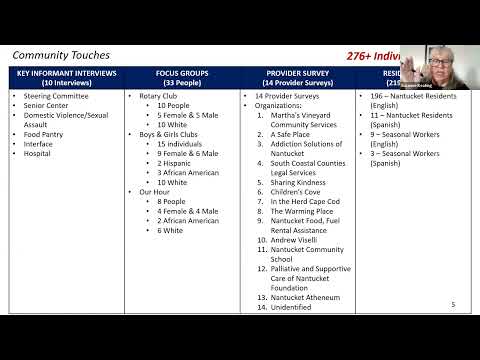
Marcos Alcorn, the project lead, said the team has collected “219 survey responses” to date, with 196 English-language full-time residents, 11 Spanish-language responses, and nine seasonal-worker responses, and plans a second on-site data collection phase in May to capture more seasonal-worker input. “We have so far 219 survey responses,” he said. The consultants noted 92% of respondents identified as year-round residents, meaning seasonal workers remain underrepresented.
The consultants highlighted awareness gaps and service priorities. Alcorn said about “26% of them are unaware of the human services that are available in Nantucket,” and that roughly 28% reported current access to some type of health or human service. Presenters said oral/dental care, primary care and specialty care emerged as the top immediate needs, while housing, mental-health services, early-childcare and food assistance also appeared among top concerns.
Council members raised methodological questions about question wording and representation. Sarah Wright and others urged the team to clarify household versus family income measures and to include non-binary gender options and better race/ethnicity capture; the consultants said the questionnaire includes nongender-conforming choices and they will “tease that out” further in analysis.
Members and staff suggested specific outreach steps to boost responses: placing posters and QR codes at high-foot-traffic sites (e.g., Trading Place, Old South Market, the library), distributing paper surveys at the food pantry and bus terminals, working with employers and the Chamber of Commerce to reach seasonal workers, and leveraging radio and social-media channels. Councillors also agreed to publish a letter to the editor and seek feature coverage to raise awareness of the survey and of human services funded by the town.
Marcos and Tracy Kulik, the project lead and CEO on the call, said the team will begin outlining the final report in late March and recommended a mid-April data cutoff for analysis to allow time for initial reporting, while continuing to collect responses through the contract’s end. The consultants said the town will receive the raw data and the final report, and that the May tranche focused on seasonal workers is critical to allow stratified analysis.