Subcommittee advances bill to clarify COAM rules, allow noncash prizes at darts and billiards tournaments
Loading...
Summary
The House Regulated Industries Subcommittee voted to give House Bill 1197 a do-pass recommendation after testimony that the bill would (1) allow location-run darts and billiards tournaments to award noncash prizes, (2) require progressive discipline by the COAM division, (3) add a reporting option for noncash lottery redemptions, and (4) permit disgorgement of funds to the lottery when arbitration claims are found frivolous.
The House Regulated Industries Subcommittee voted to give House Bill 1197 a do-pass recommendation to the full committee after members heard testimony on changes to coin-operated amusement machine (COAM) rules.
Representative Powell, the bill’s author, told the panel the measure aims to clarify COAM oversight and to restore common-sense practices for location owners. Powell noted that "pool tables are a COAM machine. They take coins," and said the bill would allow location operators to run darts and billiards tournaments that award noncash prizes, such as gift certificates, rather than cash (see section 1).
Powell also said the bill addresses what he described as the agency’s practice of "stacking" charges—holding multiple infractions to impose a severe sanction in a single action—and would require a progressive-discipline approach for most regulatory violations. He pointed committee members to sections 2, 6 and 7 for the procedural changes and to provisions clarifying appeals (including references to appeals to Fulton County business court) and arbitration procedures.
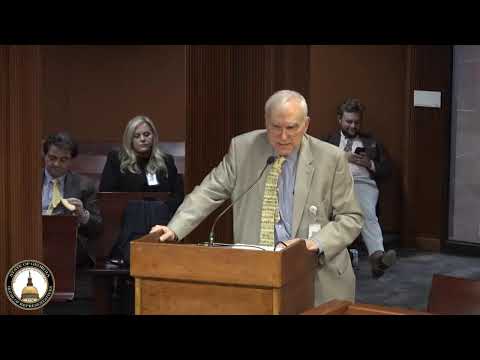
Les Schneider, representing the Georgia Amusement and Music Operators Association, told the committee the COAM program "is ahead of every other state in the country" in program success but needs statutory updates. Schneider supported the progressive-discipline language and described practical problems the bill seeks to fix, including inconsistent agency treatment of tournaments when COAM machines are on the premises. "Nobody's winning a cash prize," Schneider said. "If they win, they win a non cash prize."
Schneider also discussed a reporting requirement in section 2 (page 3, lines ~54–63): location owners would report quarterly the number of lottery tickets redeemed through noncash means so businesses would have documentation in case of a lottery audit or citation. He and committee members discussed technical options for tracking redemptions in point-of-sale (POS) systems and whether the lottery's software could be adapted to record noncash redemptions; Schneider said the reporting goal is to protect location owners from penalties but acknowledged some stakeholders have objected and that the requirement could be revisited during the bill process.
On contentious contracts and arbitration, both Powell and Schneider said the bill would discourage frivolous litigation by permitting hearing officers who find a claim frivolous to order disgorgement of proceeds to the lottery rather than to a private party. Schneider said the provision is intended to "have some teeth" to deter bad-faith claims and suggested the lottery would direct such funds to designated beneficiaries if specified.
Committee members asked whether masters or location owners usually prevail in disputes; Schneider said there are no consistent statewide statistics and that outcomes vary by case and arbitration provider.
Representative Powell moved a do-pass recommendation to the full committee and the panel approved it by voice vote; no roll-call tally was recorded. The bill now proceeds to the larger committee for further consideration. The subcommittee adjourned at the close of the session.
The committee record shows testimony and exchanges largely focused on reducing business risk for location owners, clarifying agency procedure, and balancing enforcement with certainty for industry participants; next steps are committee consideration in the full (larger) committee and any amendment process there.